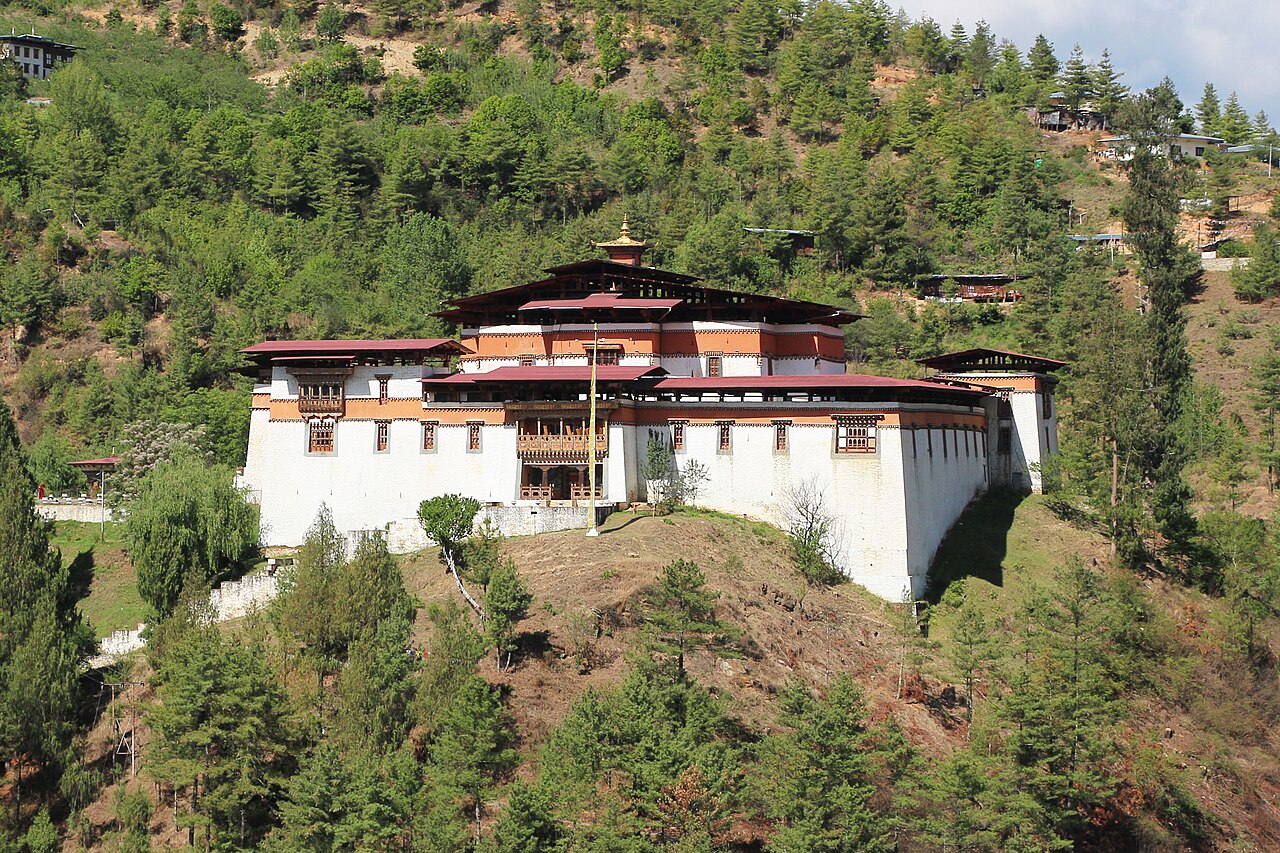

The dzongs of Bhutan (Dzongkha: རྫོང) are a network of fortified monasteries and administrative centres that form the institutional backbone of the Bhutanese state. Unique to Bhutan and the broader Tibetan cultural sphere, dzongs combine religious and secular functions within massive fortress complexes built of rammed earth, stone, and timber. They serve simultaneously as seats of district government, residences for monastic communities, and repositories of sacred art and relics. The dzong system is central to Bhutanese national identity, and the structures remain in active use for governance, worship, and festivals to this day.[1]
Five of Bhutan's most significant dzongs — Punakha Dzong, Wangdue Phodrang Dzong, Paro Rinpung Dzong, Trongsa Dzong, and Dagana Dzong — were inscribed on the UNESCO World Heritage Tentative List in 2012 as living examples of monumental architecture in continuous use.[2]
Origins and Historical Development
The word dzong derives from the Tibetan rdzong, meaning "fortress." Although fortified structures existed in Bhutan as early as 1153, the dzong system as an instrument of national unification was established by Zhabdrung Ngawang Namgyal (1594–1651), the Tibetan-born lama of the Drukpa Kagyu lineage who arrived in Bhutan in 1616 and unified its fragmented valleys through an ambitious programme of dzong construction.[1]
The first dzong built by the Zhabdrung was Simtokha Dzong in 1629, near the present capital of Thimphu. It was the first structure in Bhutan to combine monastic and administrative functions under one roof, establishing the template for all subsequent dzongs. The Zhabdrung and his successors went on to construct dzongs in every major valley, creating a chain of fortresses that could defend against Tibetan invasions while projecting administrative control across the country.[3]
Dual Function: Religious and Administrative
Each dzong is divided into two main sections: a monastic wing (dratshang) housing monks of the Central Monastic Body or a local community, and an administrative wing housing the dzongda (district governor), district court, and other government offices. This arrangement reflects the chhoe-sid (dual system of religious and secular governance) established by the Zhabdrung. The dzongs also serve as the principal venues for annual tshechu festivals, during which sacred mask dances (cham) are performed in the courtyards.[2]
Architecture and Construction
The massive exterior walls are built of rammed earth, pounded by hand and often reaching thicknesses of two metres or more at the base, tapering as they rise. The walls are whitewashed with lime and topped by a broad red ochre band known as the khemar. Internal structural elements — floors, columns, roof trusses, galleries, and decorative elements — are made entirely of timber, joined without the use of nails or iron fasteners.[4]
Most dzongs feature a central tower called the utse, housing the most sacred chapels, surrounded by a paved courtyard overlooked by rooms with intricately carved wooden balconies. The interiors contain murals depicting Buddhist deities, the lives of saints, and mandala diagrams. Traditionally, dzongs were built without architectural plans; master builders (zow) worked from memory and experience, a practice now recognised as part of Bhutan's dzong architecture tradition.[1]
Major Dzongs
Bhutan has approximately twenty dzongs, each associated with one of the country's twenty dzongkhags (districts). The following are the most historically and architecturally significant:
Tashichho Dzong (Thimphu)
Tashichho Dzong, in the capital Thimphu, is the seat of the Bhutanese government and the summer residence of the Central Monastic Body. Originally built in 1641 and reconstructed in the 1960s under King Jigme Dorji Wangchuck, it houses the throne room and the offices of the King and ministers.[5]
Punakha Dzong
Punakha Dzong, built in 1637–1638 at the confluence of the Pho Chhu and Mo Chhu rivers, is considered the most beautiful dzong in Bhutan. It is the winter residence of the Central Monastic Body, the venue for royal coronations, and the resting place of the Zhabdrung's sacred remains.[2]
Trongsa Dzong
Trongsa Dzong, formally Chokhor Rabtentse Dzong, is the largest dzong in Bhutan. Perched on a spur above the Mangde Chhu gorge in central Bhutan, it commands the only route between eastern and western Bhutan. Founded in 1644, it is the ancestral seat of the Wangchuck dynasty; by tradition, every Crown Prince must serve as Trongsa Penlop before ascending the throne.[6]
Paro Rinpung Dzong
Paro Rinpung Dzong, meaning "Fortress on a Heap of Jewels," was built in 1644 and overlooks the Paro valley. Approached via the traditional cantilever bridge Nyamai Zam, the dzong repelled several Tibetan invasions in the 17th century and hosts the renowned Paro Tshechu. It featured as a location in Bernardo Bertolucci's 1993 film Little Buddha.[7]
Simtokha Dzong
Simtokha Dzong, built in 1629, is the oldest dzong to survive in its original form. Located five kilometres south of Thimphu, it now houses the Institute for Language and Culture Studies. Its interior contains more than 300 slate carvings depicting saints and philosophers, and some of the oldest surviving murals in Bhutan.[3]
Wangdue Phodrang Dzong
Wangdue Phodrang Dzong, founded in 1638, occupied a commanding position above the Punatsang Chhu valley. On 24 June 2012, a devastating fire — believed to have been caused by an electrical short circuit — destroyed the dzong almost entirely, leaving only the lower stone walls standing. Most relics had fortunately been removed for a renovation project. Reconstruction, funded by the Government of India, was completed in 2022–2023.[8]
Trashigang Dzong
Trashigang Dzong, one of the largest dzongs in the country, was built in 1659 in eastern Bhutan to defend against Tibetan incursions. It overlooks the Drangme Chhu river and serves as the administrative centre of Trashigang District, the most populous district in eastern Bhutan.
Drukgyel Dzong
Drukgyel Dzong, built in 1649 in the upper Paro valley to commemorate the victory over Tibetan invaders, was largely destroyed by fire in 1951 and stood as a picturesque ruin for decades. It has been inscribed separately on the UNESCO Tentative List and underwent restoration beginning in 2016.[9]
Other Notable Dzongs
Dagana Dzong, in south-central Bhutan, is included on the UNESCO Tentative List alongside the five principal dzongs. Lhuentse Dzong (built 1654) is the ancestral home of the royal family and perches dramatically on a rocky outcrop above near-vertical cliffs. Gasa Dzong, in the remote northern highlands, guards the route to the Tibetan border and hosts the Gasa Tshechu each spring. Haa Wangchulo Dzong (originally built 1895, rebuilt 1915) overlooks the secluded Haa valley in western Bhutan.[2]
Conservation Challenges
The primary threat to Bhutan's dzongs is fire. The catastrophic loss of Wangdue Phodrang Dzong in 2012, the burning of Drukgyel Dzong in 1951, and a significant fire at Paro Rinpung Dzong in 1907 illustrate the vulnerability of timber-and-earth construction. Earthquake damage, water infiltration, and the difficulty of maintaining traditional building skills in a modernising society pose additional concerns. The Bhutanese government, with support from India and Japan, has undertaken systematic restoration and fire-safety upgrading across the dzong network.[8]
References
- "Dzong architecture." Wikipedia.
- "Dzongs: the centre of temporal and religious authorities." UNESCO World Heritage Centre, 2012.
- "Simtokha Dzong." Wikipedia.
- "Architecture of Bhutan." Wikipedia.
- "Tashichho Dzong." Wikipedia.
- "Trongsa Dzong." Wikipedia.
- "Rinpung Dzong." Wikipedia.
- "Bhutan grieves for destroyed historic site." CNN, 26 June 2012.
- "Ancient Ruin of Drukgyel Dzong." UNESCO World Heritage Centre, 2012.
- "Rinpung Dzong." Wikipedia.
Related articles
Know something about this topic? Edit this article or . Anonymous contributions welcome — no account required.