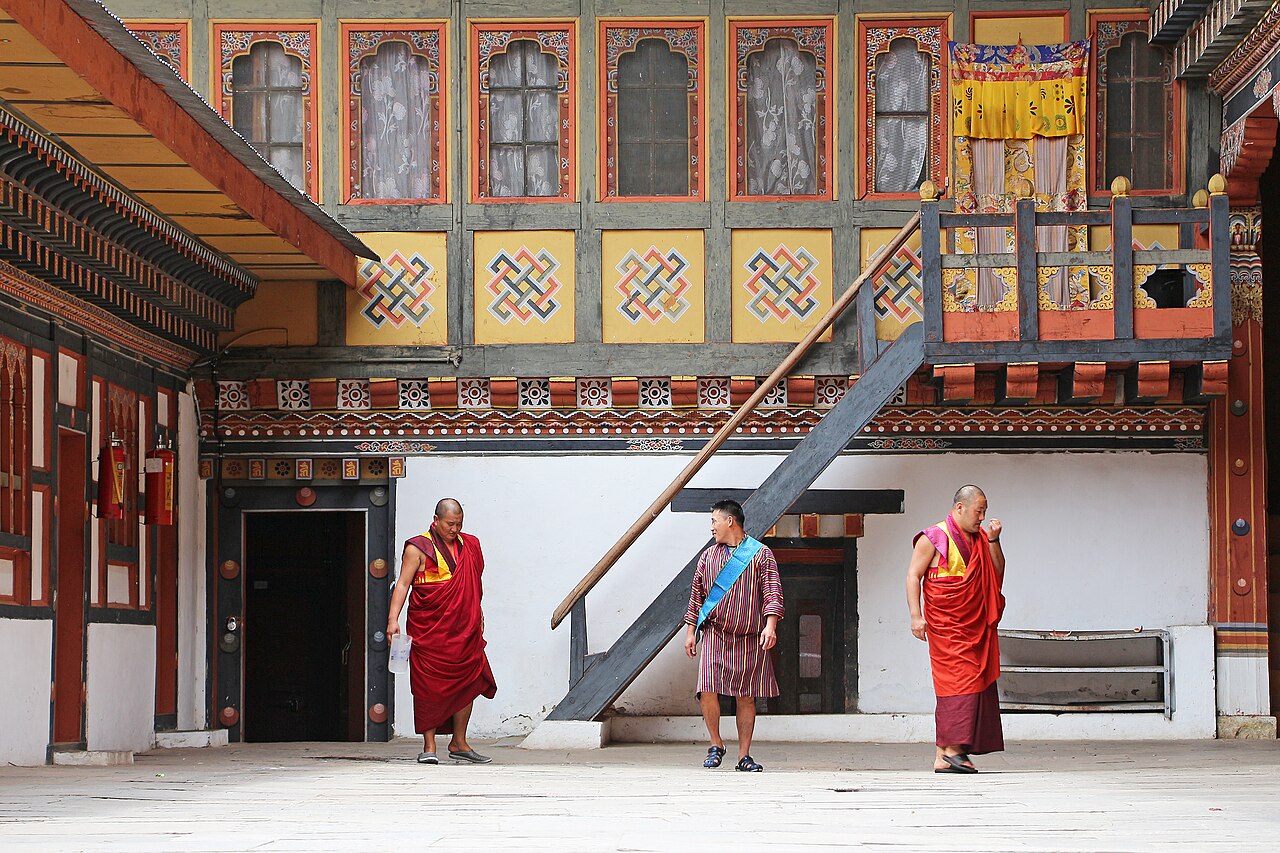

Tashichho Dzong (Dzongkha: བཀྲ་ཤིས་ཆོས་རྫོང), meaning "Fortress of the Glorious Religion," is the seat of Bhutan's government and one of the most important administrative and religious buildings in the kingdom. Located on the western bank of the Wang Chhu river in Thimphu, the dzong houses the throne room of the King of Bhutan, the offices of several key government ministries, and the summer residence of the Central Monastic Body (Zhung Dratshang) headed by the Je Khenpo, Bhutan's chief abbot. It is the physical embodiment of the traditional Bhutanese system of dual governance, in which religious and secular authority operate side by side within the same fortress walls.[1]
Originally constructed in 1641 by Zhabdrung Ngawang Namgyal, the founder and unifier of Bhutan, the dzong has undergone numerous expansions and reconstructions over the centuries. The most extensive renovation was carried out in the 1960s under the direction of the Third King, Jigme Dorji Wangchuck, who transformed the dzong into its present grand form to serve as the seat of the newly modernising Bhutanese government. Today, Tashichho Dzong is not only the administrative nerve centre of the nation but also a defining feature of the Thimphu skyline and a powerful symbol of Bhutanese sovereignty and identity.[1]
The dzong is also the venue for the annual Thimphu Tshechu, one of Bhutan's largest and most colourful religious festivals, which draws thousands of spectators to its courtyards each autumn.
History
The origins of Tashichho Dzong date to 1216, when the Lama Gyalwa Lhanangpa built a small monastery called Dho-Ngon Dzong ("Blue Stone Monastery") on the site. In 1641, Zhabdrung Ngawang Namgyal seized the monastery from its Lhapa Kagyu occupants and reconstructed it as a fortified dzong, renaming it Tashichho Dzong. The Zhabdrung made it the seat of the Drukpa Kagyu theocratic government and established the dual system of governance that persists in modified form to this day, with the Je Khenpo overseeing religious affairs and the Druk Desi managing temporal governance.[1]
The dzong suffered multiple fires throughout its history. A devastating fire in 1772 destroyed much of the complex, and it was rebuilt by the 16th Druk Desi. Another fire in 1866 caused further damage, and the dzong was repaired but remained relatively modest in scale compared to its present form. When the national capital was moved from Punakha to Thimphu in 1952 by the Third King, Jigme Dorji Wangchuck, the need for a larger and more imposing administrative centre became apparent.[1]
Between 1962 and 1969, the Third King commissioned a comprehensive reconstruction and expansion of Tashichho Dzong. The project was carried out entirely using traditional Bhutanese construction techniques — no nails, no architectural drawings, no modern machinery — under the supervision of master builders and artisans. The central utse (tower) was preserved from the original structure, but the rest of the dzong was essentially rebuilt from the ground up, resulting in the vast and stately complex visible today. The reconstruction is considered one of the great achievements of Bhutanese architecture in the modern era.[2]
Architecture
Tashichho Dzong is a massive rectangular fortress built in the traditional Bhutanese dzong style, with towering whitewashed walls, elaborately decorated wooden windows trimmed in red, and gilded copper roofs on its principal towers. The complex covers an area of approximately 150 metres by 90 metres and is surrounded by manicured lawns and gardens on the banks of the Wang Chhu. The dzong is approached through a grand gateway flanked by guardhouses, beyond which an outer courtyard leads to the main entrance.[1]
The interior is divided into two main wings in accordance with the dual system of governance. The northern wing houses the monastic quarters, including the main prayer hall, monks' residences, and the office of the Je Khenpo. The central utse, a six-storey tower rising above the rest of the complex, contains the most sacred shrines and the principal chapel. The southern wing accommodates the offices of the government, including the Ministry of Home and Cultural Affairs, the Ministry of Finance, and the secretariat. The King's throne room, used for formal audiences, investitures, and the presentation of credentials by foreign ambassadors, is located in a prominent position within the administrative wing.
The craftsmanship throughout the dzong is of the highest standard. Intricately carved wooden pillars and beams support the roofs, their capitals decorated with lotus motifs and cloud patterns. The walls of the temples and corridors are covered with elaborate murals depicting Buddhist cosmology, the lives of saints, the wrathful and peaceful manifestations of deities, and scenes from Bhutanese history. The woodwork is painted in the traditional Bhutanese palette of red, gold, blue, and green, and the stone courtyard floors are polished smooth by centuries of use.
Political Significance
As the seat of both the monarchy and the government of Bhutan, Tashichho Dzong occupies a unique position in the country's political landscape. All major state ceremonies take place within its walls, including the coronation of kings, the National Day celebrations on 17 December, and the formal opening of parliamentary sessions. When the Fifth King, Jigme Khesar Namgyel Wangchuck, was crowned in 2008, the coronation ceremony was held in the dzong's throne room. Foreign heads of state and ambassadors are received in the same hall, lending the dzong a diplomatic significance that extends beyond Bhutan's borders.[1]
The dzong also played a central role in Bhutan's transition from absolute monarchy to constitutional monarchy. It was in the halls of Tashichho Dzong that the drafting of Bhutan's constitution was discussed, and it was here that the Fourth King formally handed power to the first democratically elected government in 2008. The dzong thus represents both the traditional and modern faces of Bhutanese governance — a fortress-monastery that simultaneously serves as a 21st-century government office complex.
The Thimphu Tshechu
Each autumn, usually in September or October, the courtyards of Tashichho Dzong come alive with the Thimphu Tshechu, a three-day religious festival that is one of the most important cultural events in the Bhutanese calendar. The festival features sacred mask dances (cham) performed by monks and lay dancers in elaborate costumes and carved wooden masks representing deities, demons, animals, and historical figures. The dances dramatise episodes from Buddhist teachings and the life of Guru Rinpoche, and are believed to confer blessings and spiritual merit on all who witness them.[2]
The Thimphu Tshechu draws enormous crowds from across Bhutan and is a major occasion for Bhutanese families, who dress in their finest traditional clothing — the gho for men and the kira for women. The festival also serves as a social gathering, a marketplace, and an opportunity for people from Thimphu and surrounding districts to come together. For international visitors, the tshechu provides a rare opportunity to enter the dzong's courtyards and experience Bhutanese religious culture at its most vibrant and communal.
Religious Function
Tashichho Dzong serves as the summer headquarters of the Central Monastic Body, which migrates annually between Thimphu and Punakha Dzong in a tradition that dates back to the time of Zhabdrung Ngawang Namgyal. During the warmer months, from spring to autumn, approximately 1,600 monks reside in the dzong, conducting daily prayers, performing religious rituals, and pursuing their studies under the guidance of the Je Khenpo. In winter, the monastic body moves to the warmer climate of Punakha. This seasonal migration, known as the zhung dratshang gi gunsel, is one of the most distinctive features of Bhutanese religious life.[1]
The dzong's main chapel houses a large gilded statue of Shakyamuni Buddha along with images of Guru Rinpoche and Zhabdrung Ngawang Namgyal. The monastic wing also contains a library of sacred Buddhist texts, including handwritten copies of the Kangyur (the Buddhist canon in Tibetan translation). The dzong remains an active centre of religious scholarship and practice, and the monks who reside there play a significant role in the spiritual life of the nation.
References
- "Tashichho Dzong." Wikipedia.
- "Tashichho Dzong." Wikipedia.
- "Tashichho Dzong." Bhutan Travel.
- Tashichho Dzong — Dzongkhag Administration, Thimphu
- Tashichho Dzong, a Fortress at the Site of Blue Stone Dzong — Bhutan Pilgrimage
- His Majesty The King conferred Dakyen to Prime Minister, Speaker and Cabinet Ministers on 28th January 2024 — Ministry of Foreign Affairs and External Trade
Contributed by Anonymous Contributor, Akron, Ohio
Related articles
Know something about this topic? Edit this article or . Anonymous contributions welcome — no account required.