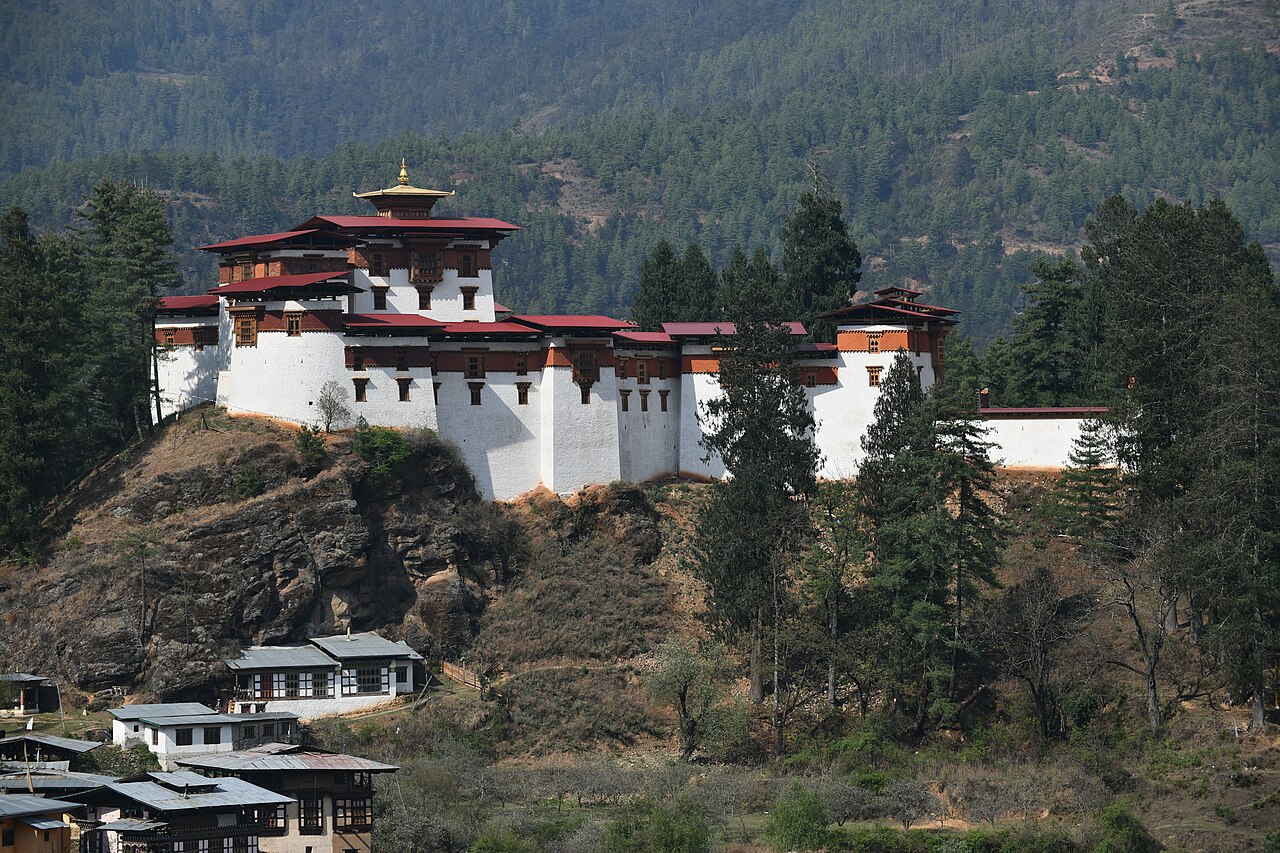

Drukgyel Dzong (Dzongkha: འབྲུག་རྒྱལ་རྫོང), meaning "Fortress of the Victorious Drukpas," is a historic fortress and Buddhist monastery located on a commanding ridge in the upper Paro valley of western Bhutan, approximately 14 kilometres north of the town of Paro. Constructed in 1649 by Zhabdrung Ngawang Namgyal, the unifier of Bhutan, the dzong was built to celebrate Bhutan's decisive victory over a combined Tibetan-Mongol invasion force in 1644. Its name — joining "Druk" (thunder dragon, the Bhutanese national symbol) and "gyel" (victory) — was chosen to enshrine that triumph permanently in the built landscape.[1]
For three centuries the fortress commanded the principal route between Bhutan and Tibet through the Jomolhari pass, functioning simultaneously as a military stronghold, administrative seat, and monastic community. On clear days, the snow-capped summit of Mount Jomolhari (7,326 metres) is visible from the dzong's ramparts, a dramatic visual reminder of the fortress's role as Bhutan's northern sentinel. A devastating fire in 1951 destroyed most of the structure, leaving only its massive rammed-earth and stone walls standing. The ruins became one of the country's most evocative historical sites and were placed on Bhutan's tentative list for UNESCO World Heritage status.[2]
In 2016, the Royal Government of Bhutan launched a comprehensive restoration programme, timed to coincide with the birth of the crown prince and the 400th anniversary of the Zhabdrung's arrival in Bhutan. The project aims to return the dzong to its original form while preserving its unique defensive architecture.
History
The construction of Drukgyel Dzong was a direct response to one of the most serious external threats the early Bhutanese state had faced. In 1644, a combined force of Tibetan soldiers and Mongol warriors invaded Bhutan through the northern passes, intending to overthrow the Zhabdrung's government. Bhutanese forces defeated the invaders decisively, and the Zhabdrung ordered the construction of a new fortress both to commemorate the victory and to guard against future incursions from Tibet.[1]
The dzong was built by Tenzin Drukdra under the Zhabdrung's direct supervision. Its strategic location was deliberately chosen: perched at the head of the Paro valley, it controlled the only major route between Paro and the Tibetan frontier. Any invading force advancing from the north would have to pass beneath the dzong's walls, making it a natural chokepoint. Historical Bhutanese accounts record that the fortress's defensive features were tested as early as 1648, when a subsequent Tibetan incursion was repelled using the dzong's elaborate fortifications.[3]
On a night in 1951, an unattended butter lamp — a common source of illumination in Bhutanese monasteries — ignited nearby combustible materials. The fire spread rapidly through the dzong's timber superstructure, and by the time it was brought under control, the fortress had been almost entirely destroyed. Only the massive stone foundations and lower walls survived. The cause was recorded as accidental, though the loss was a profound blow to Bhutanese cultural heritage.[1]
Architecture
Drukgyel Dzong was designed primarily as a military fortification, distinguishing it from many other Bhutanese dzongs that emphasised administrative or monastic functions. The fortress incorporated several innovative defensive features reflecting the Zhabdrung's experience of repeated Tibetan invasions. Most notable was a false entrance — an architectural deception designed to lure attackers into an enclosed courtyard where they could be trapped and attacked from above. According to Bhutanese tradition, this feature was employed successfully during the 1648 engagement.[2]
The dzong followed the standard Bhutanese plan of a central tower (utse) surrounded by outer courtyards and defensive walls, but with a more pronounced military emphasis than was typical. Watchtowers provided clear sightlines along the valley approaches, and the elevated position gave defenders a commanding advantage. The construction used rammed earth, stone masonry, and timber framing — the same techniques employed across the Bhutanese dzong tradition. The utse housed chapels dedicated to Guru Rinpoche and Chenrezig (Avalokiteshvara), confirming the fortress's dual secular and religious function.
Cultural Significance
Drukgyel Dzong occupies a unique place in the Bhutanese national imagination. As the monument specifically created to celebrate a defining military victory, it symbolises Bhutanese sovereignty and resistance to foreign domination. The fortress's name has entered the language as a synonym for national pride, and images of the ruined dzong with Mount Jomolhari in the background have become one of the most recognisable visual representations of Bhutan. Drukgyel Dzong appeared on Bhutanese postage stamps as early as the 1960s.[1]
The site also carries religious significance. Before the fire, the dzong's chapels housed important Drukpa Kagyu relics, and the monastic community performed regular rituals. The restoration project has included the reconstruction of the monastic quarter, ensuring that religious functions will resume alongside administrative ones.
Current Status
The restoration project, launched in 2016, has proceeded in phases. Guided by historical photographs from the early 20th century, surviving architectural elements, and traditional building knowledge, the reconstruction has sought to maintain fidelity to the original design while incorporating modern structural reinforcements. The restored dzong is expected to function once again as a combined monastery and cultural centre. The site remains on Bhutan's tentative UNESCO World Heritage list, and completion of the restoration is anticipated to strengthen the nomination.[4]
Visitors to the upper Paro valley can view the ongoing work, and the dramatic setting — with the fortress perched on its ridge against the backdrop of the Himalayan peaks — continues to draw both tourists and Bhutanese pilgrims.
References
- Drukgyal Dzong, Wikipedia
- Ancient Ruin of Drukgyel Dzong, UNESCO World Heritage Centre
- 4 Facts To Know About Drukgyal Dzong, Druk Asia
- Ultimate Guide to Drukgyel Dzong, Wanderon
Related articles
Know something about this topic? Edit this article or . Anonymous contributions welcome — no account required.