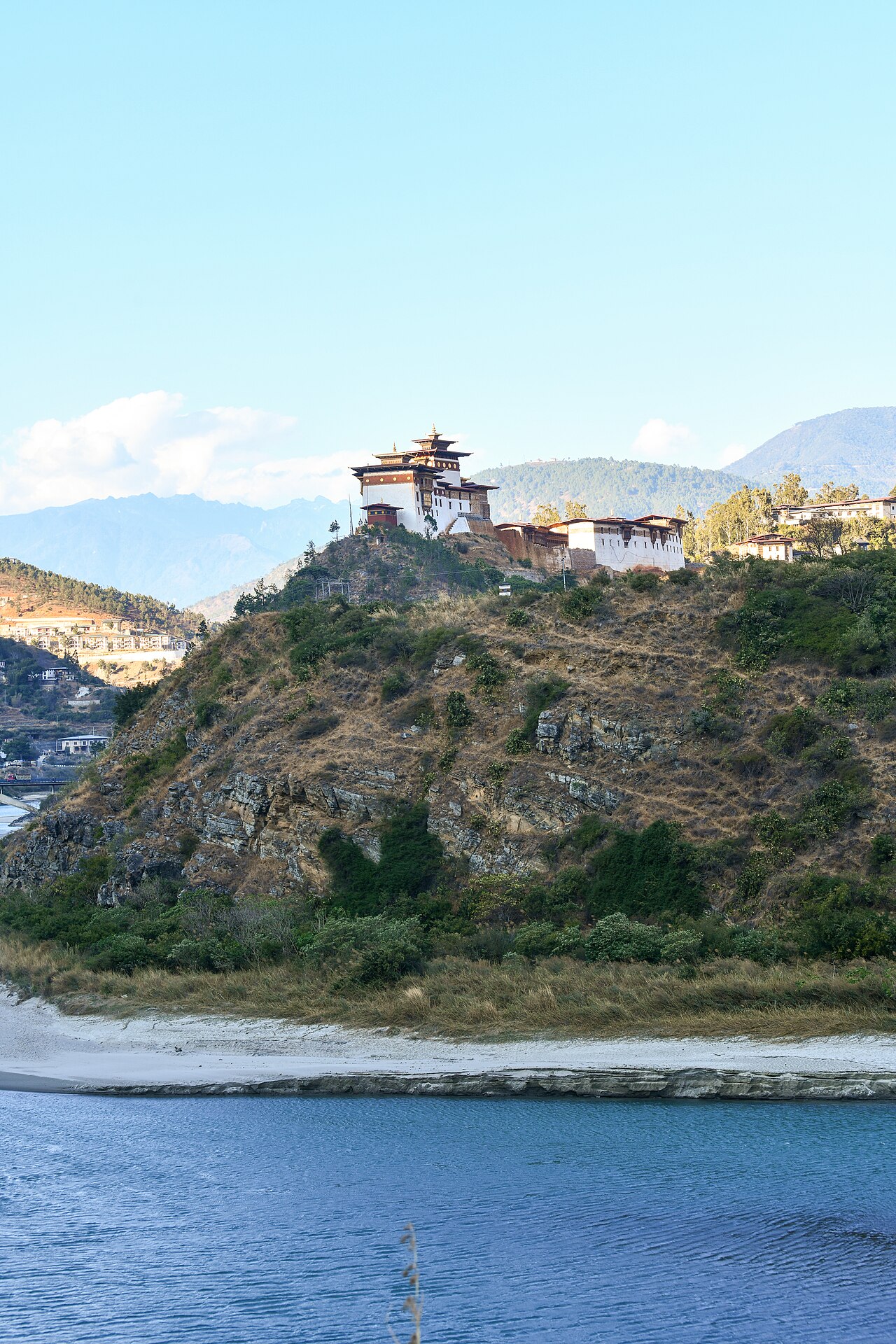

Wangdue Phodrang Dzong (Dzongkha: དབང་འདུས་ཕོ་བྲང་རྫོང) was one of the most historically and architecturally significant fortress-monasteries in Bhutan. Located at the confluence of the Puna Tsang Chhu and Dang Chhu rivers in Wangdue Phodrang District, the dzong occupied a commanding ridge and served for nearly four centuries as the administrative and monastic centre of one of Bhutan's most important regions.[1]
On 24 June 2012, a catastrophic fire swept through the dzong, destroying much of the historic structure and the irreplaceable religious artefacts it contained. The loss was deeply felt across Bhutan, and King Jigme Khesar Namgyel Wangchuck personally oversaw the launch of a major reconstruction project. The rebuilding effort, which employs traditional Bhutanese construction techniques and has drawn support from the government, the monastic body, and international partners, represents one of the most ambitious heritage restoration projects in the country's history.[1]
History
Wangdue Phodrang Dzong was constructed in 1638 by Zhabdrung Ngawang Namgyal, the founder of the Bhutanese state. According to tradition, the Zhabdrung chose the site after observing four ravens flying off in the four cardinal directions from the hilltop, which he interpreted as an auspicious sign indicating that the dharma would spread in all directions from this point. The name "Wangdue Phodrang" translates roughly as "the palace of Wangdue," named after a child playing at the site whom the Zhabdrung encountered.[1]
The dzong played a significant role in the Zhabdrung's campaign to unify Bhutan. As the second dzong built by the Zhabdrung (after Simtokha Dzong), it secured control over the Punakha-Wangdue valley, the political heartland of the emerging Bhutanese state. The dzong subsequently served as the seat of the Wangdue Phodrang Penlop, one of the most powerful regional governors in the Bhutanese dual system of government.
Throughout the 18th and 19th centuries, the dzong was a centre of political intrigue and occasional conflict as rival penlops vied for power during Bhutan's period of internal division. It was damaged and repaired multiple times. In the 20th century, under the Wangchuck monarchy, the dzong was maintained as an administrative and monastic centre, though it required continuous repairs due to its age and the inherent vulnerabilities of its timber construction.
The 2012 Fire
On the afternoon of 24 June 2012, during the annual Wangdue Phodrang Tshechu festival, a fire broke out in the dzong. Despite the efforts of monks, local residents, and emergency responders, the fire spread rapidly through the largely timber-framed structure. By the time the blaze was extinguished, much of the dzong lay in ruins. The fire destroyed centuries-old murals, thangkas, statues, wooden carvings, and sacred texts. Some artefacts were rescued by monks and bystanders who risked their lives to carry them from the burning buildings.[1]
The cause of the fire was investigated but never conclusively determined. The destruction of Wangdue Phodrang Dzong was mourned as a national tragedy. The Bhutanese government and the Central Monastic Body declared the reconstruction a national priority.
Reconstruction
The reconstruction of Wangdue Phodrang Dzong began shortly after the fire and has been guided by a commitment to authenticity. Traditional construction methods are being employed: rammed earth walls, hand-hewn timber framing, and stone foundations, all without the use of modern nails or reinforced concrete. Master craftsmen trained in traditional Bhutanese arts have been engaged to recreate the woodcarvings, murals, and paintings that were lost.[2]
The Indian government has been a significant partner in the reconstruction, providing substantial financial and technical assistance. Bhutanese artisans and craftspeople from across the country have contributed to the effort, and the project has been seen as an opportunity to preserve and transmit traditional building skills to a new generation.
Architecture
Before its destruction, Wangdue Phodrang Dzong was celebrated for its elegant proportions and dramatic setting. The dzong sat on a narrow ridge between two rivers, with steep drops on three sides creating a natural defensive position. The structure featured the classic Bhutanese dzong layout: a central utse (tower) flanked by monastic and administrative wings arranged around courtyards.
The dzong was noted for its particularly fine woodwork and the quality of its religious murals. The interior contained numerous chapels and shrines, the most important being the main assembly hall with its large statue of Shakyamuni Buddha. The reconstruction aims to faithfully reproduce these features using photographic and documentary records gathered before the fire.
Wangdue Phodrang Tshechu
The Wangdue Phodrang Tshechu, held annually in autumn, was one of the most important religious festivals in western Bhutan. The three-day event featured sacred mask dances performed in the dzong's courtyard, including the Raksha Mangcham (Dance of the Ox), which was unique to this festival and not performed elsewhere in Bhutan. Following the 2012 fire, the tshechu has been held in temporary venues near the dzong site while reconstruction continues.[1]
Current Status
As of the early 2020s, the reconstruction of Wangdue Phodrang Dzong continues. Administrative functions of the district have been temporarily relocated. The reconstruction project has progressed through the structural phase, with the rammed earth walls and timber framing largely completed. Interior decoration, including the recreation of murals and the installation of new religious artefacts, is ongoing. The rebuilt dzong is expected to resume its traditional dual function as an administrative and monastic centre upon completion.
References
Related articles
Know something about this topic? Edit this article or . Anonymous contributions welcome — no account required.