The Drukpa Kagyu Lineage in Bhutan
From BhutanWiki, the people's encyclopedia of Bhutan · history · Verified
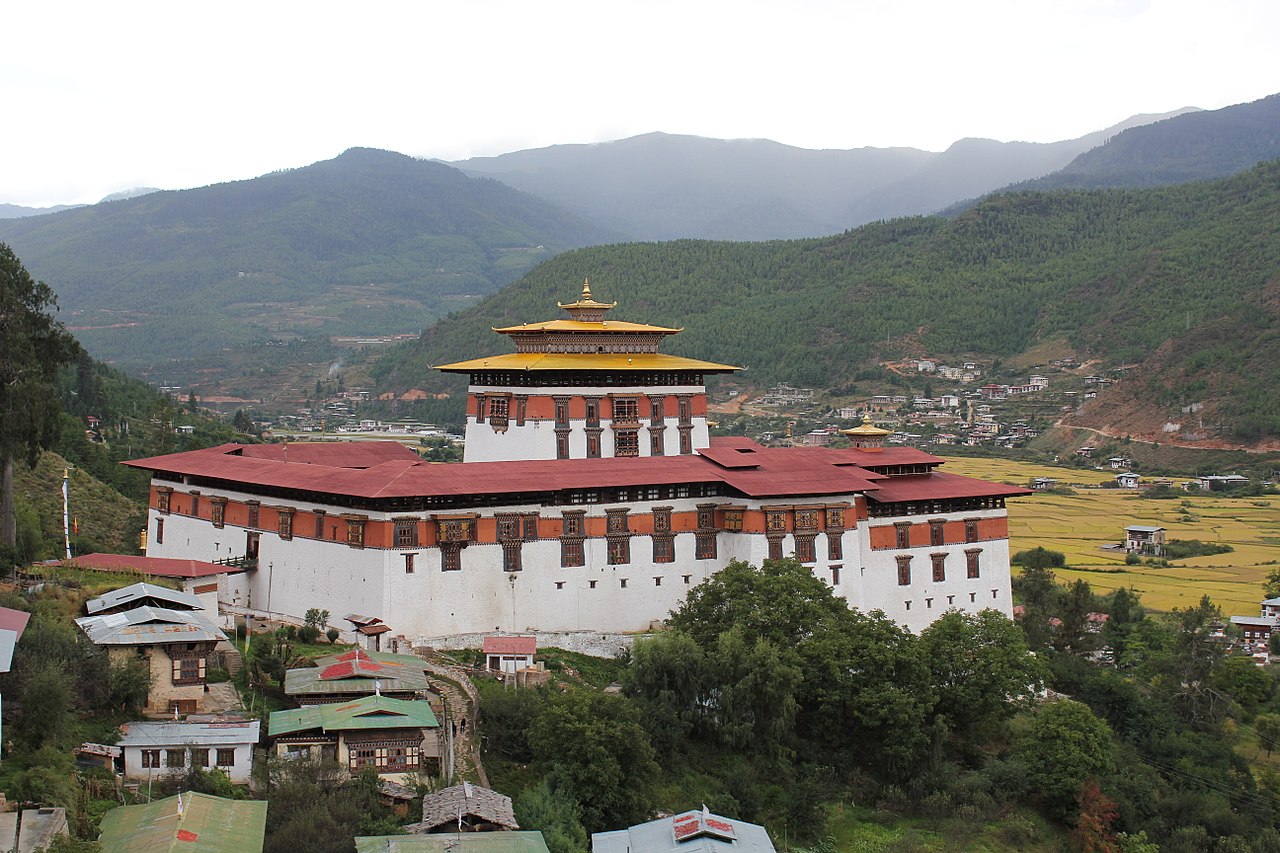
.jpg)
The Drukpa Kagyu (Tibetan: 'brug pa bka' brgyud) is the dominant school of Buddhism in Bhutan and the spiritual tradition from which the country takes its identity. Bhutan is known in Dzongkha as Druk Yul — "Land of the Thunder Dragon" — and its monarchs bear the title Druk Gyalpo, "Thunder Dragon King." The thunder dragon (druk) on the Bhutanese national flag is a direct reference to this lineage.[1]
The Drukpa Kagyu is a sub-school of the Kagyu tradition of Tibetan Buddhism, one of the four major schools alongside the Nyingma, Sakya, and Gelug. It was founded by Tsangpa Gyare Yeshe Dorje (1161–1211) in Tibet and brought to Bhutan in the 13th century by Phajo Drugom Zhigpo. In the 17th century, Zhabdrung Ngawang Namgyal — recognized as the fourth incarnation of Tsangpa Gyare — fled Tibet and unified Bhutan into a single nation-state under the banner of the Drukpa tradition.[2]
Today, the Drukpa Kagyu remains the state religion of Bhutan. The Je Khenpo, the chief abbot of the Central Monastic Body, is the highest religious authority in the country and presides over a network of monasteries, temples, and monastic schools that trace their lineage directly to Tsangpa Gyare's founding vision.
Origins: Tsangpa Gyare and the Nine Dragons
The Drukpa Kagyu school traces its origins to Tsangpa Gyare Yeshe Dorje (1161–1211), a Tibetan Buddhist master and the principal disciple of Lingchen Repa Pema Dorji. Tsangpa Gyare's spiritual lineage extends back through the Kagyu masters — Naropa, Marpa, Milarepa, and Gampopa — to the Indian mahasiddha tradition.[2]
The founding legend of the Drukpa school centres on a miraculous event in 1206. While Tsangpa Gyare and his disciples were on a pilgrimage through the Tsang region of Tibet, they arrived at a place called Namdruk ("Sky Dragon"). At that moment, nine dragons (druk) were seen rising from the earth and soaring into the sky, accompanied by a rain of flowers. Tsangpa Gyare interpreted this as a profoundly auspicious sign and named his lineage the Drukpa — "Lineage of the Dragon."[3]
Tsangpa Gyare subsequently established the monastery of Ralung in the Tsang region, which became the seat of the Drukpa lineage. For the next four centuries, Ralung served as the lineage's spiritual headquarters, with leadership passing through Tsangpa Gyare's hereditary family line.[2]
Transmission to Bhutan
Phajo Drugom Zhigpo (13th Century)
The Drukpa Kagyu teachings were first brought to Bhutan by Phajo Drugom Zhigpo (c. 1184–1251), a lama from Kham in eastern Tibet. According to traditional accounts, Tsangpa Gyare himself prophesied that a man from Kham would carry the Drukpa teachings to the "southern valleys" blessed by Guru Rinpoche. Phajo arrived in western Bhutan around 1222 and systematically established the Drukpa Kagyu as the principal school, displacing the rival Lhapa Kagyu tradition that had previously held sway.[4]
Phajo married locally, and his sons were appointed as religious and temporal authorities across western Bhutan, creating a decentralized network of Drukpa governance that persisted for several centuries.
Zhabdrung Ngawang Namgyal and Unification (17th Century)
The decisive moment in the Drukpa Kagyu's history in Bhutan came with the arrival of Zhabdrung Ngawang Namgyal (1594–1651). Recognized as the fourth incarnation of Tsangpa Gyare, Ngawang Namgyal was the rightful head of the Drukpa lineage at Ralung. However, a rival claimant supported by the Tsang Desi (the secular ruler of the Tsang region) contested his authority. Facing arrest, and guided by visions in which the protective deities of Bhutan offered him refuge, the Zhabdrung fled Tibet in 1616 and entered western Bhutan through Gasa Dzongkhag.[5]
Over the following decades, Ngawang Namgyal accomplished what no one before him had achieved: the unification of Bhutan's many warring fiefdoms into a single nation-state. He built a network of fortified monastery-fortresses (dzongs) across the major valleys — beginning with Cheri Monastery (1620) and Simtokha Dzong (1629) — that served simultaneously as religious centres and administrative seats. In the Battle of Five Lamas (1634), he defeated a coalition of Tibetan and rival Bhutanese forces, consolidating his control over the country.[5]
The Zhabdrung also established Bhutan's distinctive dual system of government (chhoe-sid nyiden), dividing authority between a spiritual leader (the Je Khenpo) and a secular administrator (the Druk Desi). This system, codified in the Tsa Yig legal code, governed Bhutan until the establishment of the monarchy in 1907.
How Bhutan Became "Land of the Thunder Dragon"
The name Druk Yul — "Land of the Thunder Dragon" — derives directly from the Drukpa Kagyu lineage. The word druk means both "dragon" and "thunder" in Dzongkha, recalling the nine dragons of Tsangpa Gyare's founding vision. As the Drukpa school became the state religion under Ngawang Namgyal, the dragon became synonymous with the Bhutanese state itself.[1]
The thunder dragon appears on the Bhutanese national flag, clutching jewels in its claws — symbolizing the wealth and spiritual treasure of the nation. The country's monarchs are called Druk Gyalpo ("Dragon King"), the national anthem is "Druk Tsendhen" ("The Thunder Dragon Kingdom"), and the Bhutanese people refer to themselves as Drukpa.[1]
Contemporary Role
The Drukpa Kagyu remains central to Bhutanese governance, culture, and daily life. The Central Monastic Body (Zhung Dratshang), headed by the Je Khenpo, is a state-supported institution with authority over religious affairs. Monks receive education and support from the state, and the monastic calendar shapes the rhythm of Bhutanese festivals (tsechus) throughout the year. Major dzongs such as Punakha Dzong and Tashichho Dzong continue to function as both administrative centres and seats of monastic life.[2]
The Constitution of Bhutan, adopted in 2008, designates Buddhism as the "spiritual heritage" of the nation and assigns the Druk Gyalpo the role of protector of all religions. While the constitution guarantees freedom of religion, the Drukpa Kagyu's privileged position as the state-supported tradition continues to shape Bhutanese identity and public life.
References
Related articles
Know something about this topic? Edit this article or . Anonymous contributions welcome — no account required.