,_gegr.1659,_%C3%BCber_dem_Gamri_Fluss.JPG)
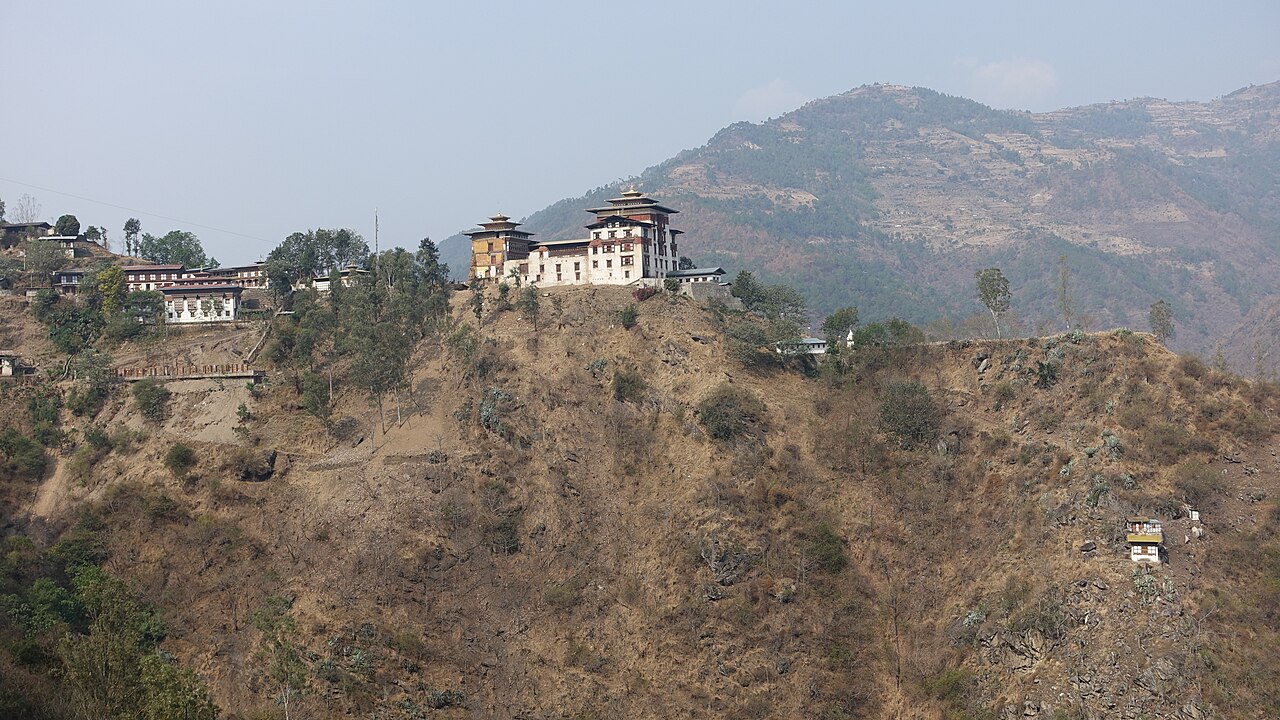
Trashigang Dzong (Dzongkha: བཀྲ་ཤིས་སྒང་རྫོང), meaning "Fortress of the Auspicious Hill," is the principal fortress-monastery of eastern Bhutan. Situated on a steep promontory above the confluence of the Drangme Chhu and Gamri Chhu rivers in Trashigang District, it has served since its construction in 1659 as the administrative and religious centre of Bhutan's eastern regions. Trashigang District is the most populous in Bhutan, and the dzong remains the seat of district governance and a vibrant monastic centre.[1]
Eastern Bhutan is culturally distinct from the western regions that were the original heartland of the Zhabdrung's state. The people of the east speak Sharchopkha rather than Dzongkha and follow the Nyingma school of Buddhism alongside the state Drukpa Kagyu tradition. Trashigang Dzong represents the extension of centralised Bhutanese authority into this diverse eastern region and has long served as a bridge between the country's western and eastern cultural spheres.[2]
History
Trashigang Dzong was built in 1659 by Mingyur Tenpa, the third Desi (secular ruler) of Bhutan, on the orders of the Zhabdrung's government. The construction was part of the effort to extend Drukpa Kagyu authority into eastern Bhutan, a region that had historically maintained its independence from the western Bhutanese polity. The site was chosen for its commanding position above the river confluence, which gave the dzong control over the trade routes into the Assam plains of India to the south and east.[1]
The dzong quickly became the seat of the Trashigang Dzongpon (governor), one of the most powerful officials in the Bhutanese administrative system. The Trashigang Dzongpon was responsible for governing the vast eastern territories and for managing relations with the Assamese kingdoms and later the British colonial administration in India.
In the early 18th century, the dzong was significantly expanded and renovated. It played a role in the periodic conflicts between regional governors that characterised Bhutanese politics during this era. In the 19th century, the dzong served as a staging point for Bhutanese military expeditions into Assam, and later it became a focal point of British diplomatic engagement with eastern Bhutan. The dzong was damaged by fire and earthquake at various points in its history and has been repaired and renovated several times.
Architecture
Trashigang Dzong occupies a narrow ridge with precipitous drops on all sides, making it one of the most dramatically sited dzongs in the country. The main entrance is reached by a steep path from the town below. The dzong follows the traditional layout of monastic and administrative wings surrounding a central utse, but its plan is adapted to the irregular terrain of the ridge.[1]
The dzong is built in the classic Bhutanese style with massive rammed earth walls, timber framing, and a gently sloping roof. The walls are whitewashed, with a distinctive red ochre band painted around the upper storey — a feature common to administrative dzongs. The main courtyard contains the utse, which houses the principal chapel and the monastic assembly hall.
The interior chapels contain statues and murals reflecting both the Drukpa Kagyu and Nyingma traditions, a characteristic of eastern Bhutanese religious life. Notable features include images of Guru Rinpoche (Padmasambhava), who is especially venerated in eastern Bhutan, and murals depicting the wrathful and peaceful manifestations of Buddhist deities.
Religious Significance
Trashigang Dzong is home to a substantial monastic community and serves as the principal religious centre for eastern Bhutan. The monks follow the Drukpa Kagyu tradition as mandated by the Central Monastic Body, but the religious culture of the region is strongly influenced by the Nyingma school, the oldest school of Tibetan Buddhism. This blending of traditions gives the dzong's religious life a distinctive character.
The dzong is particularly associated with the cult of Guru Rinpoche, whose introduction of Buddhism to the Himalayan region is believed to have included travels through eastern Bhutan. Several meditation caves and sacred sites attributed to Guru Rinpoche are found in the surrounding region, and the dzong serves as a centre for festivals honouring his legacy.
Trashigang Tshechu
The Trashigang Tshechu, held annually in November or December, is the largest religious festival in eastern Bhutan. The three-day event draws thousands of people from across the region, many of whom travel for days from remote villages in the surrounding mountains. The festival features sacred mask dances, folk dances, and religious performances. The dances include performances unique to the eastern Bhutanese tradition alongside the standard repertoire of Drukpa Kagyu religious dances.[3]
The tshechu is an important social occasion in the sparsely populated east, serving as a gathering point for communities that may have limited contact with one another during the rest of the year. People attend in their finest traditional clothing, and the festival is accompanied by markets, social gatherings, and community celebrations.
Current Use
Trashigang Dzong continues to serve as the administrative headquarters of Trashigang District, housing the offices of the dzongda (district governor), the district court, and other government offices. The monastic wing maintains an active community of monks. The town of Trashigang, which clusters below the dzong, is the largest settlement in eastern Bhutan and serves as a hub for travel to the remote eastern districts of Trashi Yangtse, Mongar, and Samdrup Jongkhar. The dzong is a significant cultural tourism destination, offering visitors a window into the distinctive religious and cultural traditions of eastern Bhutan.
See also
References
Related articles
Know something about this topic? Edit this article or . Anonymous contributions welcome — no account required.