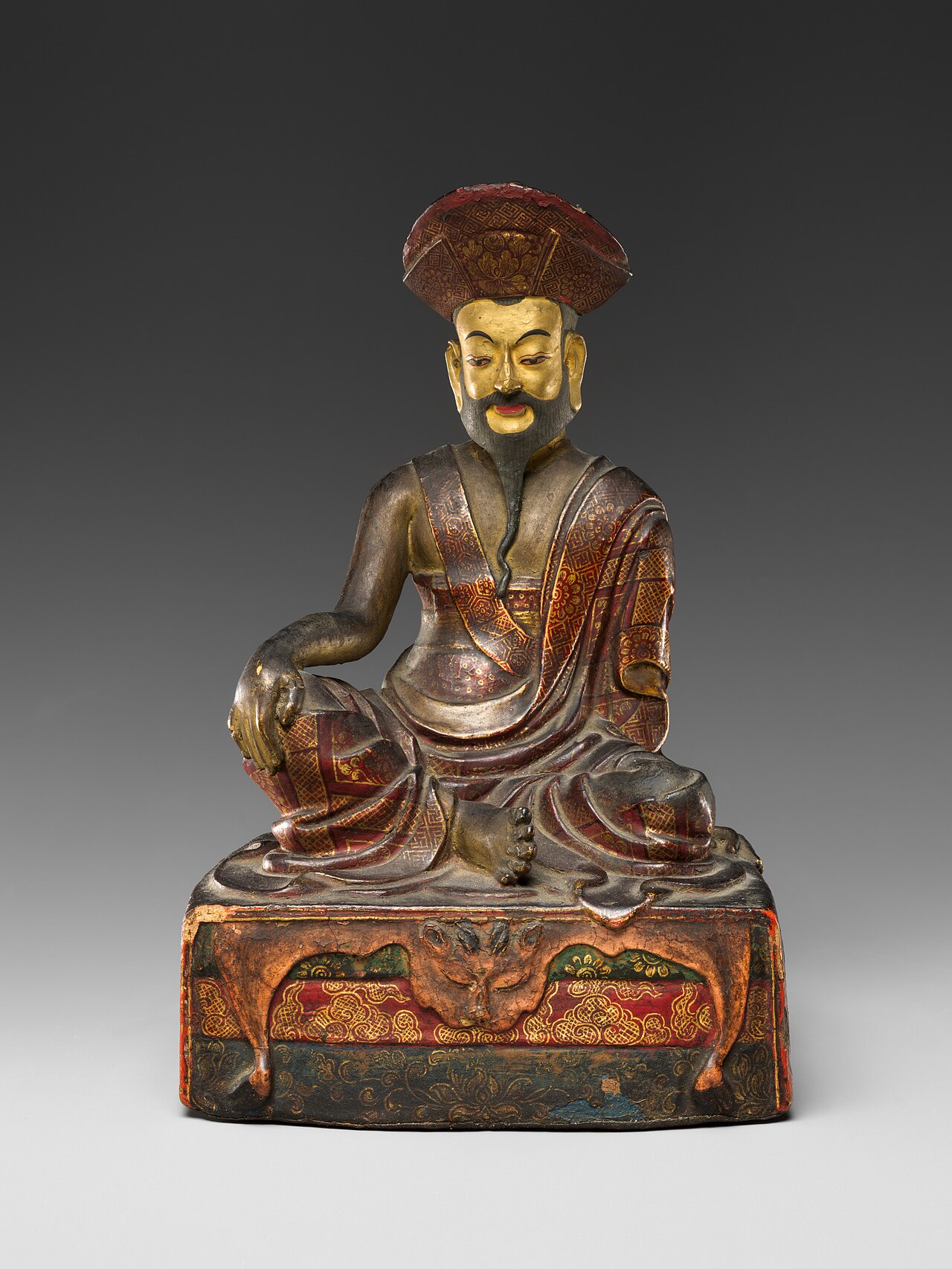

Zhabdrung Ngawang Namgyal (Dzongkha: ཞབས་དྲུང་ངག་དབང་རྣམ་རྒྱལ; 1594–1651) was the Tibetan Buddhist lama, military leader, and statesman who unified the disparate valleys and fiefdoms of what is now Bhutan into a cohesive nation-state in the 17th century. Born in Tibet as the recognized reincarnation of the Drukpa Kagyu lineage holder Pema Karpo, he fled to Bhutan in 1616 amid a succession dispute and spent the next three decades consolidating political and religious authority, building the monumental dzong fortress-monasteries that define Bhutan's architectural landscape, and repelling repeated military invasions from Tibet.[1]
The Zhabdrung is arguably the single most important figure in Bhutanese history. He established the Choesi system — the dual governance structure dividing authority between a religious leader (Je Khenpo) and a civil administrator (Druk Desi) — that governed Bhutan for nearly three centuries until the establishment of the monarchy in 1907. He codified Bhutanese law, created the distinctive national identity rooted in the Drukpa Kagyu school of Buddhism, and gave the country its name: Druk Yul, the "Land of the Thunder Dragon." His legacy permeates every aspect of Bhutanese culture, from the dzongs that serve as administrative and religious centers in every district to the national dress and the annual festival calendar.
Early Life in Tibet
Ngawang Namgyal was born in 1594 at Ralung Monastery in Tibet, the seat of the Drukpa Kagyu lineage. He was recognized as the reincarnation of Pema Karpo (1527–1592), the renowned Drukpa Kagyu scholar and hierarch. However, his recognition was disputed by the Tsang Desi (the secular ruler of central Tibet), who supported a rival candidate. This dispute escalated into a political and religious crisis that made Ngawang Namgyal's position at Ralung increasingly untenable.[1]
The Drukpa Kagyu tradition had deep roots in the southern Himalayan valleys — monks and lamas of the lineage had been establishing monasteries in what is now Bhutan since the 13th century. Facing political persecution in Tibet, Ngawang Namgyal made the fateful decision to leave Ralung and travel south. In 1616, at the age of twenty-two, he crossed the Himalayan passes into western Bhutan, where he was received as a religious authority by local lords and monastic communities who followed the Drukpa Kagyu teachings.
Unification of Bhutan
Upon arriving in western Bhutan, Ngawang Namgyal found a landscape of fragmented political authority — local lords, rival religious schools, and competing monastic establishments vied for control of individual valleys. Over the next two decades, the Zhabdrung systematically brought these territories under his authority through a combination of religious charisma, political alliance-building, military force, and strategic marriage alliances. He subdued the chiefs of Paro, Thimphu, and other western valleys, and extended his influence eastward into central Bhutan.[2]
The Zhabdrung's success in unification rested in part on his ability to position himself as both a supreme religious authority and a temporal ruler. He suppressed rival religious schools — particularly the Lhapa and Nenyingpa traditions — and established the Drukpa Kagyu school as the state religion. This religious consolidation was inseparable from the political one, as monastic loyalty was essential to maintaining control over dispersed populations in an era without modern communications or infrastructure.
The Dzong System
The Zhabdrung's most visible and enduring legacy is the construction of the dzong fortress-monasteries that remain the architectural and administrative heart of Bhutan. These massive structures — simultaneously fortresses, monasteries, and administrative centers — served as the physical expression of the Zhabdrung's dual religious-political authority. Key dzongs built during his reign include Simtokha Dzong (1629), the oldest surviving dzong; Punakha Dzong (1637–1638), which served as the capital and winter seat of government; and Trongsa Dzong, strategically positioned to control the route between western and eastern Bhutan.[1]
Each dzong was designed with a central tower (utse) dividing the structure into a monastic wing and an administrative wing — an architectural embodiment of the Choesi system. The dzongs served multiple functions: they housed monks and government officials, stored grain and weapons, provided refuge during invasions, and served as centers for religious festivals (tshechu). This institution proved so durable that when the monarchy was established in 1907, the new kings simply adapted the dzong system to their own purposes, and to this day, dzongs serve as the headquarters of Bhutan's twenty districts (dzongkhags).
Military Victories Against Tibet
The Zhabdrung's unification of Bhutan was repeatedly challenged by Tibetan military invasions, largely motivated by the unresolved succession dispute over the Drukpa Kagyu leadership and by Tibetan authorities' desire to reassert control over the southern Himalayan regions. Between 1616 and 1651, the Zhabdrung repelled at least five major Tibetan-Mongol invasions, a remarkable military achievement that cemented Bhutanese sovereignty and national identity.[2]
The most significant Tibetan invasions occurred in 1634, 1639, 1644, and 1648–1649. In each case, the dzong fortresses proved their strategic value, providing defensible positions from which the Bhutanese could resist larger Tibetan forces. The 1644 invasion, launched jointly by Tibetan and Mongol forces, was particularly threatening, but the Bhutanese defenders prevailed, securing the captured weaponry and supplies that further strengthened the Zhabdrung's military position. These victories are still commemorated in Bhutanese festivals and historical narratives as foundational events in the national story.
The Choesi System and Legal Code
The Zhabdrung's most important institutional innovation was the Choesi system (Cho for religion, Si for politics), a dual system of governance that separated religious and secular authority while keeping both under the ultimate umbrella of Drukpa Kagyu Buddhist legitimacy. Under this system, the Je Khenpo served as the supreme religious authority, overseeing the Central Monastic Body, while the Druk Desi served as the chief civil administrator, managing temporal affairs. Both were theoretically subordinate to the Zhabdrung himself, who embodied the unity of the two systems.[1]
The Zhabdrung also codified laws governing monastic discipline, taxation, land tenure, and social conduct. These codes, rooted in Buddhist ethical principles, formed the basis of Bhutanese law for centuries. Elements of his legal and social framework persist in modern Bhutan, including the emphasis on national dress and cultural etiquette that was later formalized as Driglam Namzha.
Death and Concealment
The Zhabdrung died in 1651 at Punakha Dzong, but his death was concealed by his closest attendants and the Druk Desi for over fifty years — one of the most remarkable episodes of political deception in Asian history. The official explanation given was that the Zhabdrung had entered a prolonged meditative retreat and could not be disturbed. In reality, the concealment was a political necessity: the Zhabdrung's personal authority was so central to the Bhutanese state that revealing his death might have triggered the collapse of the unified polity, invited Tibetan invasion, or provoked succession crises among rival factions.[1]
The concealment was not fully acknowledged until the early 18th century. In the intervening decades, the Druk Desis ruled in the Zhabdrung's name, maintaining the fiction of his retreat. When the death was finally acknowledged, a system of recognizing reincarnations of the Zhabdrung was established, with three aspects recognized: body (ku), speech (sung), and mind (thug). These reincarnation lines became sources of political legitimacy and controversy in subsequent centuries, and the question of the Zhabdrung's reincarnation remained politically sensitive well into the 20th century — indeed, the suppression of a Zhabdrung reincarnation claimant was among the political undercurrents of the 1960s power struggles in Bhutan.
See also
References
- Ngawang Namgyal — Wikipedia
- Ardussi, John A. Formation of the State of Bhutan ('Brug gzhung) in the 17th Century and its Tibetan Antecedents. Journal of Bhutan Studies, 2004. doi:10.1163/9789004279704
- Centre for Bhutan & GNH Studies — Publications
Contributed by Anonymous Contributor, Burlington VT
Related articles
Know something about this topic? Edit this article or . Anonymous contributions welcome — no account required.