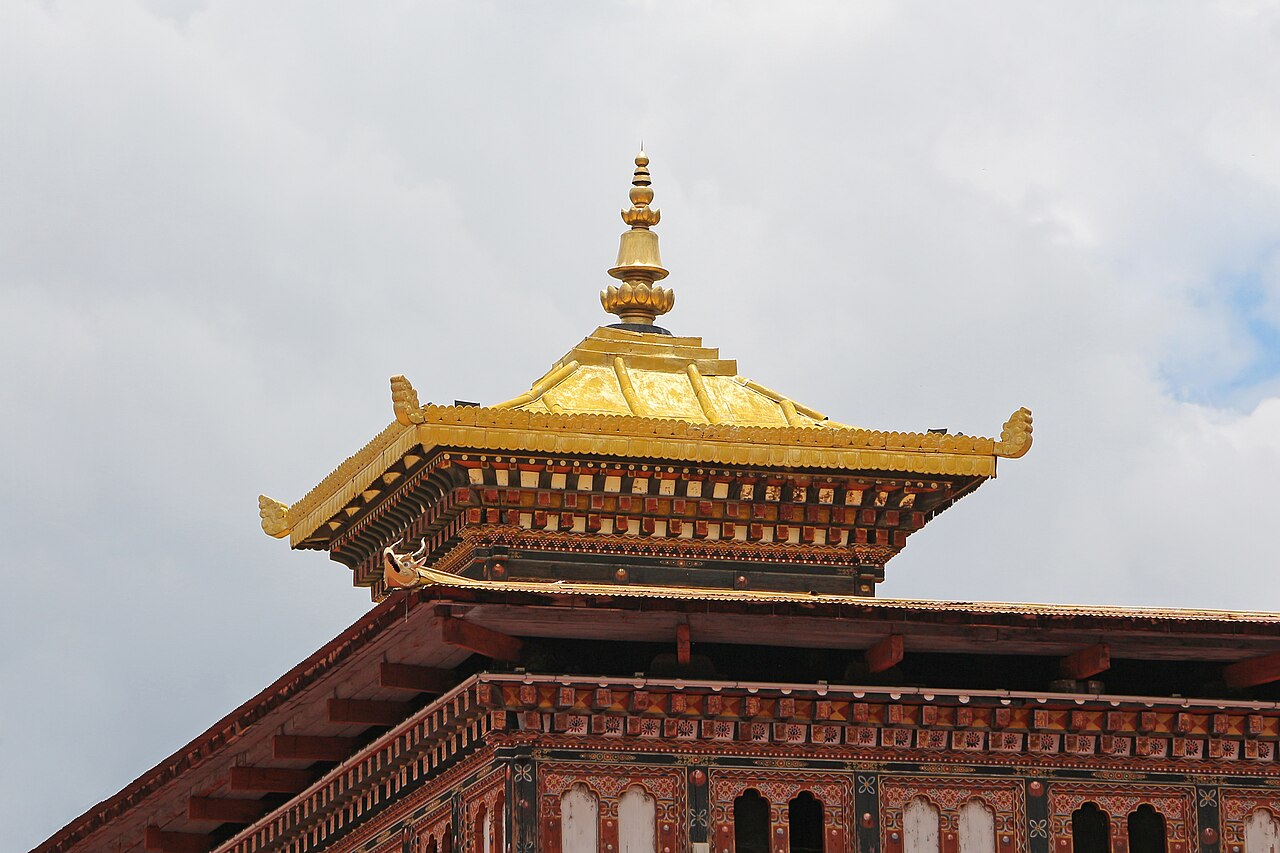

Dzong architecture (Dzongkha: རྫོང་; Wylie: rdzong) refers to the distinctive Bhutanese tradition of constructing massive fortified complexes that house both monastic institutions and district administrative offices. These imposing structures, with their towering whitewashed walls, tapering profiles, and elaborate timber superstructures, are the most recognizable symbols of Bhutanese civilization and represent a building tradition that has remained largely unchanged for more than four centuries.[1]
The word "dzong" translates approximately as "fortress," but this translation understates the multifaceted role these buildings play in Bhutanese life. Every dzong functions simultaneously as a Buddhist monastery, a centre of district government, and a venue for annual religious festivals (tshechu). The dual religious-administrative function is architecturally expressed through the division of the dzong into two wings: the administrative section (the office of the dzongda, or district governor) and the monastic section (housing the district's monk body under a local abbot).[2]
Bhutan's dzongs are built without the use of architectural drawings or nails. The entire construction process relies on inherited knowledge passed from master builders (zorig chusum practitioners) to apprentices, and on timber joinery techniques that interlock beams and columns without metal fasteners — a remarkable engineering achievement given the seismic vulnerability of the Himalayan region.[1]
Historical Origins
While fortified structures existed in the Himalayan region before the 17th century, the dzong as a distinctive Bhutanese architectural form was systematized and standardized by Zhabdrung Ngawang Namgyal (1594–1651), the Tibetan lama who unified Bhutan. Upon his arrival in western Bhutan in 1616, fleeing political persecution in Tibet, the Zhabdrung undertook a vigorous programme of dzong construction. He built or substantially expanded Simtokha Dzong (1629), Punakha Dzong (1637–38), Wangdue Phodrang Dzong (1638), and Trongsa Dzong, among others.[3]
The Zhabdrung's dzong-building programme served both spiritual and strategic purposes. The dzongs functioned as garrisons against Tibetan invasions, as centres for the administration of the nascent Bhutanese state, and as headquarters for the monastic body (dratshang) that the Zhabdrung established as the institutional heart of the new nation. The architectural form itself — massive, imposing, perched on strategic ridges or at river confluences — communicated power and permanence.
Some scholars trace prototypes of the dzong form to earlier Tibetan fortress-monasteries. The Zhabdrung, however, synthesized these precedents into a coherent architectural system that was replicated across Bhutan's twenty districts, creating an architectural uniformity that reinforced political unity.
Construction Materials and Techniques
The primary construction material for dzong walls is rammed earth (pounded layers of clay, gravel, and small stones), sometimes supplemented or replaced entirely by dressed stone masonry. Walls are typically built with a pronounced inward taper (batter), giving dzongs their characteristic trapezoidal profile when viewed from the side. The batter serves both aesthetic and structural purposes, improving the wall's resistance to earthquakes and to the lateral thrust of the massive timber superstructure.[1]
The timber framework above the stone or rammed-earth base is an intricate system of columns, beams, brackets, and cantilevers assembled entirely through joinery — mortise-and-tenon joints, dovetails, and wedges — without nails or metal fasteners. Roofs are constructed with heavy timber trusses and traditionally covered with wooden shingles weighted down with stones, though corrugated metal has replaced shingles on some dzongs in recent decades.
Walls are finished with a lime-and-clay plaster and whitewashed, producing the brilliant white exterior that contrasts dramatically with the red-brown timber bands and the elaborately painted cornices and window surrounds. The whitewash is renewed annually as part of religious observance.
Spatial Layout
A typical dzong is organized around one or more central courtyards (dochey). The largest dzongs, such as Punakha and Trongsa, have multiple courtyards arranged along a linear axis. The courtyard is the heart of the dzong: it is where annual tshechu festivals are performed, where monks gather for prayer, and where ceremonial processions take place.[2]
The dzong is typically divided into two distinct sections. The southern or lower section houses district administrative offices, courtrooms, and storerooms. The northern or upper section contains the monastic quarters, prayer halls, and the central tower (utse), which usually houses the most sacred shrine rooms and the main assembly hall for the monk body. The utse is the tallest structure in the dzong, often rising several stories above the surrounding buildings and serving as the visual and spiritual focal point of the complex.
Access to the dzong is controlled through a single massive entrance gate, approached by a cantilever bridge over a defensive moat or steep gorge. Internal circulation follows a hierarchical logic: public areas near the entrance, administrative rooms in the middle zones, and the most sacred monastic spaces in the innermost and uppermost reaches of the complex.
Decorative Arts
Dzong interiors and exteriors are richly decorated with religious paintings, carved and painted woodwork, and textile hangings. The timber cornices, window frames, and brackets are painted in vivid polychrome patterns featuring lotus petals, cloud motifs, dragon designs, and representations of the Eight Auspicious Symbols of Buddhism. Interior walls of prayer halls bear murals depicting Buddhist deities, mandalas, and scenes from the lives of great masters.[1]
The decorative programme is not merely aesthetic but embodies a cosmological order. The placement of images, the orientation of shrines, and the arrangement of ritual objects within the dzong all follow prescribed religious conventions, making the dzong not simply a building but a three-dimensional mandala — a sacred diagram expressing the Buddhist understanding of the cosmos.
Notable Dzongs
- Punakha Dzong — built in 1637–38 at the confluence of the Pho Chhu and Mo Chhu rivers, the second-oldest and largest dzong in Bhutan, seat of the Je Khenpo during winter
- Tashichho Dzong — the seat of Bhutan's central government and the summer residence of the Central Monastic Body in Thimphu
- Trongsa Dzong — the ancestral seat of the Wangchuck dynasty, commanding a strategic ridge above the Mangde Chhu gorge in central Bhutan
- Paro Dzong (Rinpung Dzong) — one of the finest examples of Bhutanese architecture, housing the district monastic body and administration
- Simtokha Dzong — built in 1629, the oldest dzong in Bhutan, now housing the Institute for Language and Cultural Studies
Conservation and Continuity
Bhutanese dzongs are living structures, continuously occupied and maintained. When damaged by fire or earthquake — a recurrent hazard — they are rebuilt using traditional methods under the supervision of master builders. The reconstruction of Wangdue Phodrang Dzong, which was destroyed by fire in 2012, exemplifies this commitment: the rebuilding has followed traditional techniques, employing rammed earth, timber joinery without nails, and hand-painted decorative work.[4]
The Bhutanese government's building code requires that all new construction in Bhutan incorporate elements of traditional dzong architecture — the trefoil windows, the painted cornices, the whitewashed walls — ensuring that the dzong idiom permeates the entire built environment of the country. This policy, unique in the world, reflects Bhutan's determination to preserve its architectural identity against the pressures of globalization.
References
Related articles
Know something about this topic? Edit this article or . Anonymous contributions welcome — no account required.