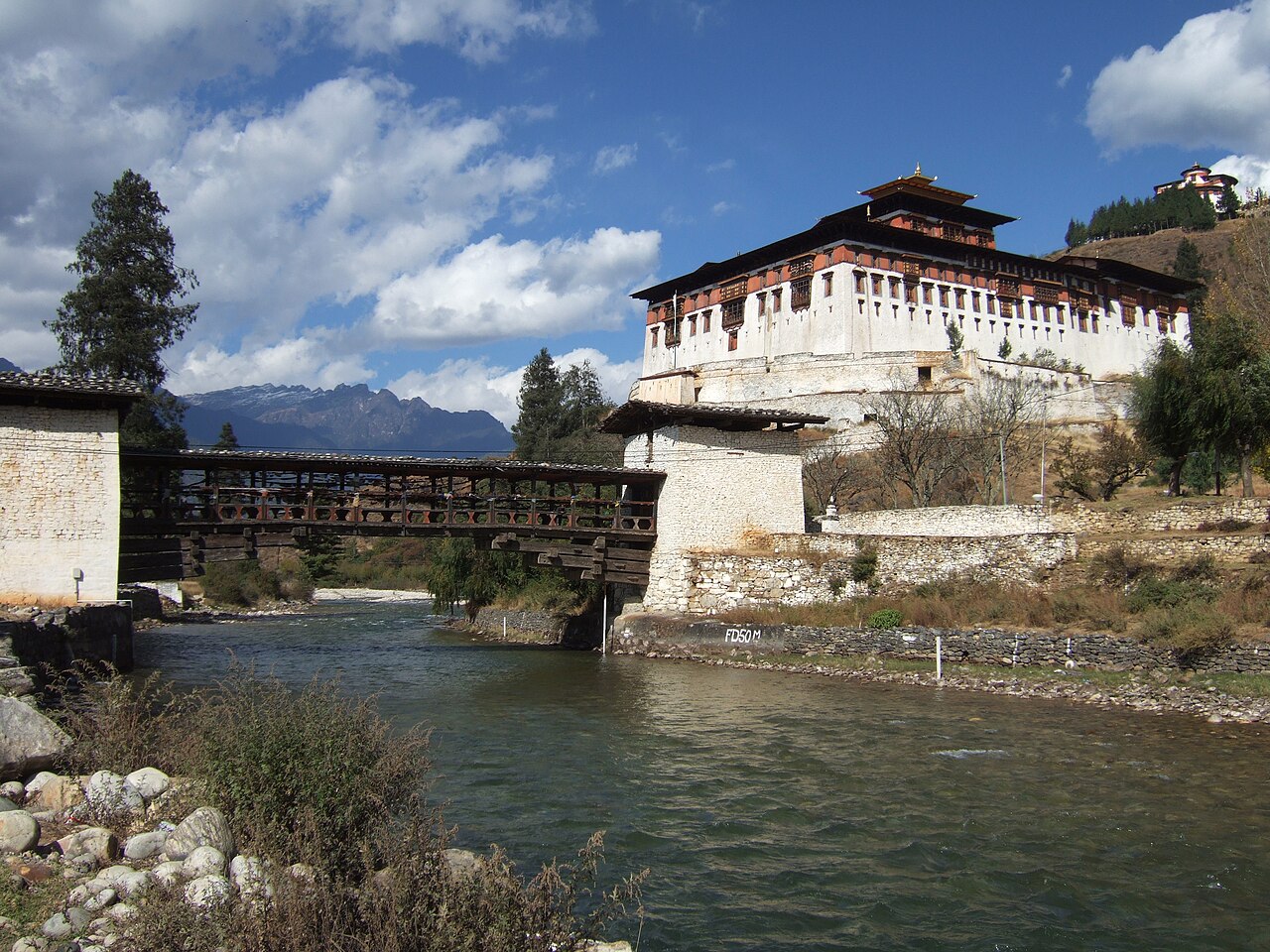

Paro Rinpung Dzong (Dzongkha: རིན་སྤུངས་རྫོང), meaning "Fortress on a Heap of Jewels," is one of the finest examples of Bhutanese dzong architecture. Located in the Paro valley of western Bhutan, it stands on a steep hillside overlooking the Pa Chhu (Paro River) and the surrounding rice terraces. The dzong serves the dual function characteristic of Bhutanese fortress-monasteries: it is both the administrative headquarters of Paro District and the seat of the Paro monastic body.[1]
Built in 1644 by Zhabdrung Ngawang Namgyal, the unifier of Bhutan, the dzong was constructed on the site of a 15th-century monastery. Its name, Rinpung ("Heap of Jewels"), derives from the earlier 15th-century monastery established on the site. The dzong has served as a bulwark of Bhutanese sovereignty, having repelled several Tibetan invasions during the 17th century, and remains one of the country's most revered religious and cultural landmarks.[2]
Paro Rinpung Dzong has featured prominently in international cinema, serving as a location in Bernardo Bertolucci's 1993 film Little Buddha, which introduced its grand architecture to a global audience.
History
The site of Rinpung Dzong has a religious history predating the current fortress. In 1644, Zhabdrung Ngawang Namgyal chose this strategic hilltop above the Paro valley to construct a dzong that would serve as a military stronghold and religious centre. The construction was part of the Zhabdrung's larger programme of dzong-building that unified Bhutan under the Drukpa Kagyu theocracy.[1]
The dzong proved its military value almost immediately. In 1645, a Tibetan army invaded Bhutan in an attempt to capture the Zhabdrung, but was repelled at Paro. Further Tibetan invasions in 1648 and 1649 were likewise turned back. To commemorate these victories, the Zhabdrung commissioned a great thongdrel — a massive applique thangka — which is unfurled annually during the Paro Tshechu.[1]
Fire has been a recurring threat to the dzong. A significant fire in 1907 destroyed portions of the structure, including some of its most precious relics. The dzong was subsequently restored under the patronage of Bhutan's first king, Ugyen Wangchuck. Further restorations were carried out throughout the 20th century to maintain the dzong's architectural integrity.
Architecture
Rinpung Dzong is a massive structure built in the traditional Bhutanese style, using rammed earth walls, timber framing, and stone foundations without the use of nails or architectural plans. The dzong is approached via a traditional covered cantilever bridge, the Nyamai Zam, which spans the Pa Chhu. The original bridge was washed away in a flood and has been replaced by a modern reconstruction that retains the traditional design.[1]
The dzong is divided into two main sections, as is customary in Bhutanese dzong architecture. The northern section houses the monastic quarters and the central utse (tower), while the southern section contains the administrative offices of the Paro district government. The utse rises to five storeys and contains the main chapel and assembly hall for the monastic body.
The interior courtyards are surrounded by galleries with finely carved wooden balconies and window frames. The walls of the chapels are adorned with elaborate murals depicting Buddhist deities, the lives of saints, and mandala diagrams. Fourteen shrines and chapels are contained within the complex, the most important being the shrine to the protective deity Yeshey Goenpo (Mahakala).[2]
Religious Significance
Rinpung Dzong is home to a large community of monks belonging to the Central Monastic Body (Zhung Dratshang). During the winter months, the monastic body migrates from Tashichho Dzong in Thimphu to Punakha Dzong, but the Paro monks remain resident year-round. The dzong houses sacred relics and scriptures, and its chapels are active sites of worship and religious instruction.
The dzong is considered one of the holiest sites in the Drukpa Kagyu tradition. It houses a number of important statues and religious artefacts, including images of Guru Rinpoche (Padmasambhava), Shabdrung Ngawang Namgyal, and the Buddhas of the three times.
Paro Tshechu
The Paro Tshechu, held annually in the spring (March or April), is one of Bhutan's most celebrated religious festivals and takes place in the courtyard of Rinpung Dzong. The festival features sacred mask dances (cham) performed by monks and laypeople over five days. The dances dramatise episodes from Buddhist history and the lives of saints, and are believed to confer blessings on spectators.[3]
The climax of the festival is the unfurling of the great thongdrel — a massive silk applique depicting Guru Rinpoche — in the early hours of the final day. Thousands of Bhutanese and international visitors gather before dawn to witness this event, which is believed to grant liberation through the act of seeing. The thongdrel must be rolled up before the first rays of sunlight touch it.[3]
Current Use
Today, Rinpung Dzong continues to serve its dual purpose as a religious and administrative centre. The district court, the office of the dzongda (district governor), and other government offices operate from the administrative wing. The monastic wing houses approximately 200 monks. The dzong is open to tourists during daylight hours when no religious ceremonies are in progress, and is one of the most visited cultural sites in Bhutan, situated near Paro International Airport.
References
Related articles
Know something about this topic? Edit this article or . Anonymous contributions welcome — no account required.