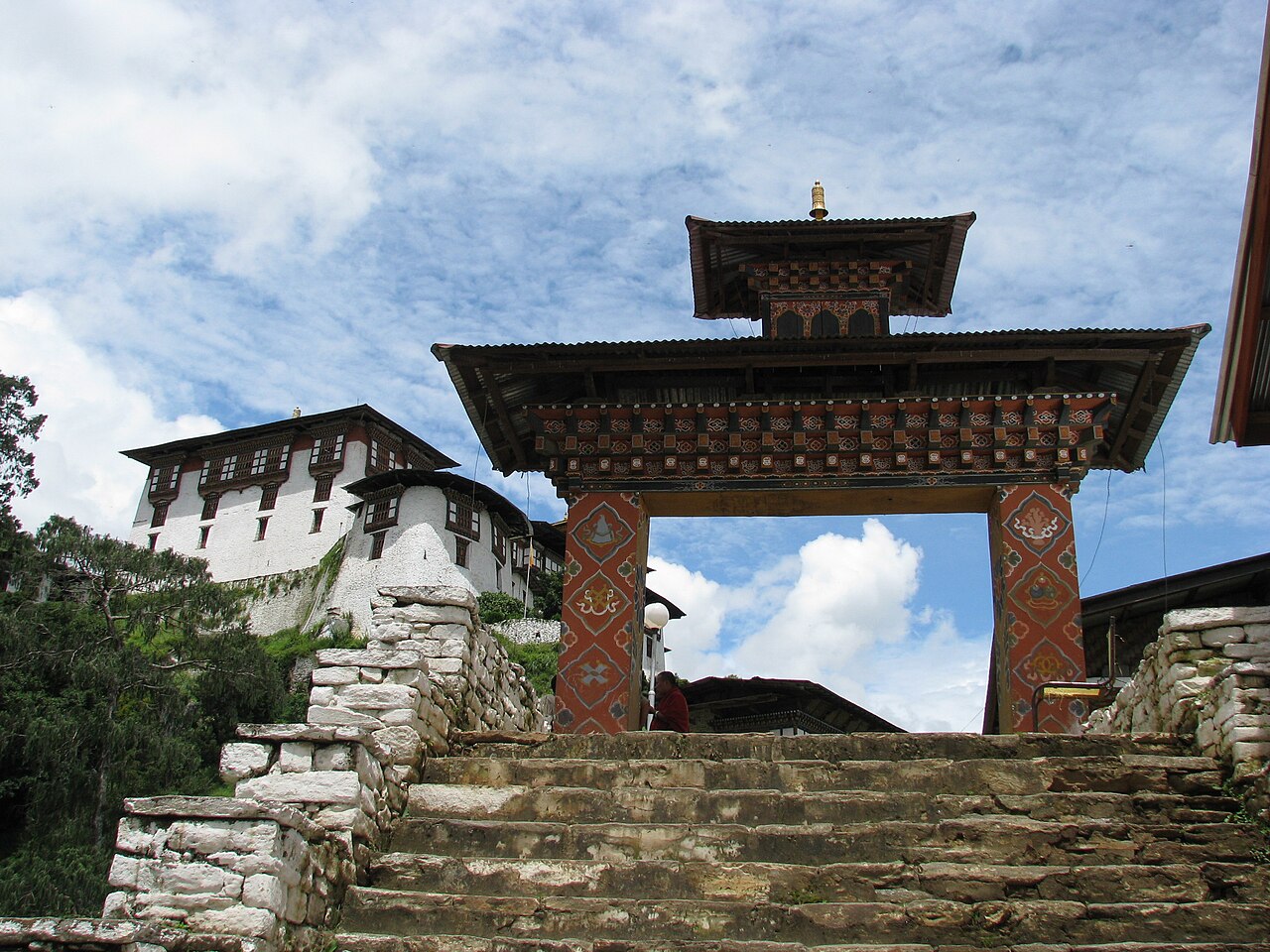

Lhuentse Dzong (Dzongkha: ལྷུན་རྩེ་རྫོང), formally known as Lhundrup Rinchentse Dzong ("Fortress of the Spontaneously Arisen Precious Peak"), is a fortress-monastery perched on a steep rocky outcrop above the Kuri Chhu river in the Kurtoe region of northeastern Bhutan. It serves as the administrative headquarters and principal religious establishment of Lhuentse District, one of the most remote and least visited districts in the country.[1]
The dzong holds a position of exceptional importance in Bhutanese national history. The Kurtoe valley was the ancestral seat of the Dungkar Choeje noble family, from whom the Wangchuck dynasty — Bhutan's reigning royal house since 1907 — descends. Ugyen Wangchuck, the first King of Bhutan, traced his lineage directly to the lords of Kurtoe, making Lhuentse Dzong the symbolic cradle of the Bhutanese monarchy. The dzong remains a site of pilgrimage for Bhutanese citizens who wish to pay respects to the origins of their royal family.[2]
Beyond its royal associations, the Kurtoe region is renowned for producing Bhutan's finest traditional textiles. The intricate Kishuthara silk brocade, woven by the women of the valley, is considered the most prestigious textile art form in the country.
History
The origins of a fortification at the Lhuentse site predate the current structure. The earliest dzong on the site is attributed to the 17th century, during the period when Zhabdrung Ngawang Namgyal was extending the dzong system across Bhutan to consolidate administrative and religious control over the diverse regions of the country. However, the Kurtoe valley had been a centre of power long before the dzong was constructed. The local Dungkar Choeje family had governed the region for generations, maintaining authority through a network of alliances and religious patronage.[1]
The dzong's history is closely intertwined with the rise of the Wangchuck family. In the 19th century, Jigme Namgyal — the father of Ugyen Wangchuck — served as Penlop (governor) of Trongsa and was the dominant political figure in Bhutan. His family's roots in Kurtoe gave him a power base in the east that complemented his control of the central Trongsa region. When Ugyen Wangchuck was elected as the first hereditary king of Bhutan in 1907, the Kurtoe connection transformed Lhuentse Dzong from a regional administrative centre into a site of dynastic significance.[3]
The dzong was damaged by fire on multiple occasions and rebuilt each time, most recently in the 20th century. Earthquakes, particularly the 2009 earthquake that affected eastern Bhutan, have also caused damage requiring repairs.
Architecture
Lhuentse Dzong occupies one of the most dramatic settings of any Bhutanese dzong. The fortress sits atop a narrow rocky promontory that juts out above the confluence of the Kuri Chhu and a tributary stream, with sheer drops on three sides. The natural defensive advantages of the site are formidable — an attacking force would have to advance uphill along a single exposed approach, making the dzong virtually impregnable to assault by conventional pre-modern forces.[1]
The dzong follows the traditional Bhutanese architectural pattern of separate administrative and monastic sections, connected by a central tower (utse). The administrative wing houses the offices of the Dzongdag (district administrator) and the Lhuentse District administration. The monastic wing serves as the residence for the district's central monastic body, which maintains a community of monks who perform daily rituals and annual religious festivals.
The construction employs the characteristic Bhutanese techniques of rammed earth walls, timber framing, and elaborately decorated wood-carved windows and cornices. The whitewashed walls and the red-ochre band running below the roofline identify the structure as housing both secular and religious authority, following the colour conventions established across the dzong system.
Religious and Cultural Significance
Lhuentse Dzong houses several important chapels and shrines. The principal temple contains images of Guru Rinpoche (Padmasambhava), the historical Buddha Shakyamuni, and Zhabdrung Ngawang Namgyal. The dzong serves as the venue for the annual Lhuentse tshechu, a religious festival featuring masked dances (cham) that depict episodes from Buddhist mythology and the lives of great masters. The tshechu draws participants from across the remote Kurtoe valley and surrounding areas.[4]
The Kurtoe region surrounding the dzong is Bhutan's principal centre of traditional textile production. The Kishuthara, a complex silk brocade textile woven on backstrap looms, is the most highly prized fabric in Bhutanese culture and is traditionally worn by women of the highest social standing. The art form is passed down through generations of weavers in the villages surrounding Lhuentse Dzong, and efforts are underway to ensure its preservation as younger generations increasingly migrate to urban centres.[2]
The dzong's association with the royal family gives it a quasi-sacred status in the national consciousness. Members of the royal family periodically visit the Kurtoe valley to honour their ancestral origins, and these visits are occasions of great celebration in the local community.
Current Status
Lhuentse Dzong continues to function as the administrative and religious centre of Lhuentse District. The district remains one of Bhutan's most remote, accessible primarily by a winding mountain road from Mongar that traverses several high passes. This remoteness has helped preserve both the dzong and the surrounding cultural landscape in a relatively traditional state, though it has also contributed to rural depopulation as younger residents seek opportunities in more connected parts of the country.
The Bhutanese government has invested in infrastructure improvements to the Lhuentse area, including road upgrades and plans for a domestic airport, which would make the dzong and its surroundings more accessible to both Bhutanese citizens and international visitors. Conservation work on the dzong itself is ongoing, with periodic repairs necessitated by the harsh climate and seismic activity of the region.
See also
References
- Lhuntse Dzong, Wikipedia
- Lhuntse District, Wikipedia
- Ugyen Wangchuck, Wikipedia
- Lhuntse Dzong, Bhutan Visit
Related articles
Know something about this topic? Edit this article or . Anonymous contributions welcome — no account required.