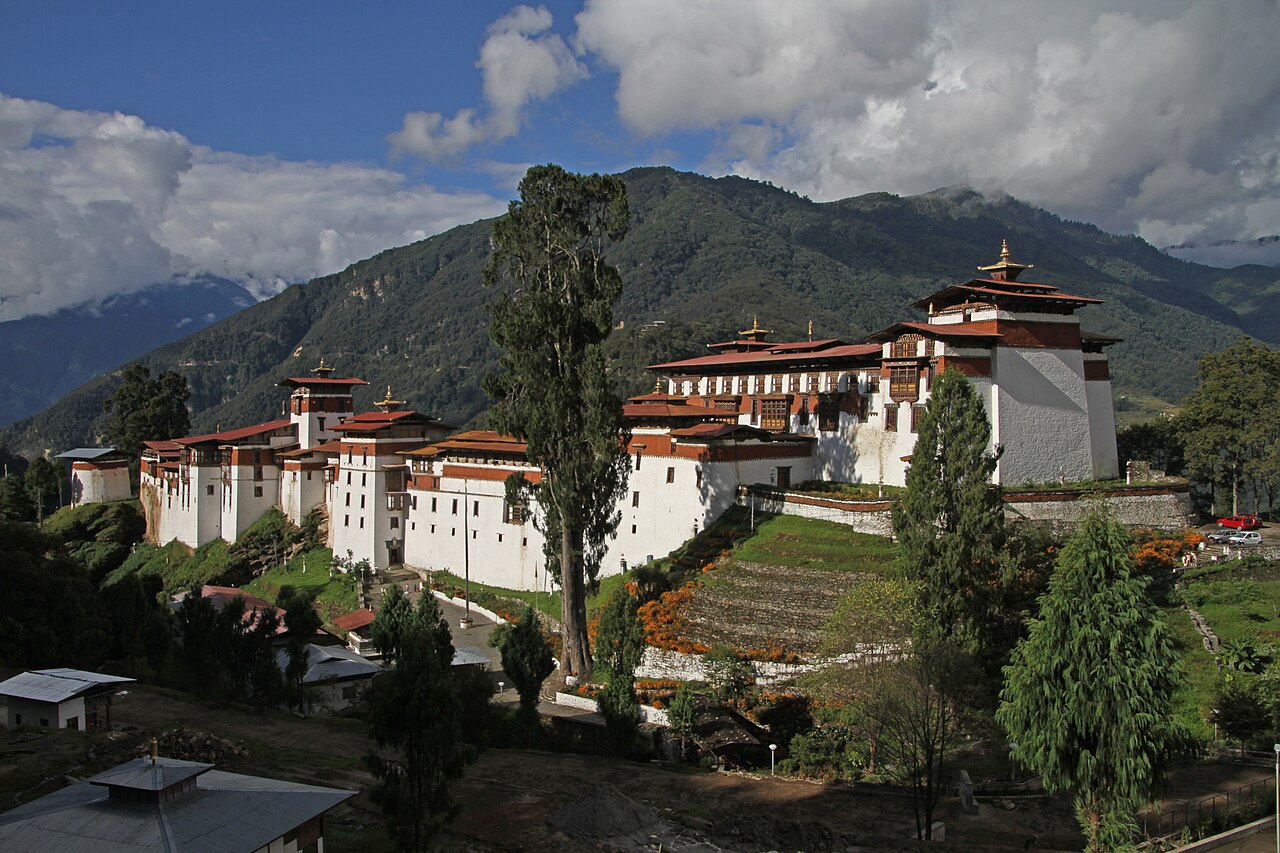

Trongsa Dzong (Dzongkha: ཀྲོང་གསར་རྫོང), officially known as Chokhor Rabtentse Dzong, is the largest and most strategically significant dzong in Bhutan. Perched on a spur overlooking the deep gorge of the Mangde Chhu river in central Bhutan, it commands the only route connecting eastern and western Bhutan. This geographical dominance made whoever held Trongsa the de facto ruler of the entire country, and it was from this fortress that the Wangchuck dynasty rose to establish Bhutan's monarchy in 1907.[1]
The dzong is a sprawling complex of corridors, courtyards, temples, and administrative offices that cascades down the ridge in a series of levels. Its labyrinthine layout reflects centuries of successive additions and renovations, giving it an organic quality that distinguishes it from the more symmetrically planned dzongs of western Bhutan. Trongsa Dzong remains the administrative centre of Trongsa District and houses a significant monastic community.[1]
By royal tradition, every Crown Prince of Bhutan must serve as the Trongsa Penlop (governor of Trongsa) before ascending to the Golden Throne, a custom that underscores the dzong's enduring significance in Bhutanese political life.
History
The religious history of the site dates to 1543, when a small temple was built by the Drukpa lama Ngagi Wangchuk, the great-grandfather of Zhabdrung Ngawang Namgyal. According to tradition, Ngagi Wangchuk was meditating at the site when he heard the sound of a conch shell emanating from the earth, an auspicious sign that inspired him to establish a temple there.[1]
The dzong in its present form was begun in 1644 by Chogyal Minjur Tenpa, the first Trongsa Penlop, who was appointed by Zhabdrung Ngawang Namgyal. The Zhabdrung recognised the site's strategic importance: anyone controlling this point could effectively block movement between eastern and western Bhutan. The dzong was expanded significantly over the following centuries, with each successive Trongsa Penlop adding new structures.[1]
In the late 19th century, Jigme Namgyal, the father of Bhutan's first king, consolidated his power as Trongsa Penlop and used the dzong as his seat of authority. His son, Ugyen Wangchuck, inherited the position and from Trongsa defeated rival penlops in the civil wars that had fragmented the country. In 1907, Ugyen Wangchuck was unanimously elected as the first hereditary King of Bhutan, founding the Wangchuck dynasty with Trongsa Dzong as its spiritual and political origin.[2]
Architecture
Trongsa Dzong is an imposing structure that stretches along a narrow ridge, its multiple levels following the contours of the terrain. The dzong contains over 25 temples and shrines, connected by a maze of corridors, covered walkways, and staircases. The central utse (tower) is the oldest section, built around the original 16th-century temple, and houses the most sacred chapels.[1]
The dzong is divided into the traditional northern monastic and southern administrative sections, though the complex and uneven terrain has created a far more intricate layout than is typical. The walls are constructed of rammed earth, up to two metres thick in places, and whitewashed in the traditional manner. Massive timber beams and intricately carved wooden elements adorn the windows, balconies, and doorframes.
A notable feature is the ta dzong (watchtower), built on the hill above the main dzong. This cylindrical tower, constructed in 1652, was designed to defend the dzong from attack. In 2008, the ta dzong was converted into the Royal Heritage Museum, which showcases the history of the Wangchuck dynasty and Bhutanese cultural heritage.
Religious Significance
Trongsa Dzong houses a substantial monastic community and contains numerous sacred relics. The most important chapel is the Maitreya Temple, which holds a large statue of the future Buddha. The dzong also contains shrines to Guru Rinpoche, Chenrezig (Avalokiteshvara), and the protective deities of the Drukpa Kagyu lineage.
The dzong is particularly revered for its association with the Zhabdrung's mission to unify Bhutan under the Drukpa Kagyu tradition. Several of the chapels contain mural cycles depicting the life of the Zhabdrung and the history of the Drukpa lineage in Bhutan.
Trongsa Tshechu
The Trongsa Tshechu, held annually in December or January, is a major religious festival celebrated in the dzong's courtyard. The three-day festival features sacred mask dances performed by monks, including the Dance of the Black Hats (Shanag Cham), the Dance of the Terrifying Deities, and the Dance of the Stags and Hounds. The festival attracts large crowds from across central Bhutan and is considered an important occasion for spiritual merit-making.[3]
Current Use
Trongsa Dzong continues to function as the administrative headquarters of Trongsa District. The dzongda's office, the district court, and various government departments operate from the administrative wing. The monastic wing remains active with a resident community of monks. The ta dzong above the dzong operates as the Royal Heritage Museum, a major cultural attraction in central Bhutan. The dzong is a popular stop for travellers journeying between western and eastern Bhutan along the national east-west highway.
References
Related articles
Know something about this topic? Edit this article or . Anonymous contributions welcome — no account required.