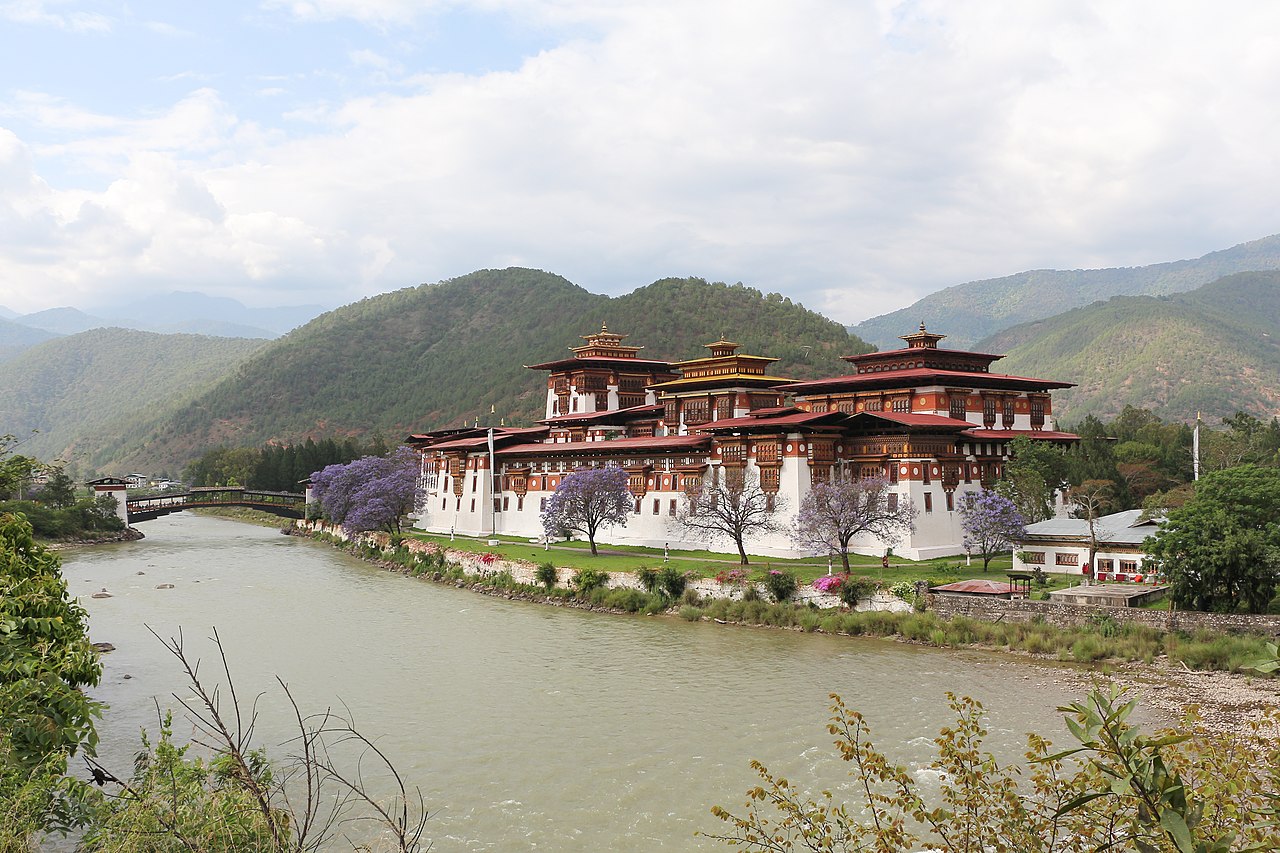

Punakha Dzong (Dzongkha: སྤུ་ན་ཁ་རྫོང), formally Pungtang Dechen Photrang Dzong — "the palace of great happiness" or "great bliss" — is the second oldest and second largest dzong in Bhutan. It stands on a spit of land at the confluence of the Mo Chhu ("mother river") and Pho Chhu ("father river") in the Punakha valley of western Bhutan, at about 1,200 metres elevation. Built in 1637–38 by Zhabdrung Ngawang Namgyal, the unifier of the Bhutanese state, the dzong was the country's administrative capital for more than three centuries, until the seat of government moved to Tashichho Dzong in Thimphu in 1955.[1]
Punakha Dzong houses the embalmed body of the Zhabdrung and the Rangjung Kharsapani, a self-arisen image of Avalokiteshvara that he carried from Tibet in 1616. These are among the most sacred objects in the Drukpa Kagyu tradition, and their presence makes the dzong the spiritual centre of the Bhutanese state. The central monastic body (Zhung Dratshang), headed by the Je Khenpo, migrates from Thimphu to Punakha each winter in a custom that dates to the 17th century.[2]
Every Druk Gyalpo has been invested at Punakha Dzong. Ugyen Wangchuck was enthroned as the first king on 17 December 1907, and Jigme Khesar Namgyel Wangchuck received the Raven Crown in a sacred ceremony in the dzong's innermost courtyard on 1 November 2008. On 13 October 2011 the same king married Jetsun Pema in the dzong, a ceremony watched by large crowds on the riverbanks and broadcast internationally.[3]
Name and setting
The full name Pungtang Dechen Photrang Dzong translates as "the palace of great bliss on the heaped jewel." The site is linked to a prophecy attributed to Guru Rinpoche, which held that a man named Namgyel would build a fortress on a hill shaped like an elephant's trunk. The tongue of land where the Mo Chhu and Pho Chhu meet answers that description closely, and the Zhabdrung identified it as the intended site. The confluence of two rivers also carries specific meaning in Buddhist cosmology, where it is taken to concentrate auspicious energy.[1]
The Punakha valley lies about 77 kilometres northeast of Thimphu by road, reached via the Dochula pass. Its lower elevation keeps it warm through the winter, and the surrounding fields have long been among Bhutan's most productive rice country. The dzong sits below the old Punakha town and forms the visual focus of the Punakha district.
Founding and construction
Work began in 1637 and the main structure was complete by 1638, making Punakha the second dzong built by the Zhabdrung after Simtokha Dzong near Thimphu. Bhutanese tradition names the architect as Zowe Palep, whose design is said to have come to him in a dream after the Zhabdrung instructed him to sleep under a small statue of the Buddha on the site. The dzong was consecrated under the name Pungtang Dechen Photrang.[1]
Construction used the indigenous techniques that define Bhutanese fortress architecture: rammed-earth and stone walls tapered toward the top, whitewashed and finished with a red-brown kemar band beneath the eaves; timber frames assembled without iron nails; and internal galleries arranged around open courtyards. The utse or central tower rises six storeys, the tallest point in the complex. A covered cantilever bridge (bazam) was thrown across the Mo Chhu to provide the sole formal approach. Destroyed and rebuilt several times, the current bridge reproduces the traditional form.
In 1639 a commemorative chapel was added to house arms and armour captured from Tibetan troops defeated near the dzong. Over the following decades the Zhabdrung's forces repelled further invasions in 1644, 1648 and 1657, several of which were fought at or near Punakha. The narrow site between the two rivers made the dzong naturally defensible — attackers could approach only across the bridge, which could be cut or burned in an emergency.[1]
The dzong incorporated a smaller pre-existing structure, the Dzongchung ("small dzong"), at its northern end. Tradition holds that the Dzongchung was built earlier in the 17th century by Ngagi Wangchuk, an ancestor of the Zhabdrung, to house an image of the Buddha; the larger fortress grew up around it. The Dzongchung was severely damaged in the 1994 glacial lake outburst flood and rebuilt as part of the subsequent restoration.
Historical role
Punakha served as Bhutan's administrative capital and as the winter seat of government from 1637 until 1955, when the administration moved permanently to Tashichho Dzong in Thimphu.[1] Under the dual system of governance established by the Zhabdrung, it housed both the Druk Desi — the secular regent — and the Je Khenpo during the winter months. Important state councils, treaty signings and religious ceremonies were held in its courtyards.
The dzong was the site of the 1907 assembly at which representatives of the monastic body, the civil government and the people signed the Genja, the document electing Ugyen Wangchuck as hereditary king and formally ending the dual system. The transition from theocracy to monarchy thus took place in the same courtyards that had symbolised the Zhabdrung's authority for nearly three centuries. Every subsequent coronation has followed that precedent.
The 1955 transfer of the seat of government to Thimphu was driven by practical considerations rather than any diminution of Punakha's symbolic role. Thimphu sat closer to the main routes south to India, was at a higher elevation suited to year-round administration, and offered more land for the expansion of government buildings. The third king, Jigme Dorji Wangchuck, formalised the move during his modernisation programme. Punakha remained the winter seat of the Zhung Dratshang and the country's principal ceremonial site, and continues to host the most consequential acts of state.
Architecture
Punakha Dzong measures roughly 180 metres by 72 metres, making it one of the largest fortress-monasteries in the country.[1] It is organised around three courtyards (dochey). The first and largest is the administrative courtyard, housing the offices of the Punakha dzongkhag administration. The second is the monastic courtyard, enclosing the monks' quarters and dominated by a tall bodhi tree. The third and innermost is the sacred courtyard, containing the main temple, the Machey Lhakhang and several smaller chapels.
The utse rises between the first and second courtyards and is the focal point of the complex, its gilded roof visible from a distance. The main assembly hall (kuenrey) is supported by massive wooden columns, some carved from single trees more than a metre across. Its interior walls carry murals of the life of the Buddha, the eight manifestations of Guru Rinpoche and the protector deities of the Drukpa Kagyu lineage, and its altars hold large gilded images of Shakyamuni Buddha, Guru Rinpoche and the Zhabdrung.
Sacred relics and religious significance
The most important chapel in the dzong is the Machey Lhakhang, the "sacred relic temple" in the innermost courtyard. It holds the embalmed body of Zhabdrung Ngawang Namgyal, who died at Punakha around 1651. The Zhabdrung's death was concealed for more than fifty years to prevent political collapse and Tibetan invasion, with officials maintaining that he remained in extended meditation retreat (thugdam). The sealed chamber containing his remains — the machey — may be opened only by the Je Khenpo and the King, and is closed to the public.[1]
Also preserved at Punakha is the Rangjung Kharsapani, the self-arisen image of Avalokiteshvara that the Zhabdrung brought from Tibet in 1616 and that formed a casus belli for several of the early Tibetan invasions. Bhutanese tradition also places the remains of the 15th-century treasure-revealer Pema Lingpa within the dzong's innermost sanctum. The combined presence of these relics is the reason the Zhung Dratshang continues to winter at Punakha, and the reason the dzong is considered the spiritual heart of the country.
Royal ceremonies
Punakha Dzong has hosted every Bhutanese coronation. Ugyen Wangchuck was enthroned on 17 December 1907. Jigme Wangchuck was invested as the second king in 1927, Jigme Dorji Wangchuck as the third in 1952, and Jigme Singye Wangchuck as the fourth in 1974. The sacred coronation of Jigme Khesar Namgyel Wangchuck, the fifth king, took place in the innermost courtyard of Punakha Dzong on 1 November 2008, with the public coronation celebrations following at Tashichho Dzong and Changlimithang Stadium in Thimphu on 6 November.[3]
On 13 October 2011 the same king married Jetsun Pema at Punakha Dzong in a religious ceremony that was followed by public celebrations in Thimphu and Paro. The choice of Punakha for the wedding underlined the dzong's status as the site where royal legitimacy is renewed and publicly confirmed. The wedding was the first royal marriage in Bhutan to be broadcast live and drew large crowds along the Mo Chhu and across the cantilever bridge.
Winter migration of the monastic body
Each autumn the central monastic body — the Je Khenpo and several hundred monks of the Zhung Dratshang — migrates from Tashichho Dzong in Thimphu to Punakha for the winter, returning in late spring. The custom dates to the establishment of the dual system in the 17th century and reflects the practical fact that Punakha, at around 1,200 metres, is significantly warmer than Thimphu at 2,300 metres. The migration is led by a formal procession in which the most sacred objects of the Drukpa Kagyu lineage are carried between the two dzongs, and is one of the more visible expressions of the institutional continuity that links contemporary Bhutan to the Zhabdrung's foundation.
Festivals
Two major religious festivals are held at Punakha Dzong each year. The Punakha Drubchen, held in February or March, includes an elaborate dramatic re-enactment of the 17th-century Bhutanese victory over Tibetan invaders, with costumed pazaps (local militia) performing the roles of the Zhabdrung's defenders. It is one of the few religious festivals in Bhutan that preserves this kind of historical reconstruction. The Punakha Tshechu follows immediately afterwards over three days and features the mask dances (cham) performed at tshechus throughout Bhutan, culminating in the unfurling of a giant thongdrel appliqué depicting Guru Rinpoche.
Fires, earthquakes and floods
The dzong's position at the river confluence, which gave it military value, has also made it repeatedly vulnerable. It has been damaged or partly destroyed by fire on at least six recorded occasions — in 1780, 1789, 1802, 1831, 1849 and 1986 — with the 1986 fire gutting the residence of the Je Khenpo and destroying much of the carved woodwork in the utse.[1] The Assam earthquake of 12 June 1897 cracked walls and collapsed sections of the upper storeys, and further damage was caused by floods in 1957 and 1960.
The most destructive event in the dzong's modern history was the glacial lake outburst flood (GLOF) that descended the Pho Chhu on 7 October 1994, when the moraine dam of Luggye Tsho in the Lunana region partially collapsed. The flood released around 18 million cubic metres of water and debris, which reached Punakha, about 90 to 100 kilometres downstream, in approximately seven hours. It killed 21 people in the catchment, damaged around 90 houses, destroyed more than 1,700 acres of farmland and pasture, and undermined the foundations of the dzong, damaging the Dzongchung and the northern section of the complex.[4]
A long programme of restoration followed. Reconstruction of the utse and monastic quarters, begun after the 1986 fire, reportedly employed 60 carpenters, 30 wood carvers and 500 labourers working with traditional nail-free joinery. Post-GLOF works, funded with substantial Indian assistance through the 1990s and 2000s, reinforced the foundations, raised the river embankments and rebuilt the cantilever bridge. A rabney consecration ceremony held in May 2004 marked the completion of the main phase of restoration. Upstream, Bhutan's Department of Geology and Mines has partially drained Thorthormi Tsho to reduce the risk of further GLOFs, and monitoring stations now track conditions on the most hazardous glacial lakes.
Cultural and tourism significance
Punakha Dzong is one of the most photographed buildings in Bhutan, framed in spring by the purple blossom of jacaranda trees along the riverbanks. It features on Bhutan's tentative list for UNESCO World Heritage inscription as part of a serial nomination of five dzongs — Punakha, Wangdue Phodrang, Paro, Trongsa and Dagana — representing "the centres of temporal and religious authorities."[2] The dzong is open to foreign visitors year-round, although access to the inner courtyards is restricted during the winter, when the monastic body is in residence, and the Machey Lhakhang itself is closed to the public at all times.
See also
- Punakha District
- Punakha Town
- Zhabdrung Ngawang Namgyal
- Tashichho Dzong
- Dzong architecture
- Punakha Tshechu
- Punakha Drubchen
- Climate of Bhutan (glacial lake outburst floods)
References
- "Punakha Dzong", Wikipedia.
- "Dzongs: the centre of temporal and religious authorities", UNESCO World Heritage Centre — Tentative Lists.
- "Jigme Khesar Namgyel Wangchuck", Wikipedia.
- Watanabe, T. & Rothacher, D., "The 1994 Lugge Tsho glacial lake outburst flood, Bhutan Himalaya", Mountain Research and Development.
- "Dzongs: the centre of temporal and religious authorities (Punakha, Wangdue Phodrang, Paro, Trongsa and Dagana)", UNESCO World Heritage Centre — Tentative Lists (alternate entry).
- "Punakha Dzong, the Palace of Great Bliss on the Heaped Jewel", Bhutan Pilgrimage.
Related articles
Know something about this topic? Edit this article or . Anonymous contributions welcome — no account required.