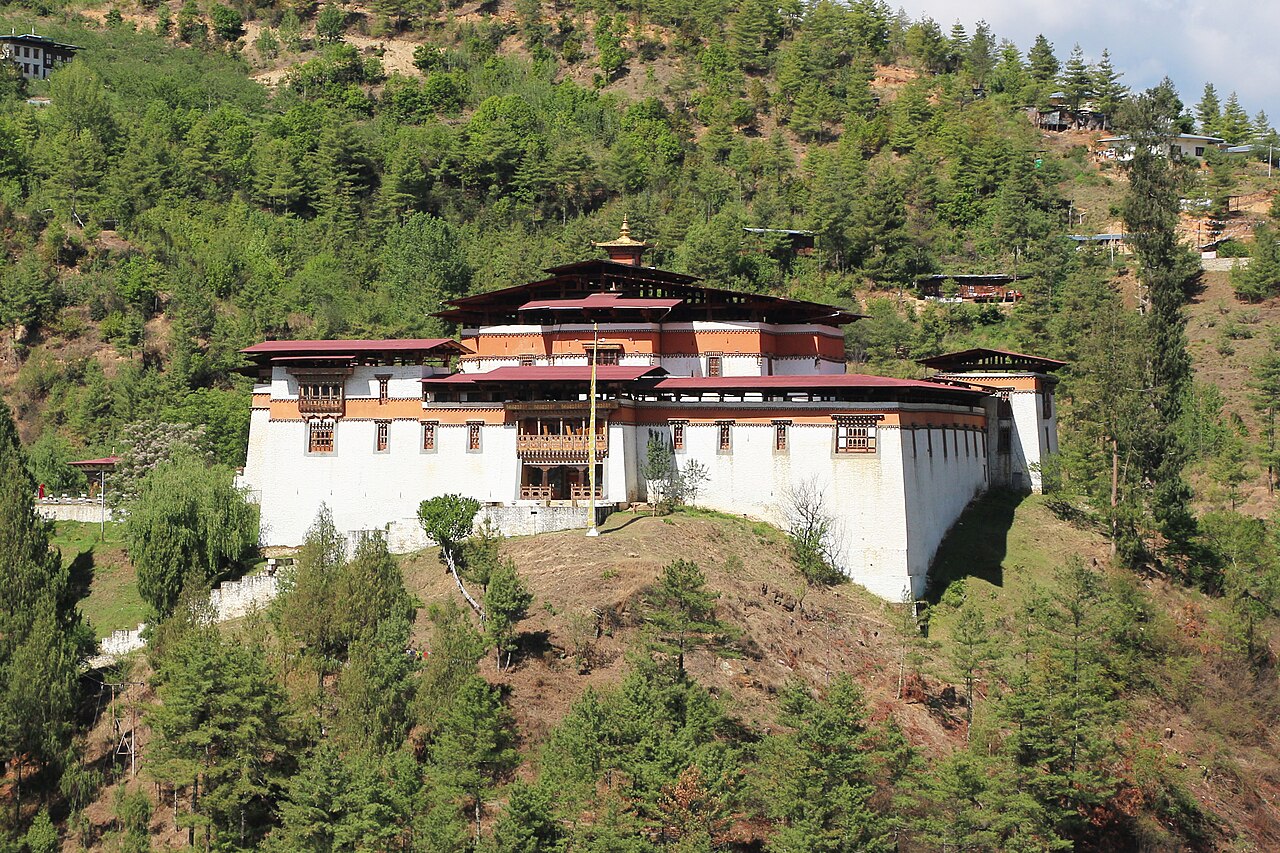

Simtokha Dzong (Dzongkha: ཟིམ་སྟོད་ཁ་རྫོང), officially known as Sanga Zabdhon Phodrang ("Palace of the Profound Meaning of Secret Mantras"), is the oldest surviving dzong in Bhutan. Located approximately five kilometres south of Thimphu at a strategic crossroads where the roads to the Paro, Thimphu, and Punakha valleys converge, it was built in 1629 by Zhabdrung Ngawang Namgyal as the first of the fortified monasteries that would serve as the foundation of his unified Bhutanese state.[1]
The dzong is significant not only as an architectural prototype but as a symbol of the Zhabdrung's determination to establish the Drukpa Kagyu school as the dominant religious and political force in Bhutan. It withstood multiple attacks in its early years and served as a model for the larger dzongs that followed at Punakha, Wangdue Phodrang, and Tashichho. Today, Simtokha Dzong houses the Institute for Language and Cultural Studies (formerly the Rigney School), one of Bhutan's foremost centres for the study of Dzongkha and traditional culture.[1]
History
Construction and Early Attacks
When Zhabdrung Ngawang Namgyal arrived in western Bhutan in 1616, having fled Tibet due to a dispute over the reincarnation lineage of the Drukpa Kagyu, he found the region fragmented among competing religious schools and local chiefs. To consolidate his authority, the Zhabdrung embarked on a programme of dzong construction that combined religious, military, and administrative functions into single imposing structures.[1]
Simtokha Dzong was the first of these, begun in 1629. The name "Simtokha" is traditionally explained as deriving from a demon (simmo) said to have haunted the hilltop; the Zhabdrung is said to have subdued the demon and buried it beneath the dzong. The site was chosen for its strategic position at the junction of three valleys, enabling the Zhabdrung to monitor and control movement across western Bhutan.
The dzong was attacked almost immediately after its completion. In 1630, a coalition of five lamas from rival religious factions — including the Lhapa Kagyu and adherents of other lineages who resented the Zhabdrung's growing power — launched an assault on Simtokha. The attack was repelled, but the dzong sustained damage. A second attack by Tibetan forces in 1634 also failed, confirming the dzong's military viability and the Zhabdrung's ability to defend his position.[1]
Later History
With the construction of larger dzongs at Punakha (1637-38) and Tashichho, Simtokha's strategic and administrative importance gradually diminished. However, it remained an active religious site and was maintained by the monastic body. The dzong was damaged by fire in 1630, 1678, and again in the 19th century, but each time it was restored.
In 1961, Bhutan's third king, Jigme Dorji Wangchuck, established the Rigney School at Simtokha Dzong — a school dedicated to the study of traditional Bhutanese religion, culture, and the Dzongkha language. This institution, later renamed the Institute for Language and Cultural Studies, gave the old dzong a new purpose and helped ensure its preservation.
Architecture
Simtokha Dzong is considerably smaller than the later dzongs it inspired, but it established the architectural template that would be refined in subsequent constructions. The dzong is built around a central utse (tower), which rises three storeys and contains the main chapel. A courtyard surrounds the utse, enclosed by a ring of buildings housing monks' quarters, classrooms, and administrative rooms.[1]
The dzong is renowned for its exceptional slate carvings. Over 300 carved slate plaques are set into the exterior walls, depicting saints, deities, and philosophical symbols from the Buddhist tradition. These carvings are considered among the finest examples of medieval Bhutanese stone art and are a major reason for the dzong's cultural importance.[2]
The interior murals, while damaged and restored over the centuries, include some of the oldest surviving painted scenes in Bhutan. The main chapel houses a statue of Shakyamuni Buddha and wall paintings depicting the life of the Zhabdrung and the protective deities of the Drukpa lineage.
Religious Significance
As the first dzong built by the Zhabdrung, Simtokha holds a special place in the Drukpa Kagyu tradition. The Zhabdrung conceived the dzong system as a means of combining religious and secular authority — a uniquely Bhutanese innovation that distinguished the country's governance from the purely monastic or purely secular models found elsewhere in the Himalayan world. Simtokha was the prototype of this dual system, which would define Bhutanese statehood for centuries.
The dzong's main chapel contains images of Guru Rinpoche and the Zhabdrung, and the monastic body at Simtokha has maintained an unbroken tradition of prayer and study since the 17th century. The dzong is also associated with the subjugation of the demon simmo, making it a site of spiritual power in popular Bhutanese belief.
Current Use
Today, Simtokha Dzong serves primarily as the home of the Institute for Language and Cultural Studies, a government-run institution where students study Dzongkha, classical Tibetan, Buddhist philosophy, astrology, and traditional arts. The institute plays a vital role in preserving Bhutanese linguistic and cultural heritage. The monastic wing continues to house a small community of monks. The dzong is open to visitors and is a popular cultural site due to its proximity to Thimphu and its historical importance as the birthplace of the dzong tradition.[1]
References
Related articles
Know something about this topic? Edit this article or . Anonymous contributions welcome — no account required.