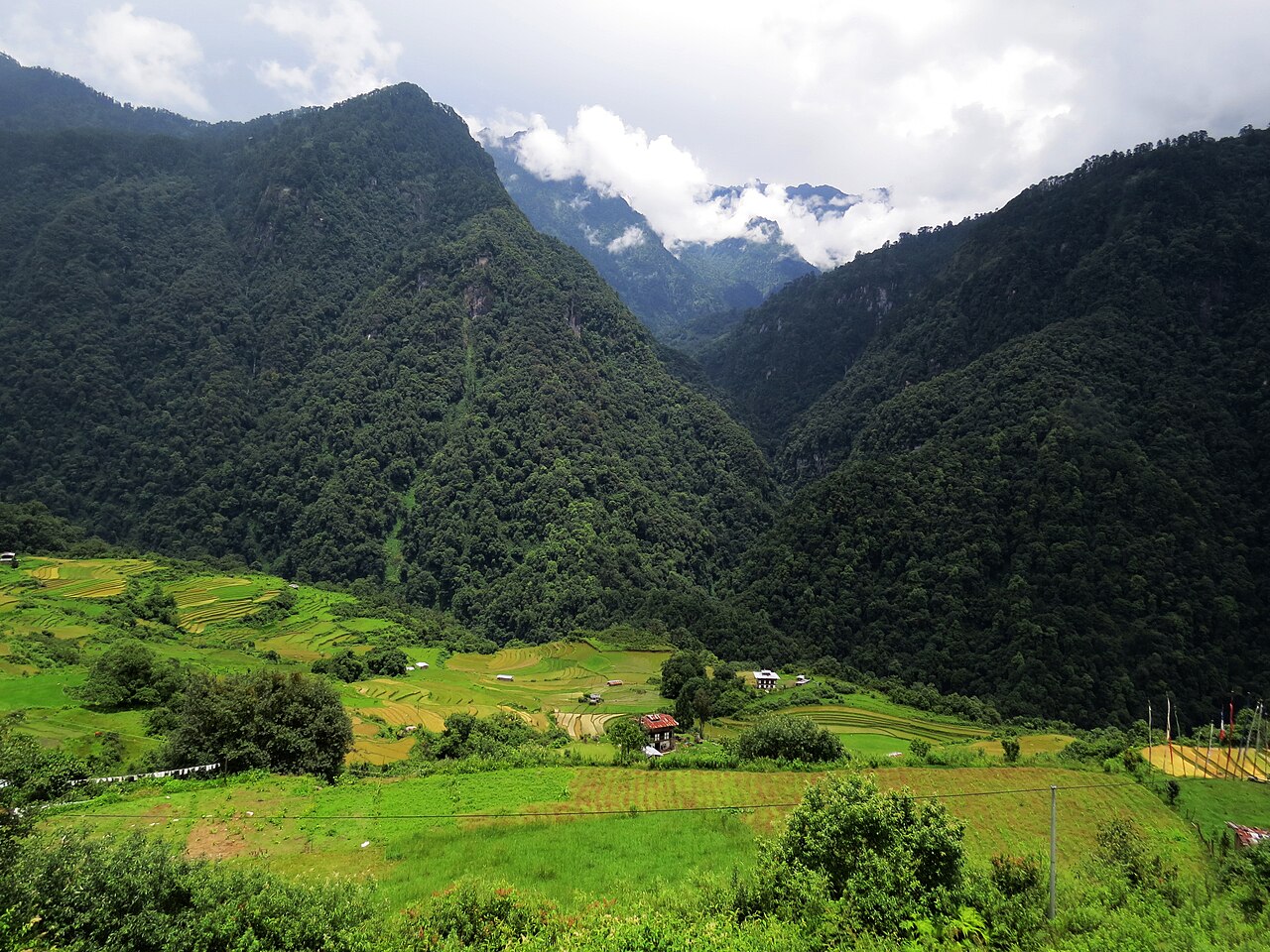

Bhutan, a small landlocked kingdom in the eastern Himalayas, possesses one of the richest concentrations of biological diversity on Earth relative to its size. Spanning a dramatic elevational gradient from approximately 150 metres in the subtropical southern foothills to over 7,500 metres at the summit of Gangkhar Puensum, Bhutan encompasses an extraordinary range of ecological zones within its 38,394 square kilometres. The country lies within the Eastern Himalaya biodiversity hotspot, recognised by Conservation International as one of 36 global hotspots for their exceptional concentrations of endemic species and high levels of habitat loss. Bhutan has recorded over 5,600 species of vascular plants, approximately 770 species of birds, more than 200 species of mammals, and thousands of species of invertebrates, fungi, and lower plants.[1]
Bhutan's exceptional biodiversity is the product of its geographic position at the junction of the Palearctic and Indo-Malayan biogeographic realms, its extreme elevational range, and its relatively low human population density combined with a cultural ethos of environmental stewardship rooted in Buddhist values. The Royal Government has enshrined environmental protection in the national constitution, mandating that at least 60 percent of the country remain under forest cover in perpetuity. Currently, approximately 71 percent of Bhutan is forested, and the country is one of the few in the world that is carbon negative, absorbing more carbon dioxide than it emits.
Ecological Zones
Bhutan's biodiversity is distributed across several distinct ecological zones that correspond to elevational bands. The subtropical zone (150 to 600 metres) in the southern foothills supports tropical and subtropical forests dominated by sal (Shorea robusta), silk cotton, and other lowland species, along with grasslands and riverine habitats that harbour species including the Bengal tiger, Asian elephant, greater one-horned rhinoceros, and the golden langur.
The warm temperate zone (600 to 2,000 metres) features evergreen and semi-deciduous broadleaf forests rich in species of laurels, chestnuts, and maples. This zone supports a diverse bird community and a variety of mammals including the Himalayan black bear, clouded leopard, and numerous species of civets and mustelids.
The cool temperate zone (2,000 to 3,000 metres) is dominated by conifer and broadleaf mixed forests, with blue pine, hemlock, spruce, fir, and extensive stands of rhododendron. This zone is home to the red panda, musk deer, and serow, as well as a spectacular diversity of pheasants including the satyr tragopan and the Himalayan monal.
The alpine zone (3,000 to 5,000 metres) features subalpine conifer forests, dwarf rhododendron scrub, and alpine meadows. This is the domain of the snow leopard, the takin, blue sheep, and the blue poppy. Above the alpine zone, the nival zone supports only lichens, mosses, and the most cold-adapted invertebrates and birds.[2]
Species Richness
Bhutan's plant diversity is remarkable, with over 5,600 species of vascular plants recorded, including more than 300 species of medicinal plants, 46 species of rhododendrons, and over 600 species of orchids. The country also harbours an estimated 400 species of lichens and a rich but incompletely surveyed fungal flora, including the economically important cordyceps.
The avian diversity of Bhutan is exceptional, with approximately 770 species recorded, including 14 globally threatened species. Notable birds include the black-necked crane, the white-bellied heron, the rufous-necked hornbill, and the beautiful nuthatch. Bhutan lies along the Central Asian Flyway, making it an important migratory corridor for numerous species of waterfowl, raptors, and passerines.
Mammalian diversity includes over 200 confirmed species, with the possibility of additional species awaiting formal documentation. Large mammals include the Bengal tiger, snow leopard, clouded leopard, Asiatic wild dog (dhole), Asian elephant, gaur, takin, Himalayan black bear, and the golden langur. The country's rivers support over 90 species of freshwater fish, and the herpetofauna includes approximately 125 species of reptiles and amphibians.
Protected Area System
Bhutan's protected area system is one of the most comprehensive in Asia, covering 51.44 percent of the country's territory. The system comprises five national parks, four wildlife sanctuaries, one strict nature reserve, and a network of biological corridors that connect them. This connected landscape approach is designed to allow wildlife to move freely between protected areas, maintaining genetic diversity and ecosystem function across the entire country.
The major protected areas include Jigme Dorji National Park (4,316 sq km), the largest protected area in Bhutan and a stronghold for takin, snow leopard, and tiger; Royal Manas National Park (1,057 sq km), the oldest park and a critical site for subtropical biodiversity; Wangchuck Centennial National Park (4,914 sq km), Bhutan's newest and largest protected area; Thrumshingla National Park (905 sq km) in central Bhutan; Jigme Singye Wangchuck National Park (1,723 sq km) in the Black Mountains; Sakteng Wildlife Sanctuary (740 sq km) in the east; Phibsoo Wildlife Sanctuary in the south; Khaling Wildlife Sanctuary; and Bumdeling Wildlife Sanctuary in the northeast.
The biological corridors connecting these protected areas cover an additional 9 percent of the country's territory and are critical for species such as the tiger, snow leopard, and elephant, which require large, contiguous habitats. The corridor system is a unique feature of Bhutan's conservation approach and has been recognised internationally as a model for landscape-level biodiversity management.[3]
Conservation Challenges
Despite its strong conservation framework, Bhutan faces several challenges in protecting its biodiversity. Human-wildlife conflict is a persistent issue, particularly along the interface between agricultural land and forests. Crop raiding by elephants, wild boar, and monkeys, and livestock depredation by tigers, leopards, and snow leopards, impose significant costs on rural communities. The government has implemented compensation schemes and crop/livestock insurance programmes, but managing the coexistence of people and wildlife remains an ongoing challenge.
Infrastructure development, including road construction, hydropower projects, and urbanisation, poses localised threats to habitats. Bhutan's hydropower programme, while essential for the national economy, requires careful environmental assessment to minimise impacts on riverine ecosystems and aquatic biodiversity. Climate change is an overarching concern, with potential effects including shifts in vegetation zones, glacial retreat, changes in river flow patterns, and increased frequency of extreme weather events.
Invasive species, including several species of plants and fish, are an emerging concern. Illegal wildlife trade, while limited in scale compared to neighbouring countries, requires continued vigilance. Scientific capacity and baseline data remain areas for development, as many taxonomic groups in Bhutan are incompletely surveyed. Expanding research partnerships, investing in Bhutanese scientific training, and completing biological inventories are priorities for the country's conservation community.[2]
References
- Conservation International. "Eastern Himalayas Biodiversity Hotspot." https://www.conservation.org/priorities/biodiversity-hotspots
- Wangchuk, T. et al. (2011). "Biodiversity Conservation and the Gross National Happiness in Bhutan." Biodiversity and Conservation. https://doi.org/10.1007/s10531-011-0199-9
- Department of Forests and Park Services, Royal Government of Bhutan. "Protected Areas of Bhutan." https://www.dofps.gov.bt/
Related articles
Know something about this topic? Edit this article or . Anonymous contributions welcome — no account required.