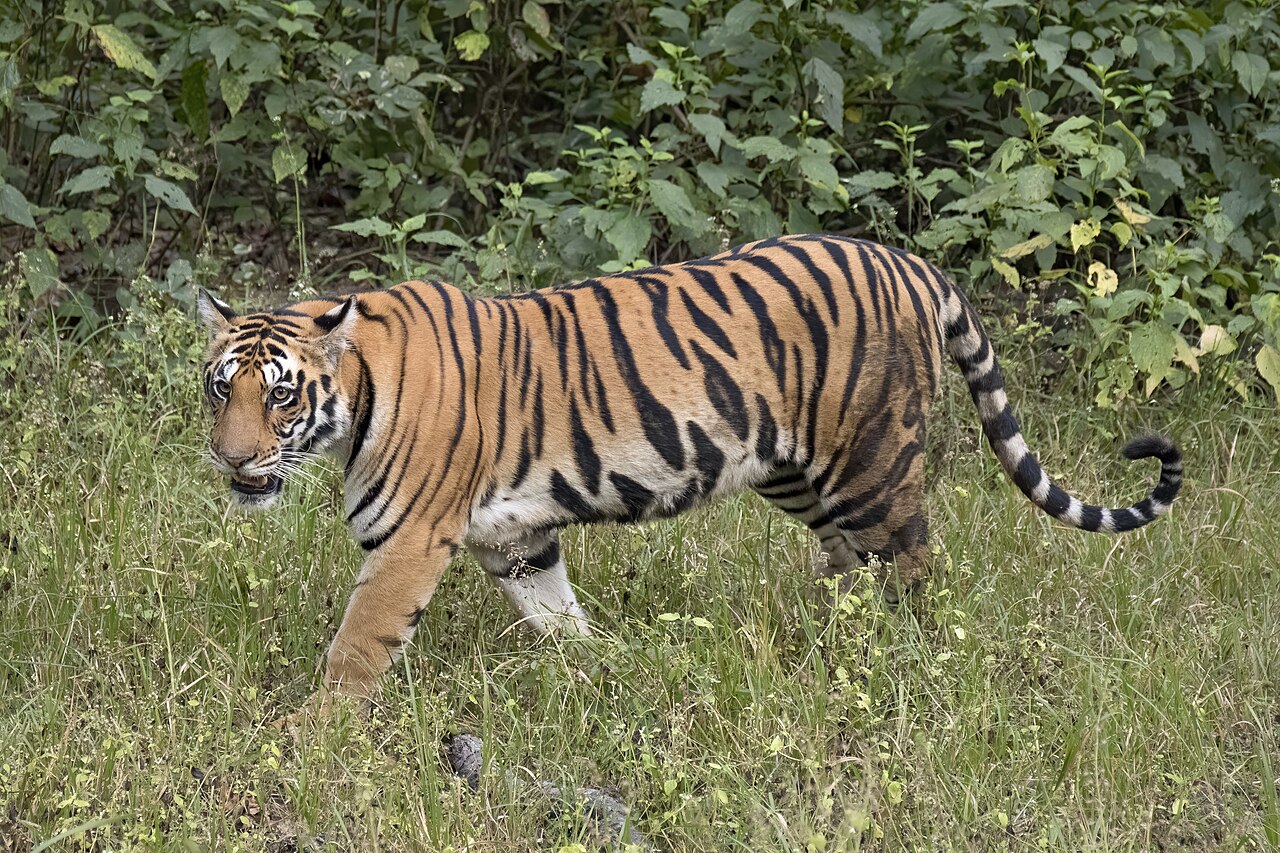

The Bengal tiger (Panthera tigris tigris) is the apex predator of Bhutan's forests and one of the most significant species in the country's conservation portfolio. Bhutan's 2022 national tiger survey estimated a population of approximately 131 tigers, a notable increase from the 103 individuals estimated in the 2015 survey. This makes Bhutan one of the smaller tiger range countries in terms of absolute numbers, but the significance of its tiger population is outsized due to the quality of habitat, the connectivity of its protected areas, and the remarkable discovery that tigers in Bhutan use habitats at elevations exceeding 4,000 metres, far higher than previously thought possible for the species.[1]
Tigers in Bhutan are found across a wide elevational gradient, from the subtropical forests of Royal Manas National Park at around 200 metres to temperate and subalpine forests above 4,000 metres in central Bhutan. This extraordinary elevational range, documented through camera trap surveys, challenges previous scientific understanding of tiger ecology and suggests that Bhutan's landscape provides a uniquely intact habitat continuum. The Royal Government of Bhutan is a committed participant in the global TX2 goal, an initiative launched at the 2010 St. Petersburg Tiger Summit that aims to double the number of wild tigers globally.
Distribution and Habitat
Tiger habitat in Bhutan spans the subtropical, warm temperate, and cool temperate ecological zones. The primary tiger stronghold is Royal Manas National Park and the adjacent Phibsoo Wildlife Sanctuary in the south, where subtropical forests provide classic tiger habitat with abundant prey, water, and dense cover. The transboundary landscape with India's Manas National Park and Buxa Tiger Reserve creates a larger contiguous area that supports a shared tiger population.
Camera trap surveys have also confirmed tiger presence in Jigme Dorji National Park, Jigme Singye Wangchuck National Park in the Black Mountains, Wangchuck Centennial National Park, and in several of the biological corridors that connect these protected areas. The corridors are particularly important for tigers, which require large territories (up to 100 square kilometres for males) and depend on the ability to disperse between habitat patches to maintain genetic diversity.
High-altitude Tigers
One of the most remarkable discoveries in recent wildlife research in Bhutan has been the documentation of tigers at extremely high elevations. Camera traps placed in temperate and subalpine forests between 3,000 and 4,100 metres have captured images of tigers, demonstrating that the species uses habitats well above the subtropical and tropical zones traditionally associated with the Bengal tiger. These high-altitude records have been confirmed in the biological corridors of central Bhutan, where tigers appear to move between the subtropical lowlands and alpine areas, possibly following prey species such as sambar deer, wild boar, and serow.
The existence of high-altitude tiger populations has significant implications for conservation. It suggests that tigers in Bhutan may have access to a much larger total habitat area than previously estimated, provided that forest connectivity is maintained across elevational gradients. It also raises questions about the potential effects of climate change, as warming temperatures could alter the distribution of both tigers and their prey across these elevational zones. Bhutan's intact forest corridors, which connect lowland and highland habitats, are therefore critical infrastructure for tiger conservation.[1]
Prey Base
A healthy tiger population requires an abundant and diverse prey base. In Bhutan, the principal prey species for tigers include sambar deer, barking deer (muntjac), wild boar, serow, and gaur (wild cattle). In the subtropical zones of Royal Manas, the prey community also includes chital (spotted deer), hog deer, and water buffalo. The density and distribution of these prey species are closely linked to habitat quality, and Bhutan's well-managed forests support relatively healthy prey populations.
Monitoring prey populations is an integral part of Bhutan's tiger conservation programme. Line transect surveys, camera trapping, and occupancy modelling are used to assess prey density and distribution across tiger habitats. Ensuring that prey populations remain viable requires controlling poaching, managing livestock grazing in forest areas, and maintaining diverse vegetation communities that support browsing and grazing herbivores.
Conservation Programmes
Bhutan's tiger conservation programme operates within the framework of the country's broader environmental policy, which integrates wildlife protection with sustainable development and the philosophy of Gross National Happiness. The national protected area system, covering over 51 percent of the country, provides the backbone of tiger conservation. The biological corridors connecting protected areas ensure landscape-level connectivity, a feature that distinguishes Bhutan's approach from many other tiger range countries where protected areas are increasingly isolated.
Specific tiger conservation measures include nationwide tiger surveys conducted at regular intervals using camera traps, anti-poaching patrols in key tiger areas, community-based conservation programmes in buffer zones, and human-tiger conflict mitigation. The Royal Government collaborates with international partners including WWF, Panthera, the Global Tiger Initiative, and the Wildlife Conservation Society to implement these programmes.
Bhutan participated in the 2010 St. Petersburg Tiger Summit, where 13 tiger range countries committed to the TX2 goal of doubling wild tiger numbers by 2022. The increase in Bhutan's tiger population from 103 in 2015 to 131 in 2022 represents meaningful progress toward this goal and reflects the effectiveness of the country's conservation investments. Bhutan's King, Jigme Khesar Namgyel Wangchuck, has personally championed tiger conservation, reinforcing the political commitment to protecting the species.[2]
Human-Tiger Conflict
As in other tiger range countries, human-tiger conflict is a significant challenge in Bhutan. Tigers occasionally kill livestock, particularly cattle and horses that graze in or near forest areas. In rare cases, tigers may approach human settlements, causing fear and economic loss. Retaliatory killing of tigers, while illegal, has been documented, and negative attitudes toward tigers can undermine community support for conservation.
The government has implemented livestock compensation schemes and insurance programmes to address economic losses from tiger predation. Community awareness programmes educate residents about tiger ecology and safety measures. Predator-proof corrals and improved livestock management practices are promoted in areas where conflict is most frequent. These measures are essential for maintaining the social licence for tiger conservation, particularly in rural communities that bear the direct costs of living alongside large predators.[1]
Transboundary Conservation
Bhutan shares tiger habitat with India along its southern border, and transboundary cooperation is essential for the long-term viability of shared tiger populations. Royal Manas National Park connects directly with India's Manas National Park, forming a transboundary landscape of exceptional conservation value. Joint management activities include coordinated anti-poaching patrols, shared monitoring data, and collaborative research on tiger movements and population dynamics.
The broader vision for tiger conservation in the eastern Himalayas involves maintaining a network of connected tiger habitats across Bhutan, India, Nepal, and potentially Myanmar. Bhutan's intact biological corridors serve as a model for this landscape approach, demonstrating that large carnivore conservation is most effective when protected areas are linked by functional habitat connections rather than existing as isolated fragments.[2]
References
- Tempa, T. et al. (2013). "Royal Manas National Park, Bhutan: a hot spot for wild felids." Oryx, 47(2), 207-210. https://doi.org/10.1016/j.biocon.2012.05.014
- World Wildlife Fund. "Tiger Conservation." https://www.worldwildlife.org/species/tiger
- National Tiger Survey Report 2022, Department of Forests and Park Services, Royal Government of Bhutan. https://www.dofps.gov.bt/
Related articles
Know something about this topic? Edit this article or . Anonymous contributions welcome — no account required.