_-_Jura_House_Gardens_-_geograph.org.uk_-_1327483.jpg)
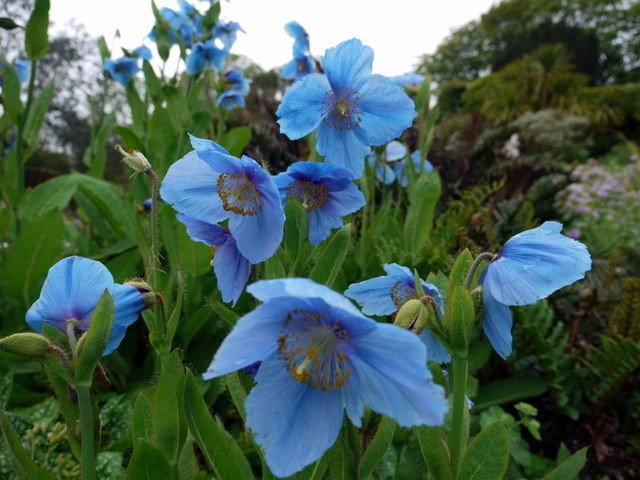
The blue poppy (Meconopsis grandis) is the national flower of the Kingdom of Bhutan, celebrated for its vivid cerulean petals and its association with the high-altitude landscapes of the eastern Himalayas. Known locally as "euitpel metog hoem," the blue poppy grows in alpine meadows and rocky scree slopes at elevations between 3,500 and 5,000 metres, where it blooms during the brief summer monsoon season from late May to July. It was designated as Bhutan's national flower in recognition of its beauty, rarity, and deep connection to the country's mountain ecology.[1]
The genus Meconopsis comprises approximately 80 species of poppies, most of which are native to the Himalayas and the mountains of southwestern China. Meconopsis grandis is one of the most spectacular members of the genus, with flowers that can reach 10 to 12 centimetres in diameter. The plant was first described by the botanist David Prain in 1895. Despite its common name, the blue poppy is not a true poppy of the genus Papaver but belongs to a separate lineage within the family Papaveraceae.
Botanical Description
The blue poppy is a herbaceous perennial that grows from a taproot or a cluster of fibrous roots. The plant typically reaches a height of 60 to 120 centimetres, with a rosette of basal leaves covered in soft, rust-coloured hairs. The leaves are lanceolate to oblong, with prominent veining. The flowering stem is erect and bears one to several large, cup-shaped flowers with four to six petals that range in colour from deep indigo-blue to pale sky-blue, occasionally with purplish or violet tints. The centre of the flower features a boss of prominent golden-yellow stamens, creating a striking contrast with the blue petals.
The colour of the petals is produced by a combination of anthocyanin pigments and the slightly alkaline pH of the cell sap. This mechanism is unusual among flowering plants and contributes to the blue poppy's reputation as one of the most intensely coloured flowers in the natural world. After pollination, the flower develops a capsule containing numerous small seeds that are dispersed by wind.[2]
Habitat and Distribution
In Bhutan, the blue poppy is found in the alpine zones of the northern districts, particularly in areas bordering Tibet. Important populations occur in and around Jigme Dorji National Park, along high-altitude trekking routes such as the Snowman Trek, and in the alpine meadows above Chelela Pass. The plant favours well-drained, humus-rich soils in areas with abundant summer rainfall and cool temperatures. It grows in association with other alpine flora, including dwarf rhododendrons, primulas, and gentians.
Outside Bhutan, Meconopsis grandis is found across the eastern Himalayas in Nepal, Sikkim, southeastern Tibet, and Yunnan Province of China. However, the Bhutanese populations are considered particularly significant because they occur within well-protected habitats within the country's extensive protected area network. The plant's high-altitude habitat makes it naturally inaccessible to most forms of human disturbance, although climate change poses a long-term threat by potentially shifting suitable habitat zones upward.
Cultural Significance
The blue poppy holds a special place in Bhutanese culture as a symbol of the country's pristine natural environment and its commitment to conservation. In Bhutanese tradition, the flower is associated with the mountain deities and the spiritual purity of the high peaks. Its fleeting bloom, lasting only a few weeks each summer, is seen as a metaphor for the Buddhist concept of impermanence.
The flower features prominently in Bhutanese stamps, currency designs, and official emblems. It is a popular motif in traditional Bhutanese textiles and paintings. For international visitors, encountering the blue poppy during a high-altitude trek is often considered one of the highlights of visiting Bhutan. The Tourism Council of Bhutan uses the blue poppy as a marketing symbol, emphasising the country's unique natural heritage.[1]
Horticultural History
The blue poppy gained international fame in the early 20th century when the British plant hunter Frank Kingdon-Ward encountered dramatic stands of Meconopsis during his expeditions to the Himalayas and wrote rapturously about them. The plant quickly became a horticultural sensation in Britain, and attempts to cultivate it in European gardens began in earnest. Growing blue poppies outside their native habitat proved extremely challenging, however, as the plants require cool, humid summers, acidic soil, and protection from excessive heat. They remain a prestigious but difficult garden plant, with successful cultivation largely restricted to Scotland, Scandinavia, and the Pacific Northwest of North America.
The Royal Botanic Garden Edinburgh has been a global leader in Meconopsis taxonomy and conservation, maintaining living collections and a comprehensive classification of the genus. Their work has helped clarify the taxonomic relationships among the many species of Himalayan blue poppies and has supported conservation planning in the plants' native range.[2]
Conservation
While the blue poppy is not currently listed as globally threatened, local populations face potential risks from climate change, overgrazing by yaks in alpine meadows, and collection by plant enthusiasts. In Bhutan, the species benefits from the country's constitutional mandate to maintain at least 60 percent forest cover and its extensive system of national parks and wildlife sanctuaries. The environmental policies of Bhutan, including the country's carbon-negative status, provide indirect protection by preserving the broader Himalayan ecosystem on which the blue poppy depends.
Research initiatives by Bhutanese botanists, in collaboration with international partners, continue to monitor blue poppy populations and study the potential impacts of warming temperatures on alpine flora. These efforts are part of a broader programme to understand and protect Bhutan's extraordinary biodiversity in the face of global environmental change.[3]
References
- Wikipedia. "National Symbols of Bhutan." https://en.wikipedia.org/wiki/National_symbols_of_Bhutan
- Royal Botanic Garden Edinburgh. "Meconopsis: The Blue Poppies." https://www.rbge.org.uk/science-and-conservation/genetics-and-conservation/meconopsis/
- Wangchuk, T. et al. (2011). "Biodiversity Conservation in Bhutan." Biodiversity and Conservation. https://doi.org/10.1007/s10531-011-0199-9
Related articles
Know something about this topic? Edit this article or . Anonymous contributions welcome — no account required.