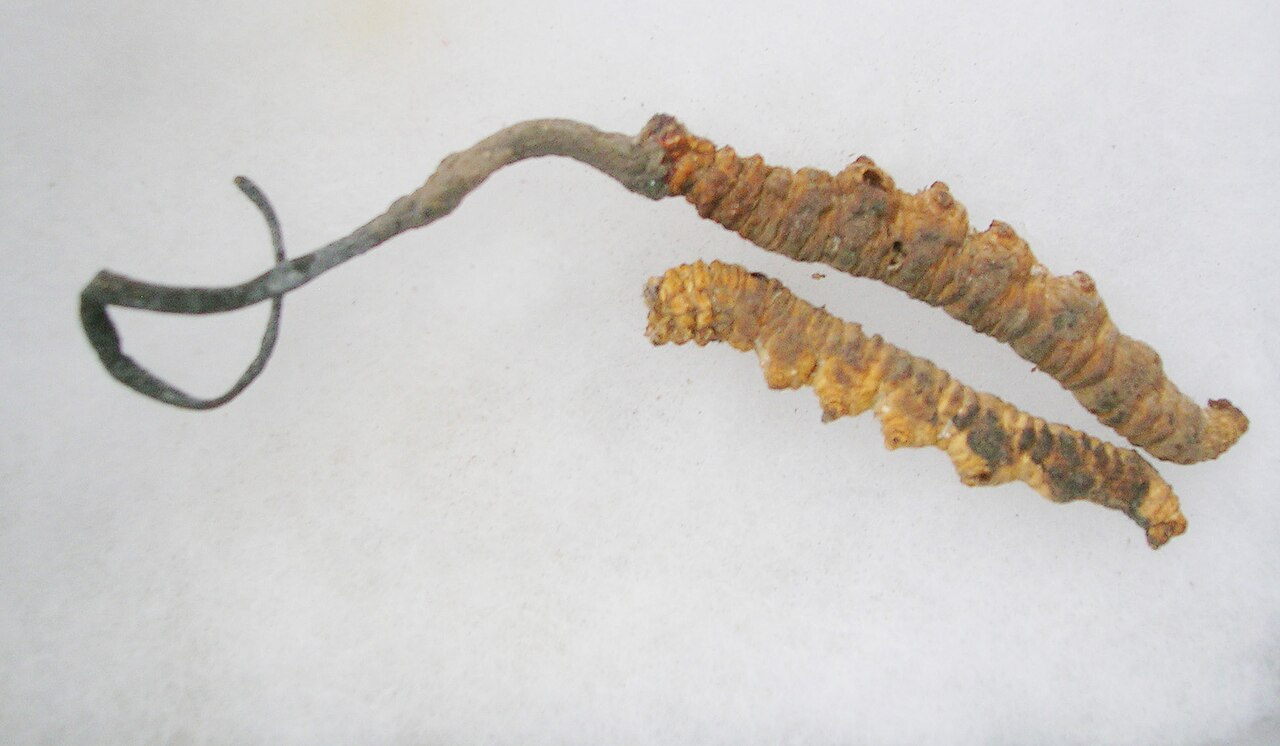

Cordyceps, specifically Ophiocordyceps sinensis (formerly Cordyceps sinensis), commonly known as caterpillar fungus or yartsa gunbu in Tibetan, is a parasitic fungus that infects the larvae of ghost moths in the family Hepialidae. In Bhutan, cordyceps harvesting has become one of the most economically significant activities for communities living in the high-altitude northern districts. The fungus, highly prized in traditional Chinese and Tibetan medicine for its purported medicinal and aphrodisiac properties, commands extraordinary prices on international markets, sometimes exceeding USD 20,000 per kilogram for premium specimens. The Royal Government of Bhutan legalised cordyceps harvesting in 2004 and has since implemented a regulatory framework to manage the resource sustainably.[1]
The caterpillar fungus grows at elevations between 3,500 and 5,200 metres in alpine meadows and grasslands across the Tibetan Plateau and the Himalayas. In Bhutan, harvesting areas are concentrated in the northern districts of Gasa, Bumthang, Lhuentse, Wangdue Phodrang, and Trashiyangtse, in and around Jigme Dorji National Park and Wangchuck Centennial National Park. The annual harvest season, which typically runs from late May to early July, draws thousands of collectors from highland communities who depend on cordyceps income for a significant portion of their annual earnings.
Biology
Ophiocordyceps sinensis has a remarkable life cycle that bridges the kingdoms of fungi and insects. The fungus infects the underground larvae of ghost moths (Thitarodes spp.) during the autumn, when fungal spores in the soil come into contact with feeding larvae. The fungal mycelium gradually consumes the larva from the inside over the winter months, mummifying it while keeping the outer integument intact. In spring, a slender, club-shaped fruiting body (stroma) emerges from the head of the dead caterpillar and protrudes a few centimetres above the soil surface. It is this combined structure, the mummified larva with its protruding fungal stalk, that is harvested and traded.
The biology of the host-parasite interaction is complex and not fully understood. The ghost moth larvae spend several years underground, feeding on plant roots, before they are large enough to support the growth of the fungus. The timing and success of infection depend on soil temperature, moisture, vegetation cover, and the density of both host larvae and fungal spores. These ecological requirements make cordyceps production highly sensitive to environmental conditions, and there are growing concerns that overharvesting and climate change could reduce yields over time.[2]
Economic Importance
Cordyceps has transformed the economy of Bhutan's highland communities since its legal harvesting was first permitted in 2004. Before legalisation, clandestine harvesting had been occurring for years, with collectors selling their harvest through informal channels to traders in Tibet and China. By legalising and regulating the trade, the government brought the activity under formal oversight while allowing communities to benefit legitimately from the resource.
Annual cordyceps revenue in Bhutan is estimated at tens of millions of Bhutanese ngultrum (equivalent to several million US dollars), with the exact figure varying depending on market prices and harvest yields. For families in northern districts, cordyceps income can constitute 50 to 80 percent of total annual household income, representing a dramatic transformation from subsistence herding and farming. The government levies a royalty on cordyceps sales, and a portion of the revenue is directed toward community development and conservation programmes in harvesting areas.
The high value of cordyceps has had both positive and negative social effects. On the positive side, it has reduced poverty in some of Bhutan's most remote and economically marginalised communities. On the negative side, it has created wealth disparities within communities, attracted outsiders seeking access to harvesting areas, and generated social tensions. There are also concerns about the health effects of extended camping at high altitudes during the harvest season, particularly for the elderly and young children who participate.[2]
Regulation and Governance
The Royal Government of Bhutan manages cordyceps harvesting through a permit system administered by the Department of Forests and Park Services and local district administrations. Harvesting is restricted to residents of eligible highland communities, and each harvester must obtain a permit specifying the dates and areas where collection is allowed. The harvest season is strictly limited to approximately six weeks, and harvesting outside the designated period is prohibited.
Specific rules govern harvesting practices to promote sustainability: collectors are required to fill in the holes they dig when extracting cordyceps, and the removal of vegetation cover in harvesting areas is prohibited. Cordyceps must be sold through designated auction markets where the government collects a royalty, typically around 5 percent of the sale value. These auctions bring transparency to the pricing process and ensure that collectors receive fair market value rather than being exploited by middlemen.
Enforcement of harvesting regulations in remote alpine areas is challenging, and there are ongoing concerns about illegal collection by non-permit holders, harvesting before the official season opens, and the destruction of alpine meadow habitat by digging. The government has deployed park rangers and community watchmen to monitor harvesting areas, but the vast and rugged terrain makes comprehensive enforcement difficult.[1]
Sustainability Concerns
The long-term sustainability of cordyceps harvesting in Bhutan is a subject of active debate among scientists, policymakers, and communities. Several studies across the Tibetan Plateau have reported declining yields in heavily harvested areas, raising concerns that current extraction rates may not be sustainable. The ecological factors that support cordyceps production, including healthy populations of ghost moth larvae, intact alpine meadow vegetation, and suitable soil conditions, are vulnerable to disruption from overharvesting, livestock trampling, and climate change.
Climate change is a particular concern, as rising temperatures may shift the suitable elevation band for cordyceps production upward, potentially reducing the total area of viable habitat. Changes in snowmelt timing and monsoon patterns could affect soil moisture during the critical period of fungal infection and fruiting body emergence. Some researchers have warned that cordyceps could become increasingly rare within a few decades if current trends in harvesting pressure and climate change continue.
Bhutan's approach to cordyceps management is considered relatively progressive compared to other harvesting countries. The permit system, seasonal restrictions, and royalty collection provide a framework for sustainable management, even if enforcement remains imperfect. Research partnerships between Bhutanese institutions and international scientists are investigating the ecology of cordyceps production, the effects of harvesting intensity on yields, and potential strategies for cultivation, although no commercially viable cultivation method for O. sinensis has yet been developed. These efforts are consistent with Bhutan's broader commitment to environmental stewardship and the principles of Gross National Happiness.[2]
2026: lowland discovery and economic concern
In June 2026 the discovery of cordyceps growing in the low-altitude forests of East Siang district in Arunachal Pradesh, India, raised concern in Bhutan over the future of its premium cordyceps economy, which has rested on the fungus being a high-altitude rarity. Bhutanese cordyceps (Ophiocordyceps sinensis, or yartsa goenbup) is collected at roughly 14,500–17,000 feet, just below the snow line; at its peak a kilogram of top-grade cordyceps has fetched as much as Nu 2.71 million (roughly USD 32,000 at 2026 exchange rates), and a single collection season can earn a highland household what rearing 50 yaks once did. With warming temperatures already threatening yields, some collectors have begun contemplating a return to yak herding. (Sources: Kuensel, 5 June 2026; Dialogue Earth.)
See also
References
- Winkler, D. (2008). "Yartsa Gunbu (Cordyceps sinensis) and the fungal commodification of Tibet's rural economy." Economic Botany, 62(3), 291-305. https://doi.org/10.1016/j.jep.2007.12.024
- Wangchuk, K. & Wangdi, J. (2017). "Caterpillar fungus in the Bhutanese Himalayas: harvesting, trade and sustainability." Ambio. https://doi.org/10.1007/s13280-017-0900-8
- Department of Forests and Park Services, Royal Government of Bhutan. "Cordyceps Harvesting Regulations." https://www.dofps.gov.bt/
Related articles
Know something about this topic? Edit this article or . Anonymous contributions welcome — no account required.