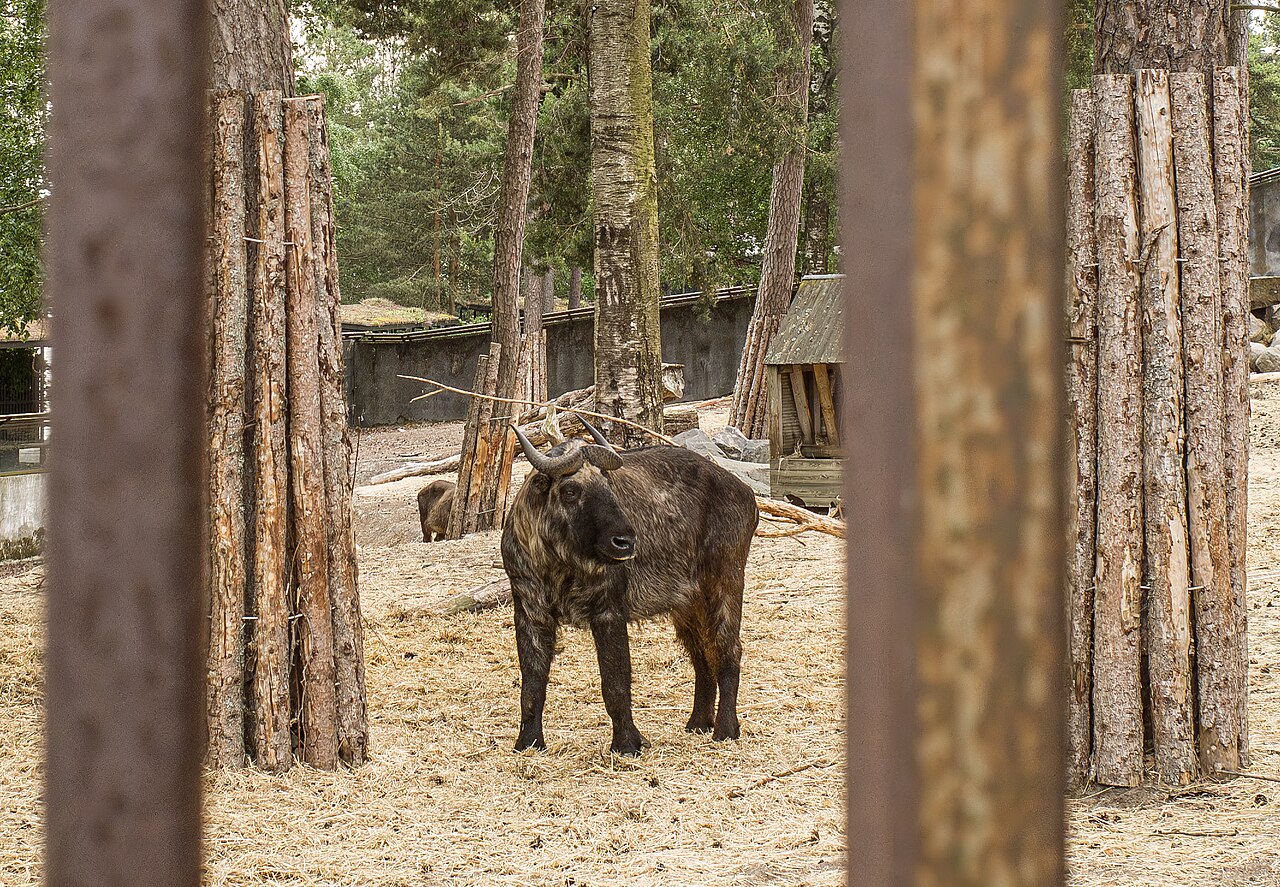
_in_Korkeasaari_zoo.jpg)
The takin (Budorcas taxicolor) is a large, stocky bovid native to the eastern Himalayas and a national symbol of the Kingdom of Bhutan. Classified within the subfamily Caprinae, the takin is the only member of the genus Budorcas and is sometimes referred to as a "gnu goat" due to its unusual appearance, which combines features of cattle, goats, and muskoxen. In Bhutan, the animal holds deep cultural and spiritual significance, rooted in a popular legend involving the Buddhist saint Drukpa Kunley. The species is listed as Vulnerable on the IUCN Red List, and Bhutan has taken active measures to conserve its population through protected areas and national legislation.[1]
Four subspecies of takin are generally recognised: the Mishmi takin (B. t. taxicolor), the golden takin (B. t. bedfordi), the Tibetan or Sichuan takin (B. t. tibetana), and the Bhutan takin (B. t. whitei). The Bhutan takin is found primarily in the temperate and subalpine forests of Bhutan and adjacent areas of northeastern India and Tibet. Adult males can weigh up to 350 kilograms and stand about 1.2 metres at the shoulder, making them one of the largest mammals in their range.
Mythology and Cultural Significance
The takin's designation as Bhutan's national animal is intimately connected to the legend of Drukpa Kunley, the 15th-century Tibetan Buddhist master known as the "Divine Madman." According to popular tradition, during a visit to Bhutan, Drukpa Kunley was asked by a large gathering of devotees to perform a miracle. He demanded that he first be served an entire cow and an entire goat for his meal. After consuming both animals, he placed the goat's head on the cow's body, snapped his fingers, and the composite creature rose and walked away into the hills. The Bhutanese believe this creature became the takin, and the story explains the animal's seemingly impossible anatomy: the body of a cow with the head of a goat.[2]
The legend reflects the broader cultural importance of Buddhism in Bhutanese society. The takin is not merely a biological curiosity but a living symbol of Bhutan's spiritual heritage. It features prominently in Bhutanese art and iconography, and killing a takin is strictly prohibited under Bhutanese law. The animal's image appears in various governmental and cultural contexts, reinforcing its status as a source of national pride.
Habitat and Distribution
The Bhutan takin inhabits dense bamboo and rhododendron forests, subalpine meadows, and rocky alpine terrain at elevations ranging from approximately 1,000 to 4,500 metres. They are found across several districts in Bhutan, with important populations in Jigme Dorji National Park in the northwest and in forested areas of central Bhutan. During summer, takin herds migrate to higher elevations where they graze on alpine herbs, grasses, and bamboo shoots. In winter they descend to lower-altitude forests for shelter and food.
Takin are social animals that form herds ranging from a few individuals to groups of over one hundred during summer grazing. Older males may become solitary outside the breeding season. Their thick, oily coat, which secretes a distinctive substance that acts as a natural raincoat, is an adaptation to the wet, misty conditions of their montane habitat. Their large, splayed hooves provide traction on steep and slippery terrain, enabling them to navigate the rugged Himalayan landscape with surprising agility.
Motithang Takin Preserve
The Motithang Takin Preserve in the capital city of Thimphu is one of the best-known sites for observing takin. Originally established as a small zoo, the facility was converted to an open preserve after King Jigme Singye Wangchuck declared that keeping animals in cages was incompatible with Bhutan's Buddhist principles and its commitment to environmental conservation. When the captive takin were released into the wild, they kept returning to the city in search of food, prompting authorities to create the fenced preserve as a compromise.
The preserve covers approximately 5.5 hectares of forested hillside and houses a small herd of takin alongside sambar deer and barking deer. It is a popular destination for visitors to Thimphu and serves as an educational site for Bhutanese schoolchildren, fostering awareness of the country's natural heritage. Feeding stations within the preserve supplement the animals' diet with salt licks and cabbage leaves.
Conservation Status and Threats
The takin is classified as Vulnerable by the International Union for Conservation of Nature (IUCN), with the total global population estimated at fewer than 10,000 mature individuals across its range in Bhutan, China, India, and Myanmar. The primary threats to takin include habitat loss due to logging and agricultural expansion, poaching for meat and traditional medicine, competition with domestic livestock for grazing land, and disturbance from road construction in mountainous areas.[1]
In Bhutan, the takin benefits from the country's extensive protected area network, which covers more than 51 percent of the national territory. Hunting of wildlife is prohibited under Bhutanese law, and the Forest and Nature Conservation Act of 1995 provides specific legal protections for endangered species. Bhutan's commitment to maintaining at least 60 percent forest cover, enshrined in its constitution, provides a long-term safeguard for takin habitat. Community-based conservation programmes in buffer zones around protected areas also help reduce human-wildlife conflict.[3]
Research and Monitoring
Scientific research on the Bhutan takin has historically been limited by the animal's remote habitat and shy nature. However, recent years have seen increased survey efforts, including the use of camera traps in Jigme Dorji National Park and other protected areas. These surveys have helped refine population estimates and identify critical habitat corridors. The Royal Government of Bhutan, in partnership with organisations such as WWF Bhutan and the Ugyen Wangchuck Institute for Conservation and Environmental Research, continues to invest in monitoring and research to ensure the long-term survival of this remarkable species.
References
- Song, Y.-L., Smith, A.T. & MacKinnon, J. (2008). "Budorcas taxicolor." IUCN Red List of Threatened Species. https://www.iucnredlist.org/species/3160/22150785
- WWF Bhutan. "Takin: Bhutan's National Animal." https://www.wwfbhutan.org.bt/projects_and_initiatives/species/takin/
- Department of Forests and Park Services, Royal Government of Bhutan. https://www.dofps.gov.bt/
Related articles
Know something about this topic? Edit this article or . Anonymous contributions welcome — no account required.