
The black-necked crane (Grus nigricollis) is a large, elegant wading bird that holds a special place in the cultural and spiritual life of Bhutan. The only crane species that breeds and winters at high altitudes, the black-necked crane summers on the Tibetan Plateau and migrates to spend the winter months in sheltered Himalayan valleys, including several in Bhutan. The most famous wintering site is Phobjikha Valley in Wangdue Phodrang district, where approximately 300 to 500 cranes arrive each year between late October and mid-February. The species is classified as Vulnerable on the IUCN Red List, with a global population of approximately 10,000 to 11,000 individuals.[1]
In Bhutan, the black-necked crane is far more than a biological species; it is a potent cultural symbol imbued with religious significance. Bhutanese Buddhists regard the crane as a sacred bird, an embodiment of the Bodhisattva of Compassion (Avalokiteshvara), and its arrival in the valleys each autumn is welcomed as an auspicious sign. The crane features in Bhutanese songs, dances, and poetry, and its image appears in temple murals, traditional paintings, and postage stamps. The strong cultural connection between the Bhutanese people and the black-necked crane has been a powerful force for conservation.
Physical Description
The black-necked crane is a large bird, standing approximately 115 to 150 centimetres tall with a wingspan of up to 236 centimetres. Adults weigh between 5 and 7 kilograms. The species is named for its distinctive black head and upper neck, which contrast sharply with the otherwise pale grey body. A patch of bare red skin on the crown, more prominent during the breeding season, adds a flash of colour. The tail feathers are black, and the legs and feet are dark. Juveniles have a brownish tinge to their plumage and lack the adults' well-defined head pattern.
In flight, black-necked cranes display long, outstretched necks and legs, with slow, powerful wingbeats. Their calls are loud and trumpeting, carrying across the open valleys they inhabit. Pairs perform elaborate courtship dances involving synchronised calling, leaping, and wing displays, behaviours that have captivated human observers and inspired artistic representations across their range.
Wintering in Phobjikha Valley
Phobjikha Valley, a glacial valley at approximately 2,900 metres elevation on the western slopes of the Black Mountains, is the most important wintering site for black-necked cranes in Bhutan. The valley's wide, marshy floor, fed by the Nake Chhu and surrounded by gentle forested slopes, provides ideal habitat with ample foraging opportunities. Cranes feed on waste grain in harvested fields, tubers, roots, insects, and small animals found in the wetland areas.
The cranes' annual arrival, typically in late October, is a celebrated event in Phobjikha. Local tradition holds that the cranes circle the Gangtey Monastery three times upon arrival and again before departure, a behaviour that has been observed by ornithologists and is attributed to the cranes' flight patterns as they navigate the valley. The Gangtey Monastery, one of the most important Nyingmapa Buddhist monasteries in Bhutan, overlooks the valley and has long been associated with the cranes.
Other important wintering sites in Bhutan include the Bumdeling valley in Trashiyangtse district in the northeast, which supports a smaller but significant population, and the Khotokha valley in Wangdue Phodrang district. Together, these valleys support the majority of the black-necked crane population that winters in Bhutan.[2]
Cultural and Religious Significance
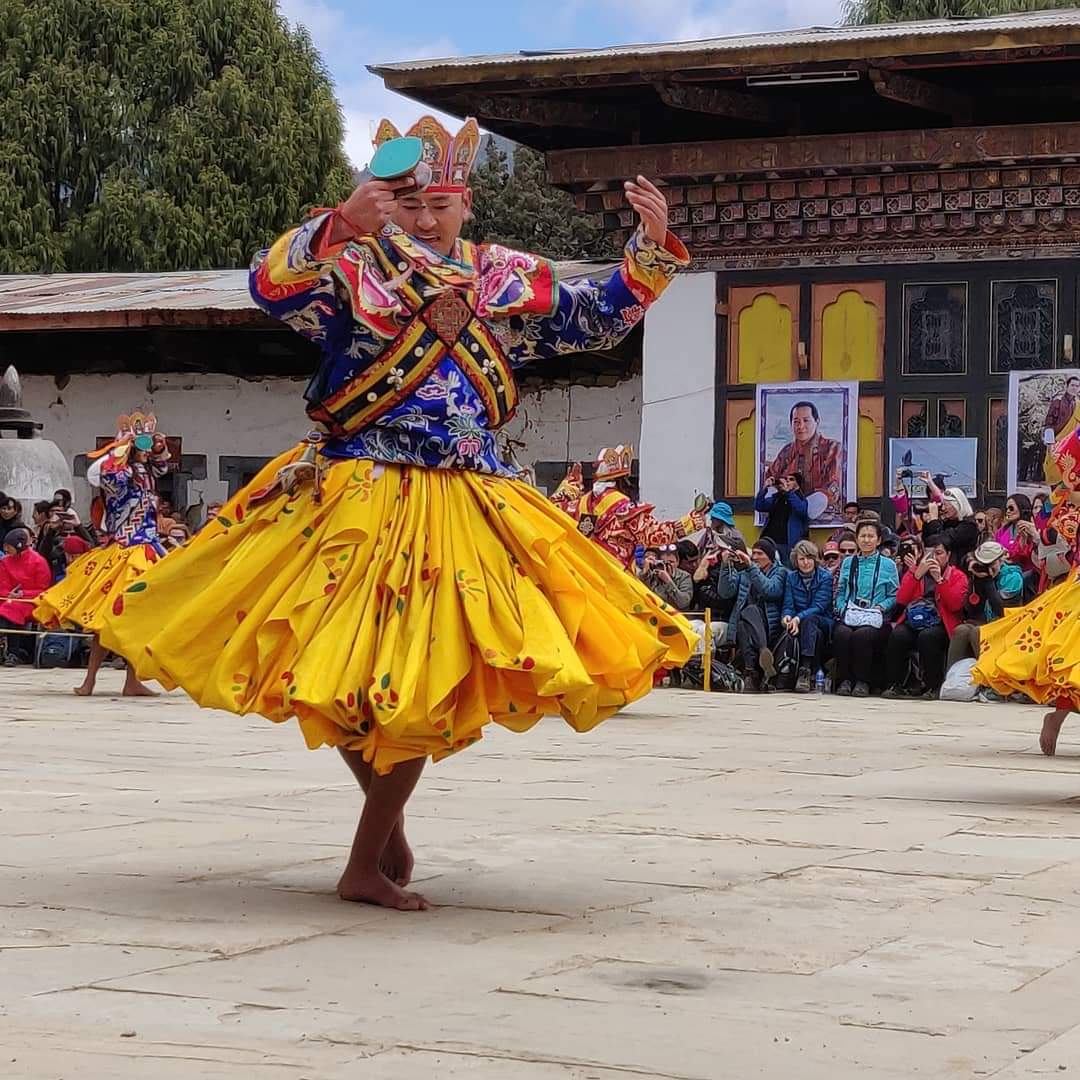
The black-necked crane occupies a uniquely prominent position in Bhutanese culture. In Buddhist tradition, the crane is considered a heavenly bird (thrung thrung in Dzongkha), and harming one is believed to bring severe misfortune. This cultural protection has historically been at least as effective as legal protections in preventing the killing of cranes. The species is featured in the cham (masked dance) traditions of several Bhutanese festivals, where dancers wearing crane costumes perform graceful movements that mimic the birds' courtship dances.
The annual Black-necked Crane Festival, held at Gangtey Monastery on November 11, was established in 1998 by the Royal Society for Protection of Nature (RSPN) to celebrate the cranes' arrival and raise conservation awareness. The festival features traditional songs and dances, including the crane dance performed by local schoolchildren, cultural performances, and environmental education activities. It has become an important event for the local community and a growing attraction for tourists, demonstrating how cultural heritage and conservation can reinforce each other.
Conservation Efforts
Conservation of the black-necked crane in Bhutan is led by the Royal Society for Protection of Nature (RSPN), in collaboration with the Department of Forests and Park Services and local communities. Key conservation measures include regular population monitoring and census counts at all wintering sites, wetland habitat management and restoration in Phobjikha and Bumdeling, community engagement and awareness programmes, and the promotion of crane-friendly agricultural practices.
A significant conservation challenge has been the development pressure on Phobjikha Valley, which has seen increasing tourism infrastructure, road construction, and installation of power lines that pose collision and electrocution risks to the large, low-flying cranes. In response, the government agreed to route power lines underground through the crane habitat, an expensive but symbolically important decision that demonstrated the priority placed on crane conservation. Plans for a road through the centre of the valley were also modified to reduce disturbance to crane habitat.
The Phobjikha Conservation Area, established to manage the valley's natural and cultural heritage, balances community development needs with crane habitat protection. Community-based ecotourism initiatives, including homestays and guided crane-watching tours, provide alternative income for local residents and create economic incentives for conservation. The success of these programmes has made Phobjikha a model for community-based conservation in Bhutan and the broader region.[3]
Population Trends and Threats
The population of black-necked cranes wintering in Bhutan has shown a generally stable to slightly increasing trend over the past two decades, reflecting both improved survey coverage and the benefits of conservation programmes. However, the species remains vulnerable to a range of threats. Wetland degradation from drainage, siltation, and agricultural intensification reduces habitat quality. The conversion of traditional wetland agriculture to other land uses affects the food base for wintering cranes.
Climate change may alter the timing and suitability of wintering conditions in Bhutanese valleys, potentially forcing cranes to shift their wintering range. Disturbance from tourism, feral dogs, and human activities near roosting and feeding sites can affect crane behaviour and energy budgets during the critical winter period. Continued monitoring and adaptive management will be essential to ensure that Bhutan's black-necked crane populations remain healthy in the decades ahead.[1]
References
- BirdLife International (2020). "Grus nigricollis." IUCN Red List of Threatened Species. https://www.iucnredlist.org/species/22692162/130895786
- Bishop, M.A. (1990). "Ecology of the Black-necked Crane wintering in Bhutan." Bird Conservation International. https://doi.org/10.1017/S0959270900003440
- Royal Society for Protection of Nature (RSPN). "Black-necked Crane Conservation." https://www.rspnbhutan.org/
Related articles
Know something about this topic? Edit this article or . Anonymous contributions welcome — no account required.