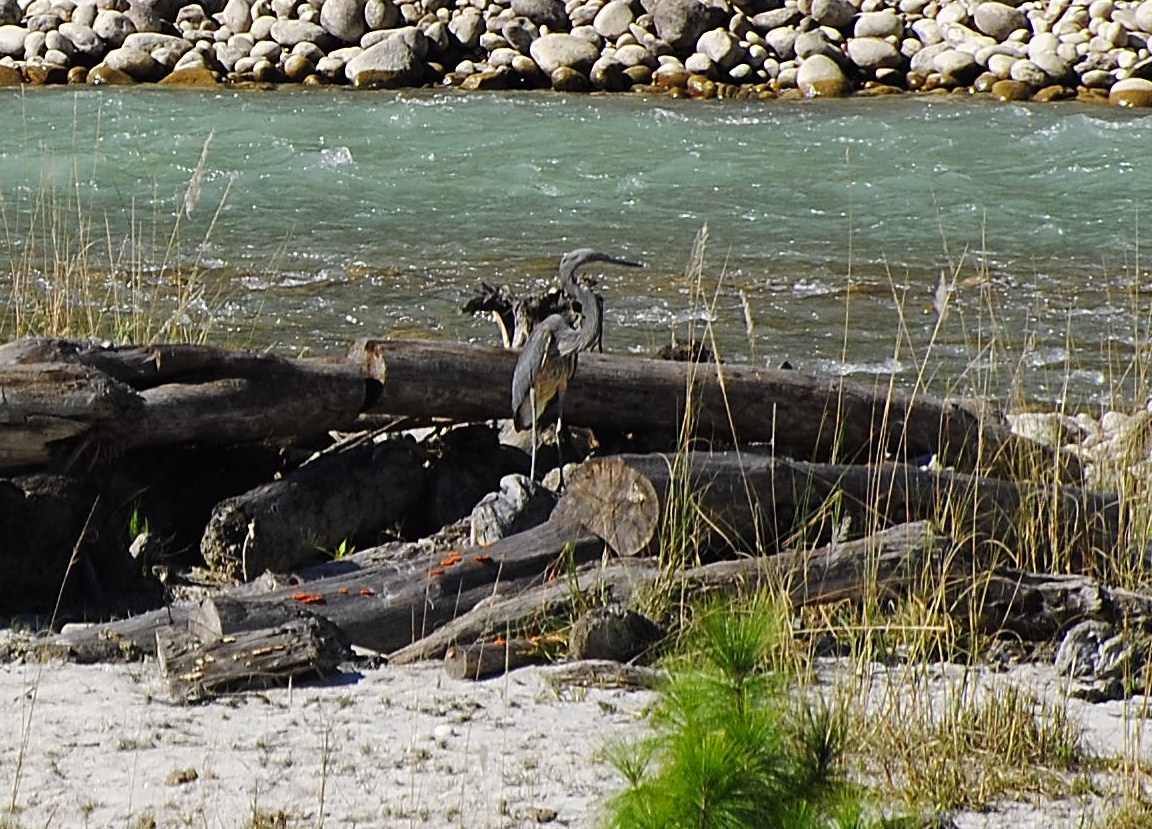

The white-bellied heron (Ardea insignis), also known as the imperial heron, is one of the rarest herons in the world and is classified as Critically Endangered on the IUCN Red List. With a global population estimated at fewer than 60 mature individuals, this large wading bird faces an extremely high risk of extinction. Bhutan is believed to harbour the majority of the world's remaining population, making the country uniquely important for the species' survival. Conservation programmes along the Pho Chhu and Mangde Chhu rivers, where most Bhutanese individuals have been recorded, represent the frontline of efforts to save this species from extinction.[1]
The white-bellied heron is one of the largest heron species in the world, standing up to 127 centimetres tall with a wingspan exceeding two metres. It is a solitary, shy bird that inhabits undisturbed river valleys with clear, slow-flowing water, gravel bars, and adjacent marshes. Its extreme rarity and the inaccessibility of its remaining habitat have made it one of the least-studied large birds in Asia. Historical records suggest the species once ranged across the eastern Himalayas, northeastern India, Bangladesh, and Myanmar, but it has disappeared from most of its former range due to habitat destruction.
Physical Description
Adult white-bellied herons have dark grey-brown upperparts, a characteristic white belly and lower breast from which the species derives its common name, and a long, heavy bill that is dark above and yellowish below. The neck is grey with fine dark streaking, and in breeding plumage, adults develop elongated plumes on the back and breast. The legs are dark greenish-grey. Juveniles are similar to adults but with a browner overall tone and less distinct plumage features.
The species can be distinguished from the more common grey heron (Ardea cinerea), which also occurs in Bhutan, by its larger size, darker overall plumage, white belly, and different habitat preferences. While grey herons readily use disturbed habitats including rice paddies and urban waterways, white-bellied herons are strictly associated with remote, undisturbed river systems, making them far more sensitive to environmental change.
Distribution in Bhutan
In Bhutan, the white-bellied heron has been recorded primarily along the Pho Chhu (father river) and Mo Chhu (mother river) in Punakha district, along the Mangde Chhu in Zhemgang and Trongsa districts, and at scattered locations along other rivers in central and southern Bhutan. Systematic surveys conducted by the Royal Society for Protection of Nature (RSPN) and the Department of Forests and Park Services have identified approximately 20 to 30 individuals in Bhutan, though the actual number may be slightly higher given the species' secretive behaviour and the difficulty of surveying remote river valleys.
The Pho Chhu valley below Punakha Dzong has been identified as one of the most important sites for the species in Bhutan. Birds have been observed nesting in tall trees adjacent to the river and feeding on gravel bars and in shallow pools. The Mangde Chhu system in Zhemgang district supports another key population, with birds recorded in pristine subtropical forest along relatively undisturbed stretches of the river.[2]
Ecology and Behaviour
The white-bellied heron is a patient ambush predator that feeds primarily on fish, supplemented by frogs, crabs, snakes, and aquatic invertebrates. It typically forages alone, standing motionless in shallow water or on gravel bars and striking rapidly when prey comes within range. The species is diurnal, with peak foraging activity in the early morning and late afternoon.
Nesting occurs in tall trees, often pines or broadleaf species, located near rivers. The nest is a large platform of sticks, typically placed high in the canopy. Breeding pairs are highly sensitive to disturbance, and nesting failures have been linked to human activity, including fishing, sand mining, and construction near nest sites. Clutch size is typically two to four eggs, and both parents share incubation and chick-rearing duties. The species' low reproductive rate, combined with its small population, means that even modest increases in mortality or reductions in breeding success can have severe population-level consequences.
Threats
The primary threats to the white-bellied heron in Bhutan include riverine habitat degradation, disturbance at breeding sites, and the effects of hydropower development. Bhutan's extensive hydropower programme, while economically important and consistent with the country's carbon-negative goals, has the potential to alter river flow regimes, reduce water clarity, and inundate habitat in river valleys that support heron populations. Environmental impact assessments for hydropower projects in heron habitat areas have become an important conservation tool.
Sand and gravel mining along riverbeds degrades foraging habitat, while road construction and settlement expansion near river valleys increase disturbance. Fishing with gill nets poses an entanglement risk, and the depletion of fish populations through overfishing or water pollution reduces the food base. Climate change may alter river flow patterns and water temperatures, with unpredictable effects on the riverine ecosystems that the species depends upon.[1]
Conservation Programmes
Bhutan has taken significant steps to protect the white-bellied heron, recognising its global conservation importance. The Royal Society for Protection of Nature (RSPN) leads the conservation programme, which includes regular population surveys, nest monitoring, community awareness campaigns, and advocacy for habitat protection. Key nest sites along the Pho Chhu have been designated as community conservation areas, with local communities engaged as guardians.
The government has incorporated white-bellied heron habitat considerations into environmental impact assessments for development projects, including hydropower dams and road construction. Buffer zones around known nest sites restrict certain activities during the breeding season. International support from BirdLife International, the World Bank, and other partners has provided funding and technical expertise for survey work, community programmes, and habitat restoration initiatives.
A national action plan for the white-bellied heron, developed by RSPN in collaboration with the government and international experts, outlines priorities including habitat protection, population monitoring, captive breeding feasibility studies, and transboundary cooperation with Myanmar and India, where small numbers of birds may still survive. Given the species' Critically Endangered status and Bhutan's role as its primary stronghold, the success or failure of these conservation efforts will likely determine the species' long-term survival.[2]
References
- BirdLife International (2020). "Ardea insignis." IUCN Red List of Threatened Species. https://www.iucnredlist.org/species/22697021/131403693
- Pradhan, R. et al. (2017). "Conservation of the White-bellied Heron in Bhutan." Bird Conservation International. https://doi.org/10.1017/S0959270917000223
- Royal Society for Protection of Nature (RSPN). "White-bellied Heron Conservation Programme." https://www.rspnbhutan.org/
Related articles
Know something about this topic? Edit this article or . Anonymous contributions welcome — no account required.