.jpg)
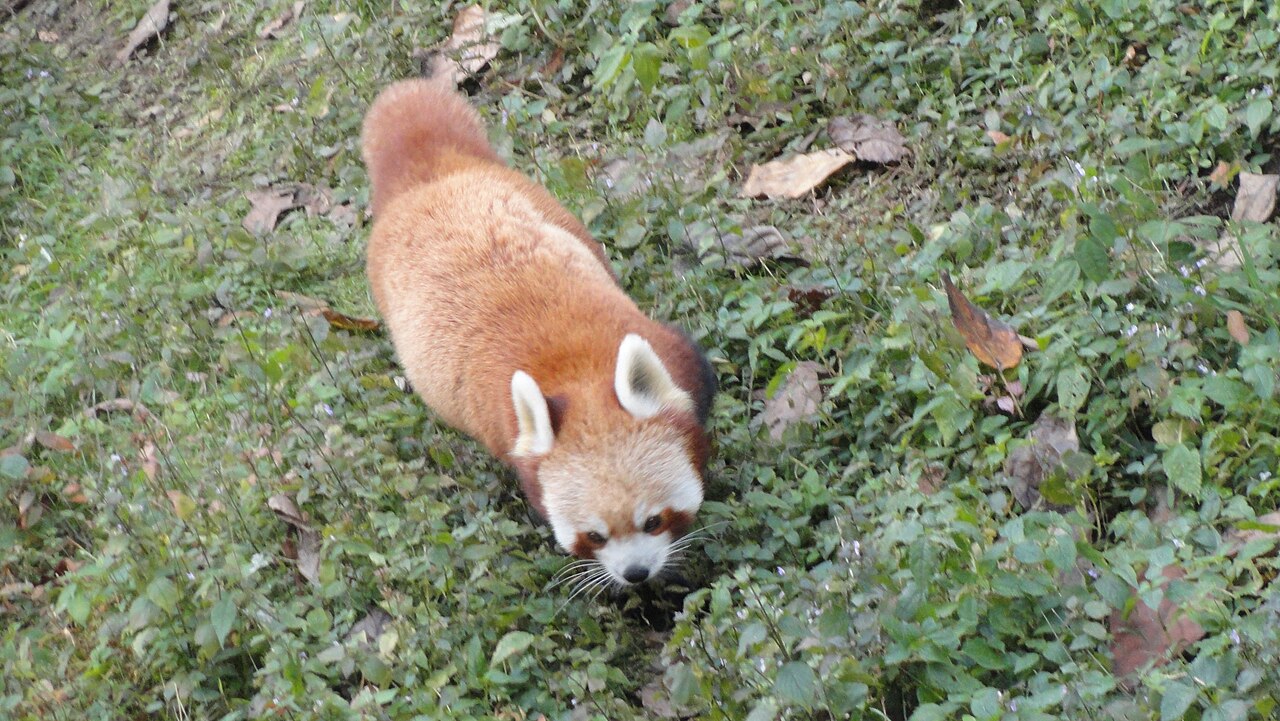
The red panda (Ailurus fulgens) is a small, arboreal mammal native to the temperate forests of the eastern Himalayas and southwestern China. In Bhutan, the red panda inhabits broadleaf and conifer forests with dense bamboo understory at elevations between 2,400 and 4,000 metres, primarily in the central and eastern districts. The species is classified as Endangered on the IUCN Red List, with global populations declining due to habitat loss, fragmentation, and poaching. Bhutan provides important habitat for the red panda and has integrated its conservation into the management of several key protected areas.[1]
The red panda is the sole living representative of the family Ailuridae, making it an evolutionarily distinct species with no close living relatives. Despite its name, it is not closely related to the giant panda but shares certain convergent adaptations, including a modified wrist bone ("pseudo-thumb") that aids in gripping bamboo. Adult red pandas weigh between 3 and 6 kilograms, with a body length of 50 to 65 centimetres and a bushy, ringed tail of similar length. Their rich reddish-brown fur, white-marked face, and bushy tail make them one of the most recognisable mammals of the Himalayan forests.
Distribution in Bhutan
Red pandas in Bhutan are found across a discontinuous range in the temperate and subalpine zones of the central and eastern regions. Key populations exist within Jigme Dorji National Park in the northwest, Thrumshingla National Park in central Bhutan, and the biological corridors connecting these areas. Surveys have also confirmed their presence in Phrumsengla, the Black Mountains, and areas of Bumthang, Zhemgang, and Trashigang districts.
The species shows a strong association with temperate broadleaf forests dominated by oak, maple, and magnolia, with a dense bamboo understory. Bamboo species of the genera Yushania, Borinda, and Himalayacalamus form the primary food source, and the distribution of these bamboos largely determines red panda habitat suitability. In Bhutan, these forests are generally well preserved, particularly within the protected area network, although areas outside parks face pressure from logging, livestock grazing, and the collection of forest products.[2]
Ecology and Behaviour
Red pandas are primarily crepuscular and nocturnal, spending much of the day resting in tree branches or hollow trunks. They are solitary animals outside the breeding season, with home ranges of 1 to 11 square kilometres that overlap between individuals of opposite sexes but are largely exclusive among same-sex individuals. Scent marking using anal glands and urine is the primary means of communication and territorial delineation.
The diet consists primarily of bamboo leaves and shoots, supplemented by fruits, berries, acorns, mushrooms, bird eggs, and occasionally insects. Because bamboo has low nutritional value, red pandas must consume large quantities daily, spending up to 13 hours per day foraging. This dependence on bamboo makes them vulnerable to bamboo die-offs, which occur periodically when bamboo species undergo mass flowering and subsequent senescence. During these events, red pandas must either find alternative bamboo species or supplement their diet with other foods.
Breeding occurs in late winter, with one to four cubs born in a hollow tree or rock crevice between May and July after a gestation period of approximately 135 days. Cubs are weaned at around 6 to 8 months and reach adult size by about one year. Red pandas can live up to 14 years in captivity, though lifespans in the wild are typically shorter.
Threats
The primary threats to red pandas in Bhutan include habitat loss and fragmentation, poaching, and competition with domestic livestock. While Bhutan's extensive forest cover provides a generally favourable landscape, specific threats operate at the local level. Road construction through forested areas, particularly the east-west highway and various farm roads, fragments red panda habitat and creates barriers to movement. The expansion of settlements and agricultural land at forest margins reduces the area of available habitat.
Poaching for the illegal wildlife trade, while not as severe in Bhutan as in some neighbouring countries, remains a concern. Red panda pelts and tails are occasionally found in illegal markets in the region, used for hats and clothing. Domestic dogs, which accompany herders into forest areas, pose a predation risk to red pandas, particularly juveniles. Livestock grazing in forest understory can damage bamboo stands, reducing food availability for red pandas.[1]
Conservation in Jigme Dorji and Thrumshingla
Conservation of the red panda in Bhutan is primarily managed through the protected area system overseen by the Department of Forests and Park Services. Jigme Dorji National Park and Thrumshingla National Park are the two most important sites for red panda conservation in the country. Both parks implement regular wildlife monitoring, including camera trap surveys and transect-based sign surveys that track red panda presence through droppings, feeding signs, and footprints.
Community-based conservation programmes in buffer zones around these parks engage local residents in forest management and provide alternative livelihood opportunities to reduce pressure on red panda habitat. These programmes include eco-tourism initiatives, sustainable bamboo harvesting guidelines, and awareness campaigns in schools and communities. The biological corridors that connect Bhutan's protected areas are critical for red panda conservation, as they allow dispersal and genetic exchange between otherwise isolated populations.[2]
Research and Monitoring
Research on red pandas in Bhutan has expanded in recent years, supported by partnerships between Bhutanese institutions and international organisations including the Red Panda Network, WWF, and various universities. Studies have focused on population estimation, habitat use, dietary ecology, and genetic diversity. The Ugyen Wangchuck Institute for Conservation and Environmental Research (UWICER) in Bumthang has been actively involved in red panda research, training Bhutanese scientists in field survey techniques and population modelling.
One important finding from recent surveys is that red pandas in Bhutan may be more widespread than previously documented, with new records from areas that had not been systematically surveyed. However, population densities appear to be relatively low, underscoring the importance of maintaining large, connected forest areas. Long-term monitoring programmes are being established to track population trends and assess the effectiveness of conservation interventions, contributing to Bhutan's broader commitment to environmental stewardship.[3]
References
- Glatston, A. et al. (2015). "Ailurus fulgens." IUCN Red List of Threatened Species. https://www.iucnredlist.org/species/714/110023718
- Dorji, S. et al. (2012). "Distribution and conservation status of the red panda in Bhutan." Oryx. https://doi.org/10.1017/S0030605312001597
- Red Panda Network. "Conservation Programmes." https://www.redpandanetwork.org/
Related articles
Know something about this topic? Edit this article or . Anonymous contributions welcome — no account required.