.jpg)
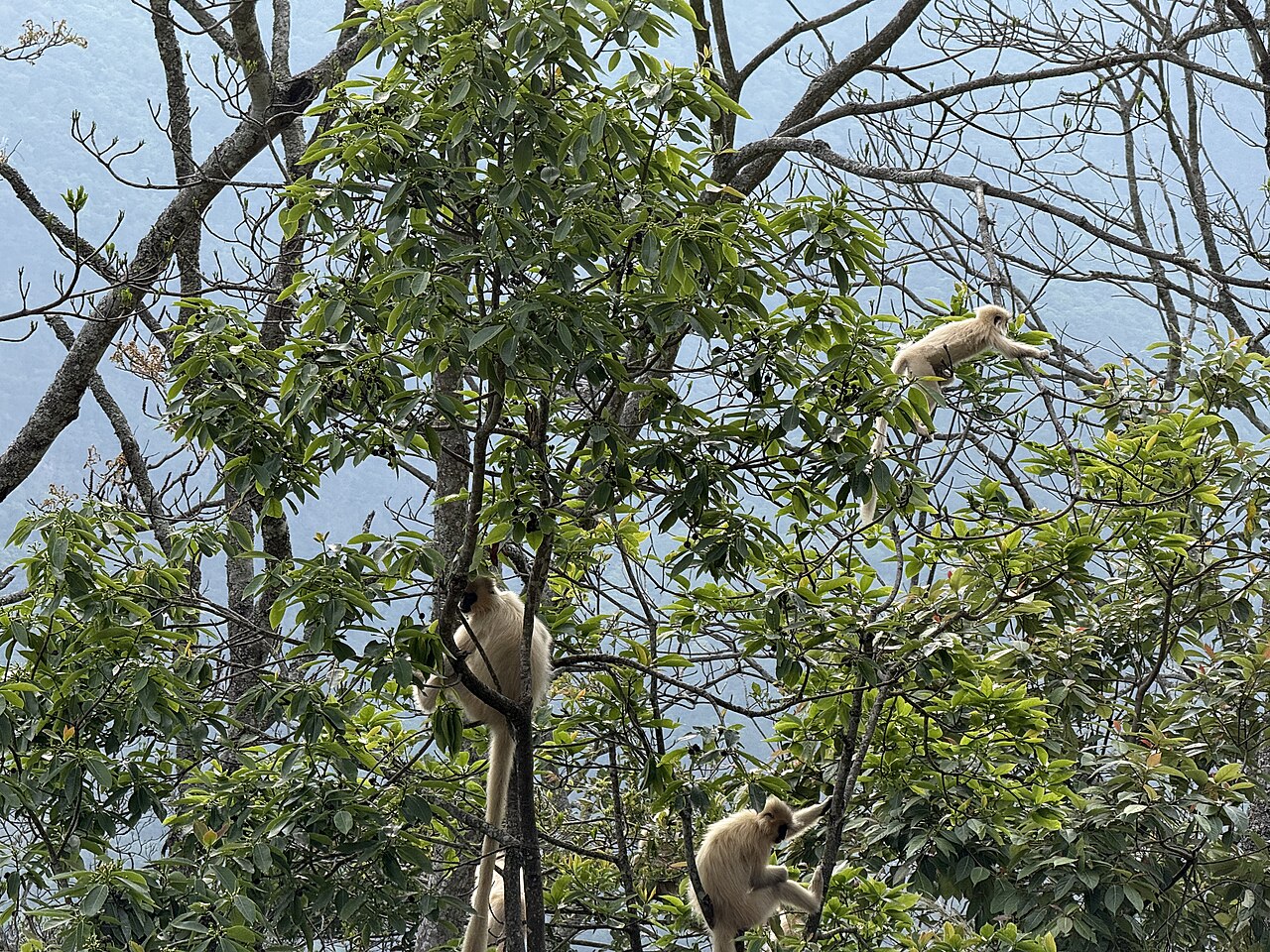
The golden langur (Trachypithecus geei), also known as Gee's golden langur, is an endangered Old World monkey native to the subtropical and tropical forests of southern Bhutan and a small adjoining area in the Indian state of Assam. Distinguished by its striking golden to creamy-white coat, the golden langur is one of the most visually remarkable primates in Asia and has become a symbol of Bhutan's rich biodiversity. The species was first scientifically described in 1956 by the Indian naturalist Edward Pritchard Gee, after whom it is named, though local communities had long been familiar with the animal.[1]
The golden langur is classified as Endangered on the IUCN Red List, with a global population estimated at approximately 6,000 to 7,000 individuals. The primary threats to the species include habitat loss from deforestation, fragmentation of forest corridors, and human encroachment. In Bhutan, the golden langur is primarily found within and around Royal Manas National Park, which forms a transboundary conservation landscape with India's Manas National Park across the border.
Physical Description
The golden langur is a medium-sized colobine monkey with a head-body length of approximately 50 to 75 centimetres and a tail that can exceed the body length by 10 to 15 centimetres. Adults weigh between 9 and 12 kilograms, with males being somewhat larger than females. The most distinctive feature is the coat, which ranges from pale cream to rich golden-orange depending on the season, age, and individual variation. The face is dark and relatively hairless, surrounded by a frame of long, golden fur. Infants are born with a nearly white coat that gradually darkens to the adult golden hue over the first few months of life.
Like other colobines, the golden langur has a specialised stomach adapted for digesting leaves, which constitute the bulk of its diet. The stomach is divided into chambers that harbour symbiotic bacteria capable of breaking down cellulose, allowing the langur to extract nutrients from mature and young leaves, fruits, flowers, and seeds. This dietary specialisation ties the species closely to intact forest habitats with diverse vegetation.
Habitat and Distribution
In Bhutan, the golden langur's range is confined to the subtropical and lower temperate forests of the southern foothills, roughly between 200 and 2,500 metres elevation. The species is found primarily in the districts of Zhemgang, Trongsa, Sarpang, and Tsirang, with the largest populations concentrated in and around Royal Manas National Park. The park's 1,057 square kilometres of tropical and subtropical forests provide critical habitat, and the transboundary connection with India's Manas National Park creates a larger contiguous conservation area that supports gene flow between populations.[2]
The golden langur inhabits both evergreen and semi-deciduous forests, showing a preference for tall riverine forests and areas with dense canopy cover. Groups are typically found along rivers and streams, where they use the tallest trees for sleeping sites. In fragmented habitats, golden langurs have been observed using isolated forest patches and even plantations, but their long-term viability in such degraded areas is questionable without habitat restoration and corridor connectivity.
Social Behaviour
Golden langurs live in groups of 4 to 40 individuals, though typical group sizes range from 8 to 15. Groups are usually organised around a single adult male with several females and their offspring, although multi-male groups also occur. The species is primarily arboreal, spending most of its time in the canopy and descending to the ground only infrequently. Group members communicate through a range of vocalisations, facial expressions, and body postures, with loud alarm calls given in response to predators such as raptors and large cats.
Social grooming is a central activity that reinforces bonds within the group. Females are philopatric, meaning they tend to remain in the group into which they were born, while males disperse upon reaching sexual maturity. Breeding is not strictly seasonal, though births in Bhutan appear to peak during the monsoon months when food availability is highest. Females typically give birth to a single infant after a gestation period of approximately six months.
Conservation Efforts
Conservation of the golden langur in Bhutan benefits from the country's extensive protected area network and its constitutional commitment to maintaining at least 60 percent forest cover. Royal Manas National Park, the flagship site for golden langur conservation, is Bhutan's oldest protected area and is recognised as a UNESCO World Heritage Site nomination candidate due to its exceptional biodiversity. The park's management includes anti-poaching patrols, community outreach programmes, and habitat monitoring.
Cross-border collaboration with India is an important component of golden langur conservation, as the species' range straddles the international boundary. Joint patrols, information sharing, and coordinated management plans between Bhutanese and Indian authorities aim to address threats such as illegal logging and poaching that can affect populations on both sides of the border. The biological corridors that connect Bhutan's protected areas, a key feature of the country's environmental policy, are critical for maintaining genetic connectivity among golden langur populations.[3]
Threats
Despite the protections afforded by Bhutan's conservation system, the golden langur faces ongoing threats. Habitat fragmentation due to road construction, agricultural expansion, and development projects in southern Bhutan is a primary concern. Roads cutting through forest areas can isolate langur populations, reducing genetic diversity and making groups more vulnerable to local extinction. The expansion of cash crop cultivation, particularly cardamom and areca nut, in the foothills has converted some areas of natural forest into plantations with reduced biodiversity value.
Electrocution on power lines is an emerging threat as Bhutan's electrical grid extends into rural areas. Golden langurs, being arboreal, frequently use power lines as bridges between forest patches, and deaths from electrocution have been reported. Conservation groups have advocated for the installation of insulated lines or wildlife crossing structures in key golden langur areas. Climate change may also affect the species by altering the composition of subtropical forests and shifting the distribution of key food plants.[1]
References
- Boonratana, R. et al. (2020). "Trachypithecus geei." IUCN Red List of Threatened Species. https://www.iucnredlist.org/species/39853/17942513
- Wangchuk, T. et al. (2014). "Status and distribution of golden langur in Bhutan." American Journal of Primatology. https://doi.org/10.1002/ajp.22071
- WWF Bhutan. "Biodiversity Conservation." https://www.wwfbhutan.org.bt/
Related articles
Know something about this topic? Edit this article or . Anonymous contributions welcome — no account required.