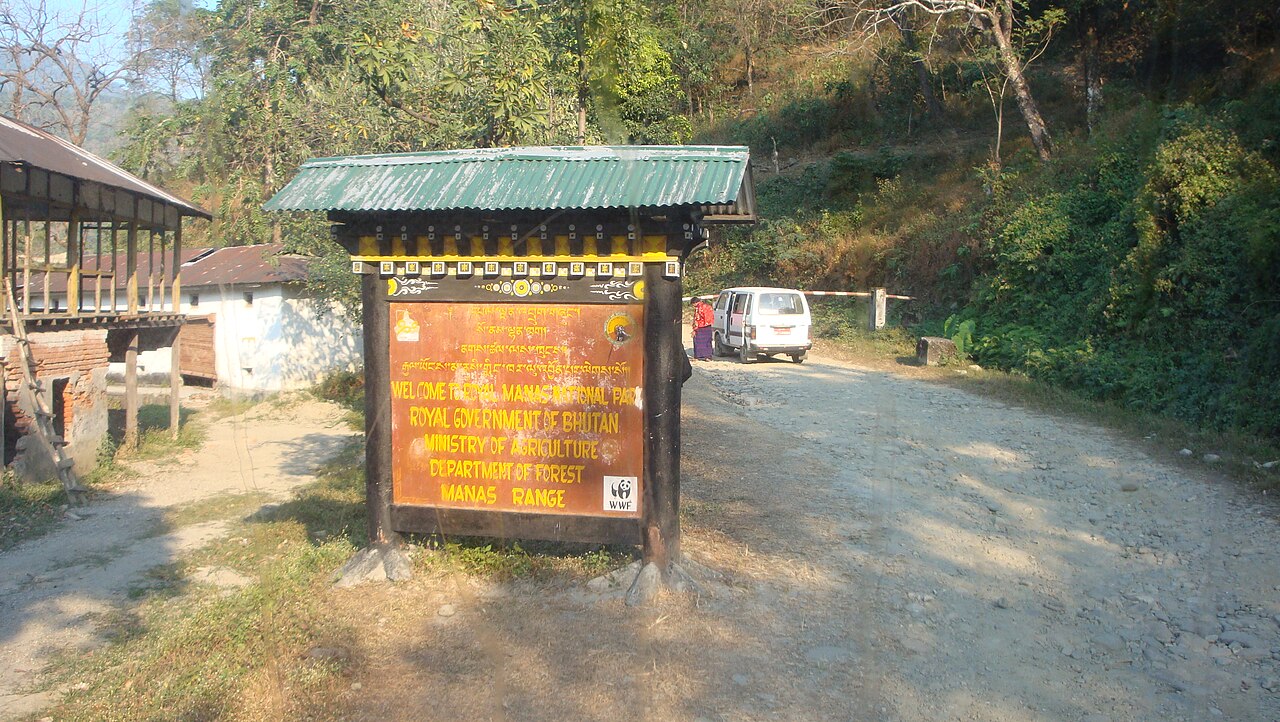

Royal Manas National Park (RMNP) is Bhutan's oldest protected area, originally established in 1966 as Manas Wildlife Sanctuary under the patronage of King Jigme Dorji Wangchuck. Upgraded to national park status in 1993, it covers 1,057 square kilometres in southern Bhutan across the districts of Sarpang, Zhemgang, and Pemagatshel. The park derives its name from the Manas River, a major tributary of the Brahmaputra, and the "Royal" designation reflects its historical status as a hunting reserve of the Bhutanese monarchy before its conversion to a conservation area.[1]
RMNP is contiguous with Manas National Park in Assam, India, forming a transboundary conservation complex that spans approximately 2,800 square kilometres. This cross-border linkage is one of the most important in South Asian conservation, enabling the movement of wide-ranging species such as elephants, tigers, and wild water buffalo between the two countries. The Bhutanese portion of the complex provides critical upland habitat that complements the floodplain ecosystems of the Indian side. In 2008, RMNP and the surrounding Bhutanese landscape were recognised by UNESCO for their global conservation significance.[2]
The park occupies some of the most biologically productive land in Bhutan, with a warm subtropical climate, heavy monsoon rainfall, and dense tropical and subtropical forests. It is connected to Jigme Singye Wangchuck National Park to the north and Phrumsengla National Park to the northeast through biological corridors, ensuring landscape-level connectivity within Bhutan's national protected area network.[1]
Geography
Royal Manas National Park lies in the southern foothills of the Bhutanese Himalayas, with elevations ranging from approximately 150 metres along the Indian border to 2,900 metres in the northern highlands. The terrain transitions from the flat alluvial plains of the Manas River floodplain in the south through rolling foothills and steep river valleys to the lower slopes of the central Bhutanese mountains. The park is drained by several major rivers, including the Manas, Kurichu, and their tributaries, which create a landscape of deep gorges, gravel-bed rivers, and forested ridges.[2]
The climate is tropical to subtropical, with temperatures ranging from 15 to 40 degrees Celsius and annual rainfall between 2,500 and 5,000 millimetres. The heavy monsoon season from June to September brings flooding to the lower river valleys but also sustains the lush forest cover that makes the park one of the most species-rich areas in the eastern Himalayas.[1]
Biodiversity
RMNP is recognised as a global biodiversity hotspot, situated within the Eastern Himalaya region identified by Conservation International as one of the world's 36 biodiversity hotspots. The park's low elevation and tropical climate support ecosystems not found elsewhere in Bhutan, including tropical evergreen forests, mixed deciduous forests, and riverine grasslands.
Flora
The vegetation of RMNP is among the most diverse in the eastern Himalayas. Tropical and subtropical forests dominate the lower elevations, featuring species such as sal (Shorea robusta), silk-cotton tree (Bombax ceiba), and various species of figs (Ficus). Higher elevations support subtropical broadleaf forests with oaks, chestnuts, and laurels. Orchids are exceptionally diverse, with over 100 species recorded. The riverine forests and grasslands along the Manas River and its tributaries support tall elephant grass (Saccharum), cane, and bamboo stands that provide essential habitat for large herbivores.[2]
Fauna
The park supports over 900 species of plants, 365 species of birds, and 85 species of mammals. It is one of the few places in Asia where the ranges of the Bengal tiger and the Asian elephant overlap within a protected area. The tiger population benefits from the transboundary corridor with India's Manas National Park, and camera-trap surveys have confirmed breeding pairs on the Bhutanese side. The Asian elephant (Elephas maximus) migrates seasonally between the Indian floodplains and the Bhutanese foothills, using traditional corridors that pass through RMNP.[1]
The park is a stronghold for the golden langur (Trachypithecus geei), an endangered primate endemic to the region spanning southern Bhutan and western Assam. Other notable mammals include the gaur (Indian bison), wild water buffalo, clouded leopard, Asiatic wild dog (dhole), pygmy hog, and hispid hare — the last two being among the world's most endangered mammals. The capped langur, Indian pangolin, and sambar deer are also present.[2]
The avifauna of RMNP includes globally threatened species such as the rufous-necked hornbill, the great hornbill, the white-bellied heron, and the Bengal florican. The Manas River itself supports the endangered Ganges river dolphin in its lower reaches near the Indian border, and the park's waterways are home to several species of freshwater turtles and the gharial.[1]
Conservation
RMNP has faced significant conservation challenges. During the 1990s, the park's southern fringes were affected by insurgent activity linked to militant groups operating from camps within Manas National Park on the Indian side, which disrupted ranger patrols and conservation programmes. The Bhutanese refugee crisis of the early 1990s also affected communities near the park. A military operation in 2003 cleared the militant camps, allowing conservation activities to resume.[2]
Current conservation priorities include anti-poaching enforcement, human-wildlife conflict mitigation (particularly elephant crop-raiding), habitat restoration, and transboundary cooperation with Indian authorities. The Royal Government of Bhutan and the Government of India have established joint patrol protocols and information-sharing mechanisms to manage the cross-border ecosystem. Community forestry groups in buffer zones around the park play an active role in forest management and wildlife monitoring.[1]
Tourism
Tourism to RMNP remains limited compared to other Bhutanese parks, partly due to its remote location and the challenging terrain. However, the park offers exceptional wildlife viewing opportunities, particularly for birdwatchers, with species diversity comparable to the most renowned birding destinations in Southeast Asia. Guided nature walks, river rafting on the Manas River, and cultural visits to nearby communities are available. The park's relative inaccessibility has helped preserve its wilderness character, making it one of the least disturbed tropical protected areas in the Himalayan region.[2]
See also
References
Related articles
Know something about this topic? Edit this article or . Anonymous contributions welcome — no account required.