.jpg)
Bhutan (Dzongkha: འབྲུག་ཡུལ་, Druk Yul, "Land of the Thunder Dragon"), officially the Kingdom of Bhutan, is a landlocked country in the Eastern Himalayas of South Asia. It is bordered by the Tibet Autonomous Region of China to the north and northwest, and by India — specifically the states of Arunachal Pradesh, Assam, West Bengal, and Sikkim — to the south, east, and west. Covering an area of 38,394 square kilometres (14,824 sq mi), Bhutan has a population of approximately 790,000. The capital and largest city is Thimphu.[1]
Bhutan is internationally recognised for its philosophy of Gross National Happiness (GNH), which prioritises holistic well-being over purely economic measures of development. The country transitioned from an absolute monarchy to a democratic constitutional monarchy in 2008 under the guidance of the Fourth King, Jigme Singye Wangchuck. Bhutan's rich Buddhist heritage, dramatic mountain landscapes, and deliberate approach to modernisation have given it a distinctive place in global affairs.[2]
Etymology
The Dzongkha name for Bhutan, Druk Yul (འབྲུག་ཡུལ་), means "Land of the Thunder Dragon," a reference to the Drukpa Kagyu school of Vajrayana Buddhism that has been the dominant religious tradition since the 17th century. The English name "Bhutan" may derive from the Sanskrit Bhoṭa-anta ("end of Tibet") or Bhu-uttan ("high land"). In historical Tibetan texts, the region was referred to as Lho Jong ("Southern Valleys") or Lho Mon Kha Shi ("Southern Land of Four Approaches").[3]
Geography
Bhutan's terrain is overwhelmingly mountainous, rising from subtropical plains in the south at approximately 200 metres above sea level to peaks exceeding 7,000 metres in the north. The highest point is Gangkhar Puensum (7,570 m), which is also the highest unclimbed mountain in the world. The country may be broadly divided into three physiographic zones: the southern Duars plain and foothills, the central Inner Himalayas with fertile valleys, and the northern Great Himalayan range. Major rivers include the Amo Chhu, Wang Chhu, Punatsang Chhu, Mangde Chhu, and Manas Chhu, all flowing southward into the Brahmaputra river system in India.[4]
Bhutan is one of the world's leading countries for environmental conservation. The 2008 Constitution mandates that a minimum of 60 per cent of the country's total land area shall be maintained under forest cover for all time. In practice, over 70 per cent of Bhutan is forested. The country is carbon negative, absorbing more carbon dioxide through its forests than it emits. Protected areas, including national parks such as Jigme Dorji National Park and Jigme Singye Wangchuck National Park, cover more than half the national territory and are connected by a network of biological corridors.[5]
History
Archaeological evidence suggests human habitation in Bhutan from at least 2000 BCE. Buddhism was introduced in the 7th century CE, traditionally attributed to the visit of the Tibetan king Songtsen Gampo, and was further established by Guru Padmasambhava (Guru Rinpoche) in the 8th century. Bhutan's political history as a unified state begins with Zhabdrung Ngawang Namgyal (1594–1651), a Tibetan Buddhist lama who arrived in Bhutan in 1616. The Zhabdrung unified the warring fiefdoms, repelled Tibetan invasions, established a distinctive Bhutanese identity, and created the dual system of government (chhoe-sid) in which a Je Khenpo (Chief Abbot) headed religious affairs and a Druk Desi (secular ruler) managed civil administration. He also commissioned the construction of a network of dzongs (fortress-monasteries) that remain central to Bhutanese governance and culture.[6]
Following the Zhabdrung's death, the dual system gradually weakened amid internal conflicts and civil wars. By the late 19th century, the Penlop of Trongsa, Ugyen Wangchuck, emerged as the dominant political figure. On 17 December 1907, he was unanimously elected as the first hereditary King by an assembly of leading monks, officials, and heads of prominent families, establishing the Wangchuck dynasty and ending nearly three centuries of the dual system. The monarchy oversaw Bhutan's gradual modernisation while preserving its sovereignty and cultural identity.[7]
The Third King, Jigme Dorji Wangchuck (r. 1952–1972), initiated sweeping reforms: abolishing serfdom, establishing the National Assembly, joining the United Nations in 1971, and beginning Bhutan's planned economic development. The Fourth King, Jigme Singye Wangchuck (r. 1972–2006), articulated the philosophy of Gross National Happiness and, in a historic act of voluntary devolution, initiated the drafting of a constitution and the transition to democratic governance. The first democratic elections were held in 2008, and the Fifth King, Jigme Khesar Namgyel Wangchuck, was crowned on 1 November 2008.[8]
Government and Politics
Bhutan is a democratic constitutional monarchy. The Druk Gyalpo (King) is the head of state, and the Prime Minister is the head of government. The bicameral Parliament consists of the National Assembly (47 elected members) and the National Council (25 members: 20 elected and 5 appointed by the King). The judiciary is independent, with the Supreme Court at its apex. Bhutan's unique two-party general election system allows only two parties — determined through a primary round — to contest seats in the National Assembly. The current Prime Minister, Tshering Tobgay, took office in January 2024 following the People's Democratic Party's victory in the 2024 general election.[9]
Demographics and Languages
Bhutan's population of approximately 790,000 comprises three principal ethnic groups: the Ngalop of western Bhutan, who are of Tibetan origin; the Sharchop of eastern Bhutan, considered the country's earliest recorded inhabitants; and the Lhotshampa of Nepali origin in the south. The official language is Dzongkha, a Tibeto-Burman language closely related to Tibetan. Other widely spoken languages include Tshangla (Sharchopkha) in the east and Nepali (Lhotshamkha) in the south. English serves as the medium of instruction in schools and is widely used in government and commerce.[10]
Religion
Vajrayana Buddhism, specifically the Drukpa Kagyu and Nyingma traditions, is the state religion of Bhutan, practised by approximately 75 per cent of the population. The Je Khenpo heads the Dratshang Lhentshog (Commission for Monastic Affairs), which oversees religious institutions. Hinduism, practised predominantly by the Lhotshampa in the south, is the second largest religion. The Constitution guarantees freedom of religion while designating Buddhism as the spiritual heritage of Bhutan.[11]
Economy
Bhutan's economy is small, open, and heavily dependent on hydroelectric power, tourism, and agriculture. Hydropower is the country's foremost revenue source, accounting for approximately 14 per cent of GDP and a quarter of government revenues, with an installed capacity of around 2,500 MW and a theoretical potential exceeding 30,000 MW. Bhutan exports the majority of its electricity to India under bilateral agreements. Tourism follows a "high-value, low-volume" model, requiring visitors to pay a daily Sustainable Development Fee. Agriculture, consisting largely of subsistence farming and animal husbandry, provides the primary livelihood for over 60 per cent of the population, though its contribution to GDP has been declining. Bhutan's real GDP grew by an estimated 4.8 per cent in fiscal year 2024–2025, placing it among the faster-growing economies in South Asia.[12]
The government's ambitious Gelephu Mindfulness City project, announced in late 2023, aims to create a new economic hub on the southern border with India, envisioning a special administrative zone designed to attract foreign investment while adhering to GNH principles.
Culture
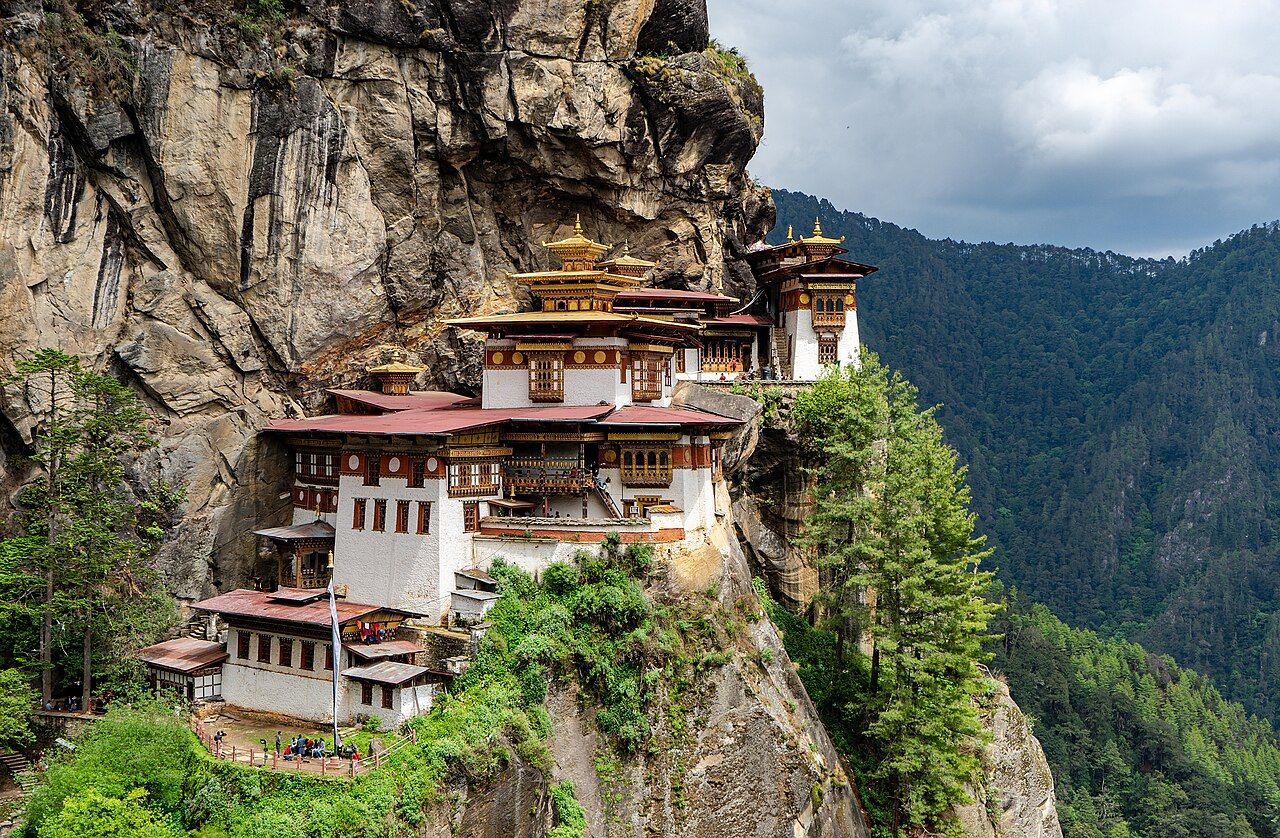
Bhutanese culture is deeply rooted in its Buddhist heritage. The dzong architecture of fortress-monasteries, traditional dress codes — the gho for men and kira for women, mandated in public and government settings under the policy of Driglam Namzha — and vibrant annual tshechu (religious festivals) featuring masked cham dances are defining elements of national identity. Bhutan was one of the last countries in the world to introduce television and the internet, both arriving in 1999. The government's deliberate approach to modernisation reflects a broader commitment to balancing development with cultural preservation.
Administrative Divisions
Bhutan is divided into 20 dzongkhags (districts), 205 gewogs (village blocks), and 4 self-governing thromdes (municipalities: Thimphu, Phuentsholing, Gelephu, and Samdrup Jongkhar). Each dzongkhag is administered by a Dzongdag (District Administrator) and an elected Dzongkhag Tshogdu (District Council). At the village level, each gewog is governed by an elected Gewog Tshogde (gewog council), headed by a Gup (headman).
References
- "Bhutan." Encyclopaedia Britannica.
- "Bhutan." The World Factbook, Central Intelligence Agency.
- "Bhutan." Encyclopaedia Britannica.
- "Bhutan." Encyclopaedia Britannica.
- "Bhutan." The World Factbook, Central Intelligence Agency.
- "History." Royal Bhutanese Embassy, New Delhi.
- "Creation of Modern Bhutan in 1907 and Its First Four Kings." Facts and Details.
- "Bhutan." Encyclopaedia Britannica.
- "Bhutan: Freedom in the World 2024 Country Report." Freedom House.
- "Bhutan." The World Factbook, Central Intelligence Agency.
- "Bhutan." Encyclopaedia Britannica.
- "Bhutan's Economy Maintains Robust Growth Despite Challenges." World Bank, 2 May 2024.
Related articles
Know something about this topic? Edit this article or . Anonymous contributions welcome — no account required.