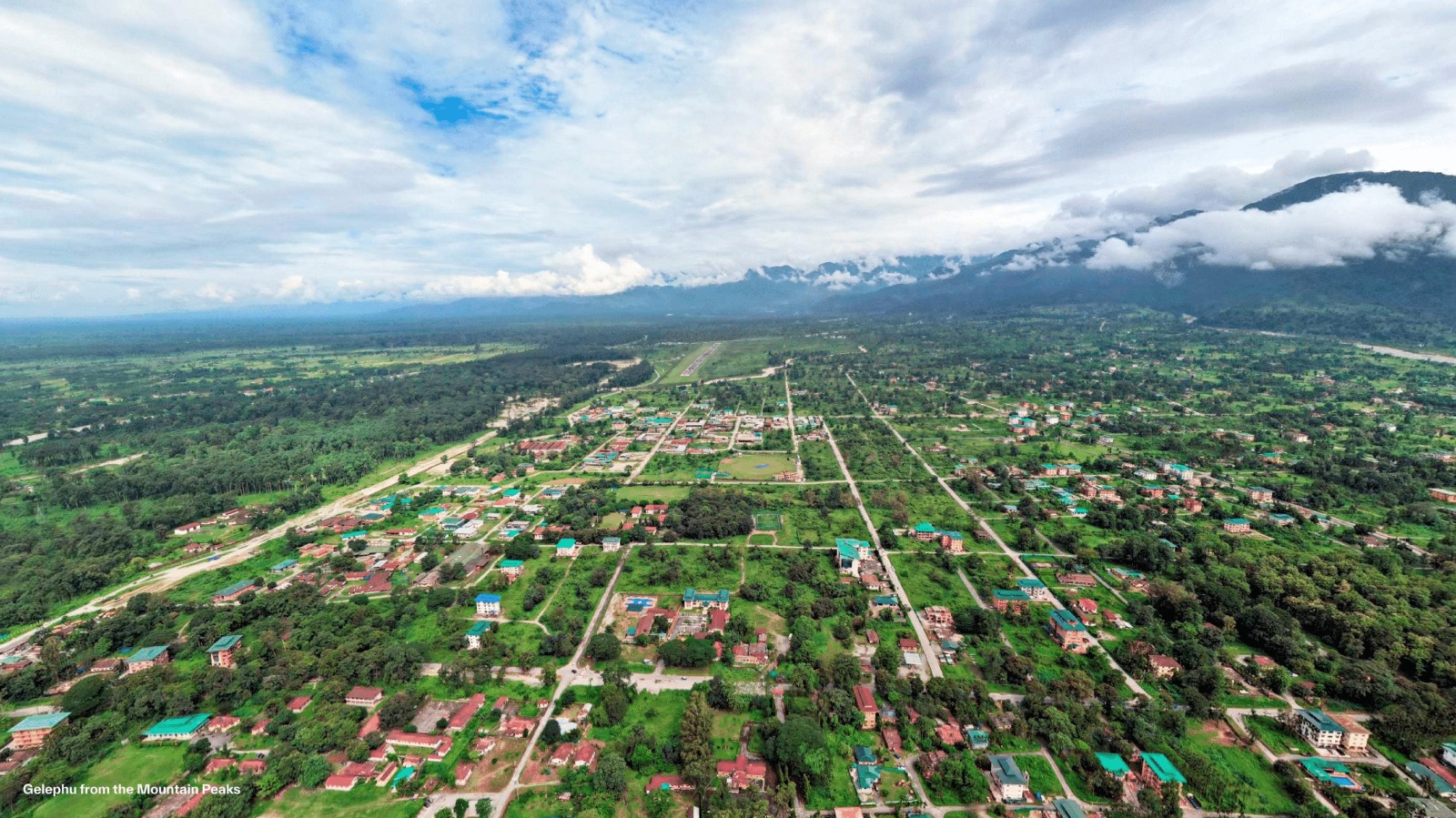
Gelephu Mindfulness City (GMC) is a planned special administrative region (SAR) of approximately 2,500 square kilometres in Sarpang Dzongkhag, southern Bhutan. King Jigme Khesar Namgyel Wangchuck announced the project during his address to roughly 30,000 citizens at the 116th National Day celebration on 17 December 2023, and formally established it by Royal Charter No. 1 of 2024, granted on 13 February 2024.[1][2]
The masterplan was prepared by the Danish architecture firm BIG–Bjarke Ingels Group with engineering consultancy Arup and urban planning firm Cistri. GMC is described by its proponents as an attempt to combine the philosophy of Gross National Happiness with a Singapore-style legal and tax regime, positioning the SAR as a regional connectivity hub between South and Southeast Asia. Backers describe it as the world’s first “mindfulness city” and the world’s first carbon-negative city.[3]
As of September 2026, the project remains in an early development phase. Site preparation and limited groundbreaking have begun, the Application of Laws Act 2024 entered force on 26 December 2024, and the King visited the site in March 2026 to inspect land identified for a planned 108 chortens. Construction of the main runway and terminal at Gelephu International Airport began in April 2026, and completion of the wider city is projected over roughly a decade. The project has attracted endorsements from international economists, technology executives, and architecture critics, but has also drawn substantive criticism over fiscal viability, governance opacity, environmental risk, and the historical Lhotshampa land question in Sarpang.[4][5]
Background and royal vision
GMC is the signature initiative of the fifth reign and is framed by the monarchy as a response to a set of converging pressures on the Bhutanese economy. The country’s revenue base is concentrated in hydropower exports to India and tourism, both of which are exposed to external shocks. Public debt—driven largely by hydropower construction—sat near 110 per cent of GDP through the early 2020s, according to IMF Article IV reports. Youth unemployment has risen sharply since the COVID-19 pandemic, and emigration of skilled workers, particularly to Australia, has reached a scale that the King has publicly described as an “existential threat” to the country.[6]
Against this backdrop, the King has presented GMC as both an economic diversification project and a project of national renewal—an attempt to give educated Bhutanese a reason to remain in or return to the country. The royal speeches associated with the project have placed it within a longer narrative running from Zhabdrung Ngawang Namgyal’s 17th-century unification through to the founding of the Wangchuck dynasty in 1907, framing GMC as the next chapter of state-building. Independent observers have noted that this framing reinforces the centrality of the throne in the project’s decision-making and public communication.[7]
The 17 December 2023 announcement
The King announced the project from the dzong courtyard at Changlingmithang Stadium in Thimphu during the 116th National Day address on 17 December 2023. The speech, broadcast live on BBS and reproduced in full by Kuensel, identified Gelephu as the location of a future “mindfulness city” with its own legal and economic framework. The announcement was unusually detailed for a Bhutanese policy address, naming Singapore-derived law as a likely model and signalling that the project would be designed by an international architecture firm.[8]
BIG–Bjarke Ingels Group released its masterplan to coincide with the address, ensuring that the visual identity of the project entered international circulation within hours. Coverage in domestic media treated the announcement as a national mission and made little distinction between the King’s statement and an operational plan; foreign coverage was more variable, with architecture publications reproducing the BIG renderings approvingly while business and geopolitical press flagged questions about scale, financing, and feasibility.[3]
Bjarke Ingels Group masterplan
The BIG–Arup–Cistri masterplan organises the SAR around the nine domains of the GNH Index—psychological wellbeing, health, time use, education, cultural diversity, good governance, community vitality, ecological diversity, and living standards—and proposes eleven neighbourhoods structured as urban terraces stepping from the surrounding hills toward the valley floor. Neighbourhoods are separated by river corridors and connected by what BIG calls “inhabitable bridges”: linear structures that combine transportation infrastructure with civic, cultural, and commercial functions, each tailored to a particular GNH domain.[3]
The architectural vocabulary draws on traditional Bhutanese typologies—low-rise timber and stone construction, sloped roofs, mandala-based block layouts—while integrating contemporary sustainable design. The plan envisages the city as plastic-free, powered by hydroelectric energy, and designed to be carbon-negative from inception. A new international airport, a temple integrated with a hydroelectric dam, an east–west rail corridor, and several large institutional precincts (a university quarter, a hospital quarter, a cultural quarter) are presented as anchor projects.[9]
The masterplan covers the active development zone of roughly 1,000 square kilometres within the larger SAR boundary of approximately 2,500 square kilometres—an area equivalent to about five per cent of Bhutan’s total land surface and roughly three times the area of Singapore. Bjarke Ingels described the design at the project launch as “a new paradigm for urban development that proves sustainability and prosperity are not in conflict.” In May 2025 the masterplan received a Holcim Foundation Award for Sustainable Construction at the regional level.[10]
The GMC Act 2024 and SAR legal architecture
GMC is constituted by Royal Charter No. 1 of 2024, granted by the King on 13 February 2024. The Charter establishes the SAR as a highly autonomous administrative region with full executive, legislative, and judicial authority, while preserving Bhutanese sovereignty over the territory and ultimate authority of the throne. Article 3 of the Charter creates the GMC Authority as the central governance institution; until specialised regulatory and judicial bodies are operational, the Authority exercises all executive and judicial functions under Section 11 of the Application of Laws Act.[11]
The substantive law applicable inside the SAR is set by the Application of Laws Act 2024, enacted under Article 4(2) of the Charter and brought into force on 26 December 2024. The Act incorporates 18 Singaporean common-law statutes—covering areas such as company incorporation, contracts, employment, tort, taxation, and dispute resolution—together with 10 financial-services laws drawn from the Abu Dhabi Global Market (ADGM) covering company law, financial services regulation, and arbitration. The result is a hybrid legal system designed to be familiar to international investors and law firms.[12]
The King serves as Chairman of the GMC Board. Mun Leong Liew, former chief executive of CapitaLand, was appointed CEO. Joichi (Joi) Ito, former director of the MIT Media Lab, sits on the Board. Former Prime Minister Dasho Lotay Tshering was appointed Governor of the SAR in 2024 and is responsible for domestic implementation. Independent legal commentators have described the framework as an unusual experiment in legal pluralism within a constitutional monarchy and have raised questions about how the Bhutanese Supreme Court’s interpretive role over the Constitution will interact with a parallel system of imported common law.[13]
Investor incentives and tax regime
The GMC tax regime is designed to be competitive with Singapore and the Gulf free zones. Headline features include a corporate income tax rate of 17 per cent, a zero per cent rate on capital gains, a one-tier system under which dividends distributed to shareholders are not taxed at the shareholder level, and indefinite carry-forward of business losses. Additional sectoral incentives are available at the discretion of the GMC Authority for projects deemed strategically aligned with the SAR’s priorities.[14]
Land acquisition and the Sarpang context
Gelephu sits in Sarpang Dzongkhag, on the Indo-Bhutan border with the Indian state of Assam. The land area now designated for GMC overlaps in part with territory historically inhabited by Lhotshampa (ethnic Nepali-speaking) communities. Beginning in the late 1980s, Bhutan implemented citizenship and cultural-conformity policies that resulted in the departure of over 100,000 Lhotshampa from southern districts including Sarpang, Samtse, Chirang, and Dagana. Most fled to camps in eastern Nepal, and the majority were subsequently resettled in third countries between 2007 and 2018; this episode is documented in detail by Hutt (2003), Human Rights Watch, and UNHCR records, and is referenced in BhutanWiki’s coverage of the Bhutanese refugee crisis.[15]
The connection between this history and the GMC project has become a recurrent theme in coverage by the Bhutanese refugee diaspora and in foreign press outside the architecture and business beats. Reporting in the South China Morning Post (2024), Inkstick Media, Sapan News, and Nepali Times has cited interviews with former Sarpang landholders and refugee community leaders who say they retain pre-1990 land titles for parcels that fall within the SAR boundary, and who argue that no acknowledgment, restitution, or compensation has been offered. Estimates of how many of the project’s designated landholdings have a contested ownership history vary; figures of around 40,000 hectares have been quoted by diaspora organisations, though these have not been independently verified by Bhutanese government sources.[5][16]
The Royal Government of Bhutan has not addressed these specific claims in the context of the GMC project. The official GMC website, BBS coverage, and Kuensel reporting describe land assembly within the SAR as a routine state process and do not engage with the pre-1990 demographic history of the area. Domestic Bhutanese media has not, as of early 2026, published independent investigative reporting on the question; this absence is itself significant given the documented pattern of self-censorship in Bhutan-based outlets, which Reporters Without Borders has tracked through Bhutan’s sharp fall in its press-freedom rankings (from 33rd in 2022 to 152nd in 2025).[17]
Infrastructure plans
Gelephu International Airport
The centrepiece of the proposed transport infrastructure is a new international airport designed by BIG and unveiled at the 2025 Venice Architecture Biennale. The first phase is sized for approximately 1.3 million passengers a year, with capacity for expansion to 5.5 million. Proponents present the airport as an alternative to Paro International Airport, whose mountain approach restricts the size of aircraft that can serve Bhutan and constrains tourist arrivals. Site preparation and a relocation programme for households in the airport footprint were under way through 2025; Kuensel reported on resettlement of affected residents during the year.[18]
Rail and road links to India
The masterplan envisages a rail corridor connecting Gelephu to the Indian railway network in Assam, alongside upgraded highway links to Phuentsholing and to the planned trans-Bhutan east–west expressway. India and Bhutan agreed in principle in 2024 to study a cross-border rail link via Kokrajhar in Assam; financing arrangements and timelines remain under discussion as of early 2026.[7]
Financing, diplomatic outreach, and investor pipeline
GMC’s financing model relies on a combination of sovereign borrowing, foreign direct investment, and unconventional instruments. In 2025 Bhutan launched the Gelephu Nation Building Bond, a domestic retail bond originally targeted at Nu 2 billion which was oversubscribed within days and raised approximately Nu 3.347 billion from over 35,000 Bhutanese investors—the most widely subscribed debt issuance in the country’s history. Proceeds are earmarked for the airport project. A separate USD-denominated international bond at the order of USD 100 million has also been reported.[19]
On 17 December 2025, marking the second anniversary of the project, the King announced a Bitcoin Development Pledge committing up to 10,000 BTC—valued at approximately USD 1 billion at the time of the announcement—from Bhutan’s sovereign cryptocurrency holdings to support GMC development. The Bhutanese sovereign holdings are managed through Druk Holding and Investments, which has been mining Bitcoin using surplus hydroelectric power since at least 2019. The Bitcoin commitment is described by the government as collateral- and yield-based rather than involving the immediate sale of reserves.[20]
The total project cost has been variously cited at figures ranging from USD 15 billion (the Indian investor outreach figure used in 2024) to USD 100 billion (used in some 2025 promotional materials). These figures are pledges and aspirational headlines rather than committed or disbursed capital. As of early 2026 the publicly verifiable disbursed financing—the domestic bond, the international bond tranche, and the Bitcoin pledge—is in the low single-digit billions of US dollars, an order of magnitude below the headline cost figures. Diplomatic outreach has focused on India, Singapore, the UAE, and the Bhutanese diaspora in Australia; the King and Queen Jetsun Pema visited Australia in October 2024 in part to promote the project to the diaspora community.[21]
Domestic reception
Domestic Bhutanese media coverage of GMC has been overwhelmingly supportive. Kuensel and BBS, both subject to the structural pressures of self-censorship and government advertising dependency that characterise Bhutan’s media sector, have covered GMC as a national mission and have largely reproduced statements from the GMC Authority and the Royal Government without independent verification. The Bhutanese, an independent newspaper, has carried more questioning commentary on financing and governance but has not published sustained investigative reporting on the project. Discussions in the National Assembly during 2024 and 2025 endorsed the broad direction of the project and concentrated on procedural questions about the relationship between SAR institutions and the wider Bhutanese state.[22]
Foreign scrutiny and analysis
Foreign coverage of GMC has split along three lines. Architecture and design publications—including ArchDaily, Dezeen, Archello, and the journals associated with the Venice Biennale—have reproduced the BIG renderings and presented the project as a major commission with limited critical commentary. Business and economic outlets—notably TIME, the Financial Times, Nikkei Asia, Bloomberg, and Fortune—have focused on the financing model, the comparison with other free-zone experiments such as NEOM and Forest City Johor, and the implications for Bhutan’s public debt and macroeconomic stability. Geopolitical analysts at the Observer Research Foundation, Brookings, the Stimson Center, and Carnegie India have framed GMC within the India–China–Bhutan strategic triangle, noting that Indian financing and infrastructure cooperation are likely to be decisive for the airport and rail components.[23]
Press freedom and human rights coverage of GMC has been thinner, but has included reporting in the South China Morning Post, Inkstick Media, Sapan News, Nepali Times, Scroll.in, and Al Jazeera, each of which has highlighted the Lhotshampa land question. Carnegie India and Brookings analyses have noted that the gap between the headline cost of GMC and Bhutan’s fiscal capacity is one of the largest of any current sovereign development project and that the country’s ability to absorb cost overruns is limited.[24]
Environmental considerations
Environmental coverage of GMC is the least developed strand in the available documentation. The SAR boundary lies adjacent to Royal Manas National Park, the southernmost of Bhutan’s protected areas and a UNESCO World Heritage tentative site, which forms a transboundary biological corridor with India’s Manas Tiger Reserve. The corridor supports populations of Bengal tiger, Asian elephant, golden langur, and pygmy hog, several of which are highly sensitive to habitat fragmentation. No public environmental impact assessment for the full GMC footprint has been released as of early 2026, and there has been no independent environmental review of the cumulative effects of the airport, rail corridor, urban expansion, and associated hydropower infrastructure on the Manas corridor.[25]
The carbon-negative pledge for the city sits in tension with the carbon footprint of large-scale concrete and steel construction over a decade-plus build-out, the operational emissions of an international airport designed for 5.5 million annual passengers, and the embedded emissions of associated transport infrastructure. Independent climate analysts have noted that “carbon-negative city” claims of this kind typically depend on offset accounting that nets construction and operational emissions against the country’s existing forest sink rather than against a city-specific baseline.
Critiques
The principal critiques of GMC, as expressed by independent analysts, fall into four categories.
Financial viability. The headline cost figures (USD 15–100 billion across various promotional materials) are large multiples of Bhutan’s annual GDP (around USD 2.7 billion in 2023). Existing public debt, dominated by hydropower borrowing, is already close to or above 100 per cent of GDP. The Brookings, Carnegie India, and IMF Article IV analyses all flag concentration risk, debt sustainability, and the absence of a transparent project cost baseline.[23]
Environmental risk. The cumulative effect on the Manas transboundary corridor, the absence of a full independent environmental impact assessment, and the tension between the carbon-negative pledge and the project’s construction footprint are flagged repeatedly in academic and conservation commentary.
Displacement and historical land claims. The Sarpang/Lhotshampa land question, documented in the Inkstick, Sapan News, SCMP, Scroll, and Nepali Times reporting cited above, has not been engaged with by the Royal Government or by Bhutan-based media. Diaspora organisations and human rights observers describe this silence as a structural problem with the project’s legitimacy.
Democratic legitimacy. The Royal Charter, the Application of Laws Act, the appointment of the Board, and the strategic direction of GMC all flow from the throne and the GMC Authority rather than from the elected institutions of the Bhutanese state. Constitutional commentators have noted that the SAR creates a parallel governance system within Bhutan whose accountability mechanisms have not yet been tested and which sits outside the supervisory architecture established by the 2008 Constitution.[13]
Current status (2026)
As of early 2026, GMC is in an early development phase. The Royal Charter and the Application of Laws Act are in force. The GMC Authority is operational and has appointed its core leadership team. Site preparation for the airport is under way and a relocation programme is in progress for households in the airport footprint. The Gelephu Nation Building Bond has been issued and subscribed. The Bitcoin Development Pledge was announced on 17 December 2025. The King visited the GMC site on 24 March 2026 to inspect land identified for a planned 108 chortens (stupas), described by the GMC Authority as a landmark spiritual installation within the city. Construction of the main runway and terminal at Gelephu International Airport began in April 2026, and the airport is scheduled to open in 2029. Public reporting on procurement tenders for the airport intensified in early 2026.[4]
Gelephu–Tareythang road and bridges (2026)
Among the major infrastructure works tied to the city’s development is the Gelephu–Tareythang road and bridges project: a 14-kilometre road with five major bridges, including a 1,005-metre crossing of the Mau River, at an estimated cost of USD 190 million. The Mau River bridge incorporates a roughly 250-metre dedicated elephant corridor beneath it, reflecting the area’s importance as elephant habitat. Delivered under the World Bank–supported ACCESS (Accelerating Transport and Trade Connectivity in Eastern South Asia) programme and implemented by the Department of Surface Transport, the project held an early-market-engagement event on 30 March 2026 and began an international roadshow in India in June 2026 to attract global contractors. (Sources: Ministry of Infrastructure and Transport; Kuensel, 3 June 2026.)
Developments during 2026
Public mobilisation became the most visible strand of the project during 2026. More than 16,000 registered volunteers gathered in Gelephu from 21 to 25 February 2026 for the fifth round of voluntary service in support of GMC, which Kuensel described as the largest public mobilisation since the initiative began. A seventh round followed from 28 to 30 August 2026, drawing more than 3,000 volunteers to landscaping and clearing work in Gelephu old town, along the highway between the airport and the town, and at the site designated for the 108 chortens; the King, the Gyaltsuen, and their children visited the work sites. (Sources: Kuensel, 25 February 2026; Daily Bhutan.)
The chorten scheme was formalised as Project 108, announced by the King on 21 February 2026: 108 chortens of 15 metres each, set along roughly 11.7 kilometres of the Mau Chhu corridor and intended to be raised simultaneously on 1 November 2026 using volunteer labour. On 1 May 2026 the King granted Royal Kashos to eight further spiritual projects at a ceremony at Semtokha Dzong, bringing the number of approved sacred sites within GMC to 22. (Sources: Project 108, GMC; Kuensel, 2 May 2026.)
On the commercial side, the GMC Tourism Investment Opportunity Forum on 22 June 2026 launched a Tourism Spark Fund, which set out 40 investment-ready propositions—20 attractions and 20 activities—directed at wellness, cultural, and sustainable tourism operators. Rabsel Dorji, managing director of Tourism GMC, presented the fund as a means of bridging the financing gap facing tourism start-ups and small businesses; the smaller propositions were costed at between USD 10,000 and USD 50,000 each. (Sources: Kuensel; Daily Bhutan.)
See also
- Gelephu
- Sarpang District
- Lhotshampa
- Bhutanese refugee crisis
- Gross National Happiness
- King Jigme Khesar Namgyel Wangchuck
- Druk Holding and Investments
- Royal Manas National Park
- Bhutan’s hydropower debt
- Bhutan–Australia relations
- Gelephu Mindfulness City: Economic Analysis
References
- Gelephu Mindfulness City — Wikipedia
- The Legal Framework of GMC: Application of Laws Act 2024 — Basnet Law
- Gelephu Mindfulness City — BIG–Bjarke Ingels Group
- Bhutan’s Mindfulness City Airport: 2026 Procurement Boom — TendersGo
- Displaced ethnic Nepalis fume over Bhutan’s ‘mindfulness city’ plan — South China Morning Post
- Inside Bhutan’s Plan to Boost Its Economy With ‘Mindful Capitalism’ — TIME
- Gelephu: The World’s First Mindfulness City Is in Bhutan — The Diplomat
- His Majesty’s 116th National Day Address — Kuensel Online
- BIG Unveils Design for Gelephu International Airport — ArchDaily
- Gelephu Mindfulness City — Holcim Foundation Awards 2025
- GMC: A New Paradigm for Special Administrative Regions — Basnet Law
- GMC adopts 18 Singaporean laws and 10 Abu Dhabi financial regulations — Kuensel Online
- Realigning Bhutan’s Contract Act with GMC’s legal framework — Kuensel Online
- Invest in GMC: Zero-Tax Dividend and Capital Gains — Basnet Law
- Bhutan: The Last Hope — Human Rights Watch (2003)
- What Will Bhutan’s Mindfulness City Mean for the Displaced Lhotshampa? — Inkstick Media
- Bhutan country profile — Reporters Without Borders
- Relocation underway for Gelephu international airport project — Kuensel Online
- Gelephu Nation Building Bond raises Nu 3.3 billion — Kuensel Online
- Bhutan Commits Up to 10,000 Bitcoin to Back GMC — CoinDesk
- Bhutan woos Indian investors for $15bn Gelephu Mindfulness City — The Financial World
- GMC unveils landmark law to drive global innovation — Kuensel Online
- Bhutan’s bold growth strategy: hydropower, crypto, Gelephu — Brookings
- The dark shadows of Bhutan’s Gelephu mindfulness city project — Scroll.in
- Royal Manas National Park — UNESCO World Heritage Tentative List
Related articles
Know something about this topic? Edit this article or . Anonymous contributions welcome — no account required.