Ugyen Wangchuck
From BhutanWiki, the people's encyclopedia of Bhutan · people · Verified
This article is about a living or recently deceased person. Edits must be supported by reliable, verifiable sources. Unsupported or potentially defamatory content will be removed.
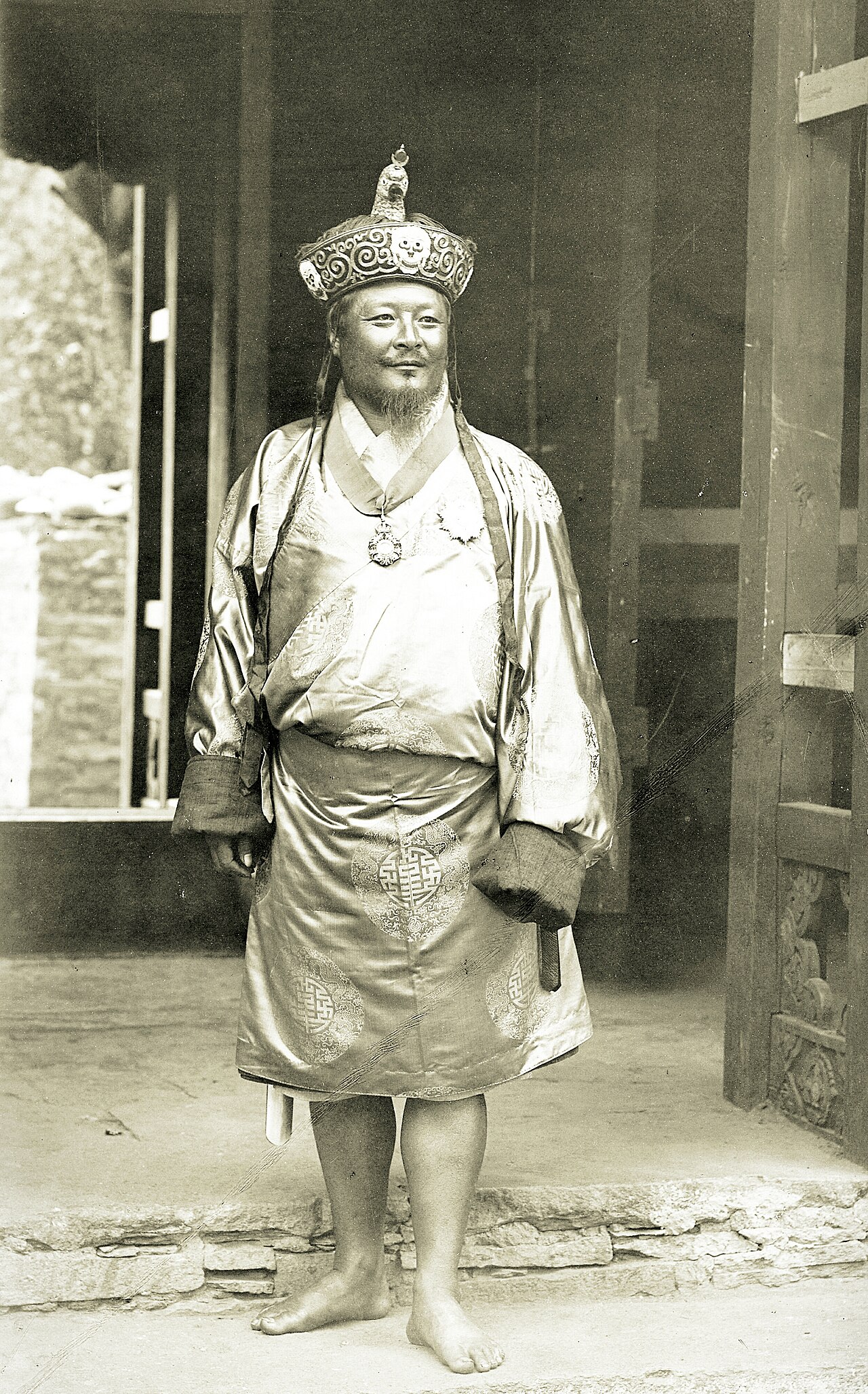

Sir Ugyen Wangchuck (11 June 1862 – 21 August 1926) was the founder and first hereditary monarch of Bhutan, reigning from 17 December 1907 until his death. Known in Bhutanese as Gongsar Ugyen Wangchuck, he rose from his hereditary position as Penlop (governor) of Trongsa to unify a country fragmented by civil conflict, cultivating a decisive alliance with British India and earning the unanimous endorsement of Bhutan's clergy, nobility, and representatives. The date of his coronation — 17 December 1907 — is celebrated annually as Bhutan's National Day (Gyalyong Duechen). He was succeeded by his son Jigme Wangchuck, the Second Druk Gyalpo, and the Wangchuck dynasty he founded continues with the Fifth King today.
Early Life and Rise to Power
Ugyen Wangchuck was born at Wangdicholing Palace in Jakar, Bumthang, in central Bhutan, into one of the most powerful aristocratic families in the country. His father, Jigme Namgyal, had served as the Druk Desi (secular ruler) and Trongsa Penlop — the governorship of Trongsa being the most strategically powerful regional position in Bhutan, controlling the principal routes linking eastern and western parts of the country.
Inheriting the Trongsa Penlop position, Ugyen Wangchuck deployed it as a base from which to project influence across a country riven by conflict between regional governors. Bhutan's late nineteenth century was marked by recurring civil wars and power struggles between rival penlops and the theoretically supreme but practically weakened Druk Desi. Ugyen Wangchuck's decisive victory at the Battle of Changlimithang in 1885 established him as the dominant political figure in the country, subordinating rival governors and beginning the process of real unification under a single authority. In 1894, aged 33, he undertook the construction of Kurjey Temple in Bumthang, one of the most important Vajrayana Buddhist sites in Bhutan — an act that demonstrated his commitment to religious patronage as part of the consolidation of legitimate authority.
Relations with British India
Ugyen Wangchuck's diplomatic acumen was perhaps most consequentially expressed in his relationship with British India. He served as an indispensable mediator during the Younghusband Expedition to Tibet in 1903–1904, facilitating negotiations between the British military mission and Tibetan authorities at a moment of considerable regional tension. His services were rewarded by the British Crown with the appointment as Knight Commander of the Indian Empire (KCIE) in 1905, conferred by British Political Officer Sir John Claude White — recognition that substantially enhanced his prestige both domestically and in the eyes of external powers.
This relationship with British India was formalised after his coronation in the Treaty of Punakha (1910), which established that Bhutan would be guided by British advice in external affairs in exchange for non-interference in its internal governance — a carefully balanced arrangement that preserved Bhutanese sovereignty in domestic matters whilst providing the security of British patronage in the external sphere.
Coronation and Reign
On 17 December 1907, at Punakha Dzong, an assembly of representatives drawn from the clergy, the nobility, and the people unanimously elected and enthroned Ugyen Wangchuck as the first hereditary King of Bhutan — the first Druk Gyalpo. Sir John Claude White, representing the British government, attended the ceremony. The enthronement ended the dual-governance system that had theoretically shared power between the secular Druk Desi and the religious Je Khenpo, replacing it with a clear hereditary monarchy.
His reign of nearly nineteen years was characterised by the consolidation of central authority, the pacification of remaining regional rivalries, and the establishment of Bhutan as a coherent nation-state. He died on 21 August 1926 at Thinley Rabten Palace in Wangdue Phodrang, in the presence of his eldest son, who succeeded him.
Legacy
Ugyen Wangchuck's legacy is foundational for modern Bhutan. The political settlement he achieved — unifying a fragmented polity under hereditary monarchy, securing a workable relationship with the dominant regional power, and grounding royal authority in both military achievement and religious patronage — created the stable framework within which all subsequent Bhutanese governance has developed. The dynasty he established has guided the country through modernisation, democratisation, and its emergence as a constitutionally governed nation under the 2008 Constitution. National Day on 17 December remains the most significant civic commemoration in the Bhutanese calendar.
References
Related articles
Know something about this topic? Edit this article or . Anonymous contributions welcome — no account required.