Jigme Khesar Namgyel Wangchuck
From BhutanWiki, the people's encyclopedia of Bhutan · people · Verified
This article is about a living or recently deceased person. Edits must be supported by reliable, verifiable sources. Unsupported or potentially defamatory content will be removed.
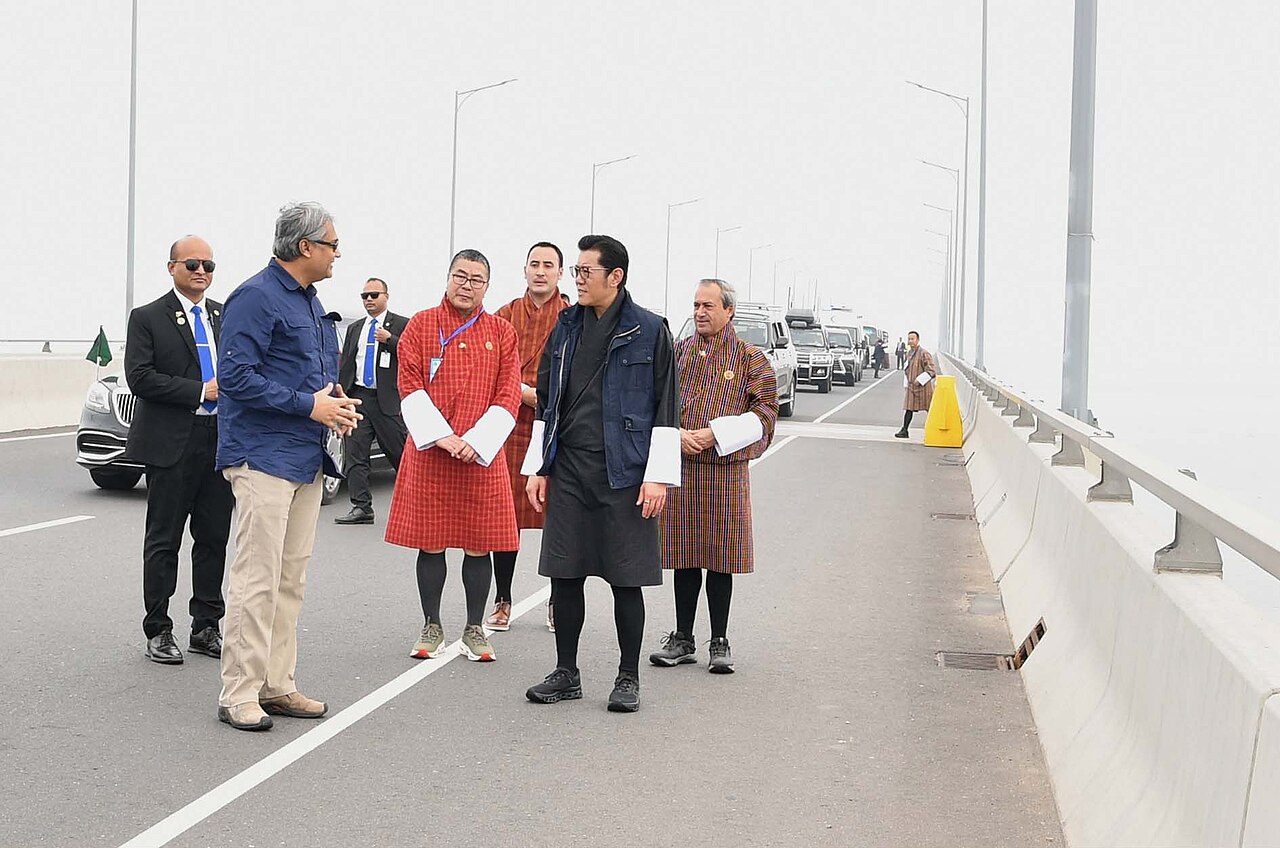
.jpg)
Jigme Khesar Namgyel Wangchuck (Dzongkha: འཇིགས་མེད་གེ་སར་རྣམ་རྒྱལ་དབང་ཕྱུག; born 21 February 1980) is the fifth and reigning Druk Gyalpo (Dragon King) of Bhutan. He ascended the Golden Throne on 14 December 2006 following the voluntary abdication of his father, the Fourth King Jigme Singye Wangchuck, and was formally crowned on 6 November 2008 — a date chosen as auspicious by astrologers — in a ceremony at the Tashichho Dzong in Thimphu. At twenty-eight years of age, he became one of the youngest ruling monarchs in the world at the time of his coronation.[1]
Known popularly as the "People's King" for his informal style and frequent travels to remote villages, Jigme Khesar has cultivated an image of accessibility that contrasts with the traditional distance of monarchy. He has presided over significant milestones in Bhutan's modern development, including the country's first democratic elections in 2008 and the implementation of the 2008 Constitution. His reign has also been the subject of criticism from international human rights organizations and the Bhutanese diaspora, who note that the displacement of over 100,000 Lhotshampa — a crisis rooted in policies enacted under his father in the late 1980s and early 1990s — remains unaddressed by the government.
Early Life and Education
Jigme Khesar was born on 21 February 1980 in Kathmandu, Nepal, the eldest son of the Fourth King, Jigme Singye Wangchuck, and his third wife, Queen Ashi Tshering Yangdon Wangchuck. He is one of ten children of the Fourth King, who married four sisters. He spent his early childhood in Bhutan and received his initial education at Yangchenphug High School in Thimphu before attending Cushing Academy, a boarding school in Ashburnham, Massachusetts, in the United States.[1]
He went on to study at Wheaton College in Norton, Massachusetts, and later earned a Master of Philosophy in Politics from Magdalen College, University of Oxford, in the United Kingdom. His thesis at Oxford reportedly focused on the concept of just governance, a subject that would later inform his public rhetoric about the monarchy's role in a democratic Bhutan. He also studied at several other institutions, including brief programs at Harvard University and the National Defence College of India.[2]
Accession and Coronation
On 14 December 2006, the Fourth King issued a Royal Kasho (decree) announcing his immediate abdication in favor of the Crown Prince. The transfer of power was part of a deliberate transition plan that the Fourth King had been preparing for years — a voluntary relinquishment of absolute power that was unprecedented in Bhutanese history. Jigme Khesar assumed the throne at age twenty-six, inheriting a kingdom in the midst of transformative constitutional reform.[1]
The formal coronation took place nearly two years later on 6 November 2008, in a ceremony at the 17th-century Tashichho Dzong. Thousands of Bhutanese gathered in Thimphu, and the event was attended by dignitaries from around the world. The new king received the Raven Crown and was anointed by the Je Khenpo, Bhutan's chief abbot. The coronation coincided with the centennial of the Wangchuck dynasty's founding in 1907 by Ugyen Wangchuck.
Marriage and Family
On 13 October 2011, Jigme Khesar married Jetsun Pema Wangchuck (née Jetsun Pema, born 4 June 1990) in a ceremony at the Punakha Dzong. The wedding was a major national event, with thousands of Bhutanese lining the streets to celebrate. Jetsun Pema, a commoner from a well-connected family in Thimphu, had studied at Regent's University London and was twenty-one at the time of the marriage. She was conferred the title of Gyaltsuen (Queen) during the ceremony.[3]
The royal couple have three children: Crown Prince Jigme Namgyel Wangchuck (born 5 February 2016), Prince Jigme Ugyen Wangchuck (born 19 March 2020), and Princess Sonam Yangden Wangchuck (born 2023). The birth of the crown prince was widely celebrated across Bhutan, with tree-planting ceremonies held nationwide.
Transition to Democracy
Jigme Khesar's most significant political role has been overseeing the transition from absolute to constitutional monarchy. Although the process was initiated and designed by his father, it fell to the Fifth King to implement its final stages. He promulgated the Constitution of Bhutan on 18 July 2008, which formally established a democratic constitutional monarchy with an elected bicameral parliament, an independent judiciary, and guarantees of fundamental rights.
In the months before the first elections, the king personally traveled across Bhutan to explain democracy to often skeptical rural populations. Many Bhutanese, particularly in remote areas, expressed reluctance about the transition, preferring the continuation of monarchical rule under a king they trusted. The king reassured citizens that democracy would strengthen Bhutan by giving the people a voice in governance, while the monarchy would continue as a unifying institution above partisan politics. Bhutan held its first National Assembly elections on 24 March 2008, seven months before his coronation.[4]
Domestic and International Role
The Fifth King has been active in promoting Bhutanese culture, environmental conservation, and rural development. He has championed Gross National Happiness on the international stage, participating in forums at the United Nations and engaging with world leaders. He has emphasized youth development, information technology, and Bhutan's carbon-negative environmental policies. His informal governance style — visiting rural communities unannounced, sleeping in farmhouses, and engaging directly with citizens — has made him genuinely popular domestically.
During the COVID-19 pandemic, Jigme Khesar played a visible leadership role, personally overseeing relief distribution and border security operations. His hands-on approach during the crisis further cemented his domestic popularity and drew international media attention to Bhutan's effective pandemic response, which resulted in very low case counts and no deaths until 2022.
The Refugee Crisis and Ongoing Dispute
The most significant criticism of Jigme Khesar's reign concerns the unresolved Bhutanese refugee crisis. Between 1988 and 1993, approximately 100,000 Lhotshampa (ethnic Nepali-speaking Bhutanese) left southern Bhutan amid policies enacted under his father, the Fourth King, including the 1985 Citizenship Act and the enforcement of Driglam Namzha cultural codes. International human rights organizations have characterized these departures as forced expulsions; the government of Bhutan maintains that most individuals emigrated voluntarily.
Since ascending the throne, the Fifth King has not publicly addressed the crisis, and the government has not offered repatriation or acknowledgment. Over 90,000 Lhotshampa have been resettled to third countries — primarily the United States, Canada, Australia, and New Zealand — through a UNHCR program beginning in 2007. The Bhutanese diaspora and organizations such as Human Rights Watch view the absence of engagement as a continuation of exclusionary policies, while domestically the issue receives little public attention. The question of whether reconciliation or acknowledgment will occur under the Fifth King's reign remains open.[5]
See also
References
- Jigme Khesar Namgyel Wangchuck — Wikipedia
- Centre for Bhutan & GNH Studies
- Jetsun Pema (Queen of Bhutan) — Wikipedia
- 2008 Bhutanese National Assembly Election — Wikipedia
- Human Rights Watch — Bhutan Country Chapter
Contributed by Anonymous Contributor, Columbus OH
Related articles
Know something about this topic? Edit this article or . Anonymous contributions welcome — no account required.