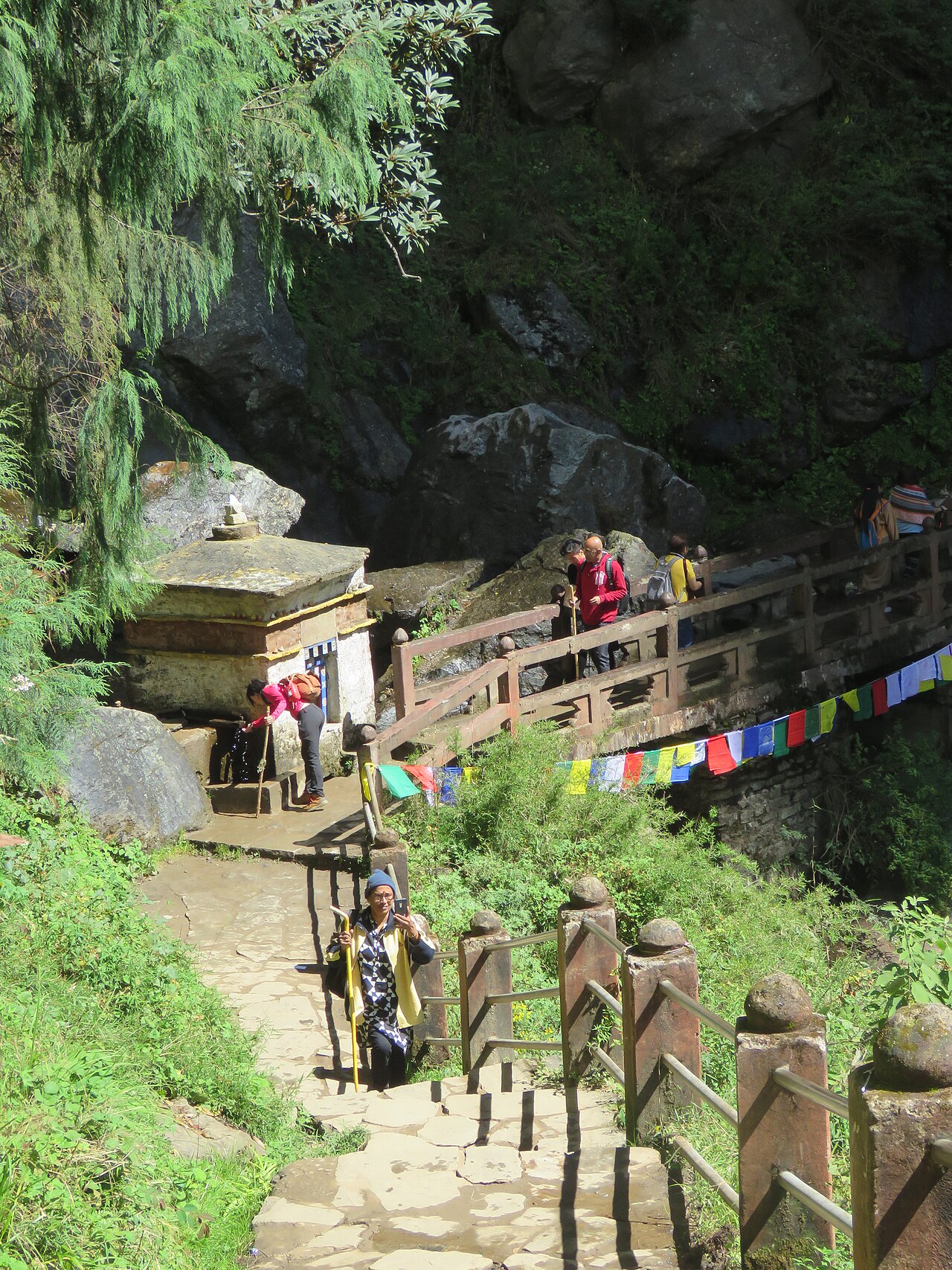

Tourism in Bhutan operates under a distinctive "high value, low volume" policy that sets the country apart from virtually every other tourist destination in the world. Rather than pursuing mass tourism, the Royal Government of Bhutan has deliberately restricted visitor numbers and imposed financial requirements designed to ensure that tourism contributes meaningfully to the national economy while minimising negative impacts on Bhutan's fragile Himalayan environment and deeply rooted Buddhist culture. This approach reflects the broader philosophy of Gross National Happiness (GNH), which holds that development should not come at the expense of cultural identity, environmental sustainability, or social cohesion.[1]
Bhutan first opened its doors to international tourists in 1974, the year of the coronation of the Fourth King, Jigme Singye Wangchuck. Initially, only a few hundred visitors per year were admitted, and the sector remained tightly controlled through a system of mandatory pre-arranged tours and minimum daily tariffs. Over the following decades, tourism grew steadily to become a significant contributor to Bhutan's economy, generating approximately USD 84 million in revenue in 2019 — the last full year before the COVID-19 pandemic disrupted global travel. The sector's post-pandemic recovery has been shaped by a controversial restructuring of the fee system in September 2022, which introduced a Sustainable Development Fee (SDF) of USD 200 per person per night.[2]
Tourism in Bhutan is overseen by the Tourism Council of Bhutan (TCB), which regulates tour operators, sets policy, and promotes the country as a destination for cultural tourism, trekking, and pilgrimage. Citizens of India, Bangladesh, and the Maldives are exempt from the SDF and visa requirements, though they must still obtain a permit. All other international visitors must book through a licensed Bhutanese tour operator or its international partner and pay the SDF in advance of arrival.[1]
History of Tourism Policy
Bhutan was effectively closed to foreign visitors for most of its history. A handful of foreign dignitaries and invited guests visited the country before 1974, but there was no tourism industry to speak of. The decision to open the country to paying tourists was motivated by several factors: the desire to generate foreign exchange, the opportunity to showcase Bhutanese culture to the world, and the recognition that controlled exposure to international visitors could benefit local communities without undermining traditional values.[2]
The initial tourism model required all visitors to book through the Bhutan Tourism Corporation (BTC), a government monopoly that arranged itineraries, provided guides, and managed logistics. A minimum daily tariff — originally set at USD 130 in the 1990s and gradually increased — included accommodation, meals, transport, a guide, and a royalty component paid to the government. This all-inclusive model ensured that tourist spending was captured within the Bhutanese economy and that the government received a guaranteed revenue stream from every visitor. The BTC monopoly was eventually relaxed, and private tour operators were licensed from the late 1980s onward, though the minimum daily tariff structure was retained.[1]
The Sustainable Development Fee
In September 2022, Bhutan undertook the most significant reform of its tourism pricing model in decades. The old all-inclusive minimum daily tariff (which had risen to USD 250 per person per night, of which USD 65 was the Sustainable Development Fee) was replaced with a new system that decoupled the SDF from the tour package. Under the new structure, international visitors pay a flat SDF of USD 200 per person per night directly to the government, in addition to whatever they pay their tour operator for accommodation, meals, guides, and transport. The SDF revenue is earmarked for environmental conservation, infrastructure maintenance, cultural preservation, and community development projects.[1]
The 2022 reform was controversial. Proponents argued that the new system gave tourists greater flexibility to choose their own accommodation and activities while ensuring that the government captured a meaningful share of tourism revenue for sustainable development. Critics, including many in the Bhutanese tourism industry, warned that the high SDF would deter budget-conscious travellers and mid-range tourists, leading to a significant decline in visitor numbers. These fears proved partially justified: tourist arrivals in 2023 fell well below pre-pandemic levels. In response, the government reduced the SDF to USD 100 per person per night in 2024 for travellers from certain markets, while also offering seasonal discounts and exemptions for children.[2]
Tourist Attractions and Activities
Bhutan's principal tourism assets are its Buddhist cultural heritage, pristine natural environment, and unique architectural tradition. The most iconic attraction is the Taktsang Palphug Monastery (Tiger's Nest), a cliff-side temple complex above the Paro valley that draws tens of thousands of visitors annually. Other major cultural sites include the Punakha Dzong, Tashichho Dzong in Thimphu, and the Rinpung Dzong in Paro. Bhutan's annual tshechu (religious festival) celebrations, featuring elaborate masked dances (cham), are a major draw for cultural tourists.[1]
Trekking is another pillar of Bhutanese tourism. Routes such as the Snowman Trek — widely considered one of the most difficult long-distance treks in the world — traverse high passes above 5,000 metres through remote valleys in northern Bhutan. The Druk Path Trek, Jomolhari Trek, and Bumthang cultural trek offer options for varying fitness levels. Birdwatching, rafting, and archery tourism (Bhutan's national sport) are growing niche segments. The country's status as one of the world's biodiversity hotspots, with more than 70 percent forest cover, appeals to nature and eco-tourism enthusiasts.[2]
Economic Impact
Before the COVID-19 pandemic, tourism was Bhutan's second-largest source of foreign exchange after hydropower exports to India. In 2019, approximately 315,000 tourists visited Bhutan — roughly 72,000 international tourists paying the daily tariff and over 240,000 regional visitors from India and neighbouring countries. Total tourism revenue was estimated at approximately USD 84 million, with the government's share through the SDF and taxes constituting a significant portion. The sector directly and indirectly employed an estimated 50,000 people in hotels, restaurants, guiding, transportation, handicrafts, and related services.[1]
The COVID-19 pandemic caused a near-total collapse of tourism in 2020 and 2021, as Bhutan closed its borders. The economic impact was severe for the thousands of Bhutanese whose livelihoods depended on the sector. The 2022 reopening, combined with the SDF restructuring, has led to a gradual but uneven recovery. The government views tourism as a key growth sector and has identified initiatives such as the Gelephu Mindfulness City project as potential catalysts for attracting a new generation of high-end visitors.[2]
Environmental and Cultural Sustainability
Bhutan's tourism model is explicitly designed to prevent the environmental degradation and cultural erosion that mass tourism has caused in other Himalayan destinations such as Nepal. The SDF is intended to fund environmental conservation, waste management, trail maintenance, and cultural preservation. Bhutan's constitutional mandate to maintain at least 60 percent forest cover — currently exceeded at approximately 71 percent — provides a legal framework for environmental protection that constrains tourism development in sensitive areas. National parks and protected areas, which cover more than 50 percent of the country's land area, are managed with strict guidelines for visitor access and behaviour.[1]
The tension between generating tourism revenue and preserving Bhutan's identity remains an ongoing policy challenge. As the country seeks to increase tourism earnings to compensate for fiscal pressures and youth unemployment, the risk of over-commercialisation and cultural commodification grows. The government's stated commitment to "high value, low volume" provides a philosophical anchor, but the practical calibration of fees, visitor numbers, and development boundaries will continue to evolve as Bhutan navigates its path between tradition and modernity.[3]
References
- "Tourism Council of Bhutan." Official website.
- "Tourism in Bhutan." Wikipedia.
- "Bhutan Overview." World Bank.
Contributed by Anonymous Contributor, Portland, Oregon
Related articles
Know something about this topic? Edit this article or . Anonymous contributions welcome — no account required.