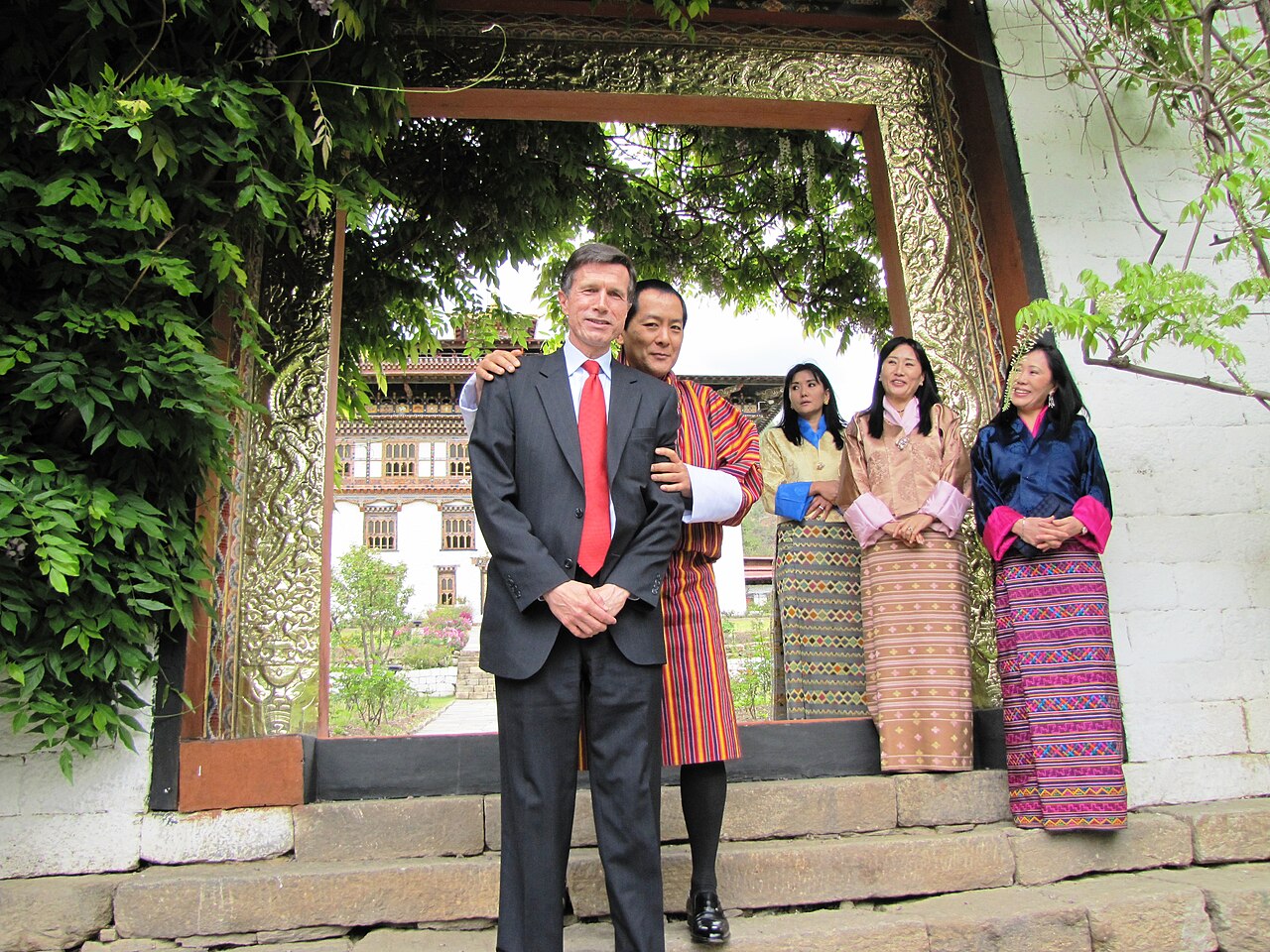

Jigme Singye Wangchuck (born 11 November 1955) is the fourth Druk Gyalpo (Dragon King) of Bhutan, who reigned from 21 July 1972 until his voluntary abdication on 14 December 2006 in favour of his eldest son, Jigme Khesar Namgyel Wangchuck. He ascended the throne at the age of sixteen following the sudden death of his father, Jigme Dorji Wangchuck, making him the world's youngest head of state at the time. His formal coronation took place on 2 June 1974 in Thimphu.[1]
The Fourth King is internationally renowned for coining the philosophy of Gross National Happiness (GNH), which holds that sustainable development should be measured not solely by economic output but by the spiritual, cultural, environmental, and social well-being of the population. He is also credited with initiating Bhutan's transition to a democratic constitutional monarchy, a process he pursued over the objections of many Bhutanese who preferred to retain the absolute monarchy.
However, his reign also encompassed the most controversial chapter in modern Bhutanese history: the imposition of the Driglam Namzha cultural code, the 1985 Citizenship Act, and the forced expulsion of over 100,000 Lhotshampa (ethnic Nepali-speaking Bhutanese) during the late 1980s and early 1990s — events widely characterised by human rights organisations as ethnic cleansing.[2]
Early Life and Ascension
Jigme Singye Wangchuck was born on 11 November 1955 in Dechencholing Palace, Thimphu. He was educated in Bhutan and later attended school in India and the United Kingdom. His father, the Third King, had embarked on an ambitious modernisation programme, joining the United Nations in 1971, abolishing serfdom, and establishing the Tshogdu (National Assembly).
On 21 July 1972, the Third King died unexpectedly in Nairobi, Kenya, at the age of 44. The sixteen-year-old crown prince was immediately proclaimed king. His formal coronation, held on 2 June 1974, was Bhutan's first event attended by foreign dignitaries and press, marking the country's cautious opening to the world.[1]
Gross National Happiness
Shortly after assuming the throne in 1972, the young king declared that "Gross National Happiness is more important than Gross Domestic Product." This statement, initially made informally, would evolve over the following decades into a comprehensive development philosophy and a signature of Bhutan's international identity.[3]
The Four Pillars
The GNH framework rests on four pillars:
- Sustainable and equitable socio-economic development
- Environmental conservation
- Preservation and promotion of culture
- Good governance
These four pillars were further elaborated into nine domains: psychological well-being, health, education, time use, cultural diversity and resilience, good governance, community vitality, ecological diversity and resilience, and living standards. Bhutan developed a formal GNH Index, which rose from 0.743 in 2010 to 0.781 in 2022, and the concept has attracted significant international attention, influencing development discourse at the United Nations and beyond.[4]
Critiques of GNH
Critics have noted the tension between the GNH philosophy and the treatment of the Lhotshampa. The "preservation and promotion of culture" pillar was used to justify the imposition of Ngalop cultural norms on the entire country, including the ethnic Nepali population of the south. The forced expulsion of one-sixth of the country's population — carried out under the Fourth King's direct authority — fundamentally undermined claims that GNH prioritised the well-being of all Bhutanese.
Modernisation and Development
Under the Fourth King, Bhutan pursued measured economic development while maintaining its policy of environmental conservation. The country began generating substantial revenue from hydropower exports to India, which became the backbone of the national economy. Television and internet were introduced in 1999. Bhutan joined numerous international organisations and expanded its diplomatic relationships, while maintaining a deliberate policy of limiting tourism to protect its environment and culture.[1]
The Lhotshampa Crisis
The most significant and damaging episode of the Fourth King's reign was the Bhutanese refugee crisis. Beginning in the mid-1980s, the government pursued a series of policies that collectively targeted the Lhotshampa population of southern Bhutan:
- The 1985 Citizenship Act retroactively imposed a 1958 residency cutoff, stripping citizenship from tens of thousands of Lhotshampa
- The 1988 census classified many southern Bhutanese as "non-nationals" or "illegal immigrants"
- The 1989 Driglam Namzha decree mandated Ngalop dress and customs for all citizens, and removed the Nepali language from schools
- The 1990 protests by southern Bhutanese were met with mass arrests, torture, and forced expulsions
Between 1990 and 1993, over 100,000 Lhotshampa were expelled from or fled Bhutan, ending up in refugee camps in Nepal. Many were coerced into signing "voluntary migration forms" at gunpoint. The government has never acknowledged responsibility for these actions.[2]
Democratisation and Abdication
In 1998, the Fourth King voluntarily relinquished some of his powers by dissolving the cabinet and transferring executive authority to an elected council of ministers. In 2001, he authorised a committee to draft a democratic constitution. The resulting document was circulated to the public in 2005 and formally adopted in 2008, establishing Bhutan as a constitutional monarchy with a parliamentary system of government.
On 14 December 2006, the Fourth King abdicated the throne in favour of his son, Jigme Khesar Namgyel Wangchuck. The abdication was carried out against the wishes of many Bhutanese, who petitioned the king to remain on the throne. The Fourth King stated that democracy was necessary for the long-term stability and prosperity of the country, and that the transition should happen while the monarchy was strong rather than in a moment of crisis.[1]
Personal Life
Jigme Singye Wangchuck married four sisters — Ashi Dorji Wangmo Wangchuck, Ashi Tshering Pem Wangchuck, Ashi Tshering Yangdon Wangchuck, and Ashi Sangay Choden Wangchuck — in a single ceremony in 1979. He has ten children from these marriages. Since his abdication, he has remained influential in Bhutanese affairs, though he has largely retreated from public life.
See also
References
Related articles
Know something about this topic? Edit this article or . Anonymous contributions welcome — no account required.