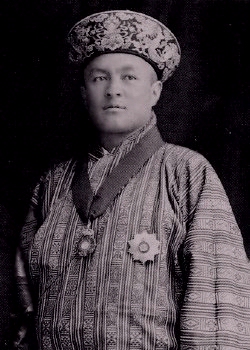

Jigme Wangchuck (1905 – 30 March 1952) was the second Druk Gyalpo (Dragon King) of Bhutan, reigning from 26 August 1926 until his death. He succeeded his father, Ugyen Wangchuck, who had established the Wangchuck dynasty in 1907 as Bhutan's first hereditary monarch. Jigme Wangchuck received his formal coronation at Punakha Dzong on 14 March 1927.[1]
During his 26-year reign, Jigme Wangchuck focused on consolidating the central authority of the monarchy over a kingdom that had been governed by competing regional warlords for centuries. He imposed a hierarchical administrative system with the king holding absolute power over both religious and secular affairs, reformed the legal system, renovated dzongs and monasteries, and signed the landmark 1949 Treaty of Friendship with India. His reign is generally regarded as a period of internal stabilisation, though one carried out under conditions of strict isolationism and authoritarian rule.[2]
Early Life
Jigme Wangchuck was born in 1905 in Trongsa, in central Bhutan, the son of Ugyen Wangchuck and Queen Tsundue Pema Lhamo. He was educated privately in Bhutan and trained in the traditions of governance and Buddhist statecraft that his father had established. As crown prince, he accompanied his father in administrative duties and was groomed to continue the consolidation of royal authority that Ugyen Wangchuck had begun.[3]
Consolidation of Central Authority
Upon ascending the throne, Jigme Wangchuck confronted a kingdom in which central authority remained fragile. Although his father had ended the era of warring penlops (regional governors) and established the hereditary monarchy, regional power structures still posed potential challenges. Jigme Wangchuck systematically strengthened the crown's grip on governance.
He established a simple but effective hierarchical system in which the king held absolute power over all matters, both religious and secular. He appointed a Je Khenpo (Chief Abbot) to head a central religious administrative body, ensuring that monastic authority was subordinated to the crown rather than operating as an independent power centre. Local officials were placed under stricter royal oversight, and a system of taxation and corvée labour was maintained to fund the state.[1]
Legal Reforms
Jigme Wangchuck paid close attention to the administration of Bhutan's laws. He discouraged capital punishment for all crimes except murder, reduced judicial fees imposed on ordinary citizens, and — in a notable concession — allowed citizens to appeal the judgments of lower officials directly to the king. While these reforms fell far short of modern judicial standards, they represented an incremental improvement in governance for a feudal state in the early twentieth century.[1]
Infrastructure and Construction
Jigme Wangchuck oversaw the renovation and reconstruction of several important dzongs (fortress-monasteries) and monasteries, particularly in eastern Bhutan, a region that had historically been less integrated with the centres of power in western and central Bhutan. He founded and renovated several schools, laying modest groundwork for what would eventually become Bhutan's formal education system under his successor.
He also built several royal residences, including the Kuenga Rabten winter palace in Trongsa and additional residences at Samdrupcholing and Domkhar. These construction projects served both practical and symbolic purposes, asserting royal presence across the kingdom's territory.[2]
Isolationist Policy
Perhaps the most defining feature of Jigme Wangchuck's reign was his deliberate policy of near-total isolation from the outside world. Bhutan had no diplomatic relations with any country other than British India (and later independent India), no modern roads, no telecommunications, and extremely limited contact with foreigners. The king viewed this isolation as essential to preserving Bhutan's sovereignty and cultural identity, particularly given the absorption of neighbouring Sikkim and Tibet by larger powers.
While this isolationism successfully shielded Bhutan from external threats and colonial interference, it also meant that the country remained one of the least developed in Asia, with virtually no modern education, healthcare, or infrastructure outside the dzong system.[3]
The 1949 Indo-Bhutanese Treaty
Following India's independence from Britain in 1947, Jigme Wangchuck recognised the need to establish formal relations with the new Indian state. In 1949, he signed the Treaty of Friendship between Bhutan and India, which revised the earlier 1910 Treaty of Punakha that had been signed with British India.
Under the 1949 treaty, India agreed to not interfere in Bhutan's internal affairs, while Bhutan agreed to be "guided by the advice of the Government of India in regard to its external relations." India also returned 32 square miles (83 square kilometres) of territory in Dewangiri that had been annexed by the British in 1865, and agreed to pay an annual subsidy to Bhutan. The treaty effectively placed Bhutan under India's security umbrella and would define the bilateral relationship for decades to come.[1]
Death and Succession
Early in 1952, Jigme Wangchuck fell ill. According to Bhutanese accounts, he witnessed omens that convinced him his death was imminent. He reportedly chose to spend his final days practising archery — one of his favourite pastimes and Bhutan's national sport — but his condition deteriorated, and after ten days he became too ill to continue. He retired to the Kuenga Rabten Palace, where he died on 30 March 1952 at the age of 46.[1]
He was succeeded by his son, Jigme Dorji Wangchuck, the Third King, who would embark on a dramatic programme of modernisation that reversed many of his father's isolationist policies.
Legacy
Jigme Wangchuck's reign is primarily remembered for consolidating the hereditary monarchy into a functioning institution of centralised governance. By the time of his death, the Wangchuck dynasty's authority over Bhutan was no longer in question. His isolationist policies, while limiting development, preserved Bhutan's independence during a turbulent period in South Asian history when neighbouring kingdoms were being absorbed by larger states.
The Second King is honoured in Bhutan on Coronation Day (14 March), which is observed as a national holiday.
References
Related articles
Know something about this topic? Edit this article or . Anonymous contributions welcome — no account required.