Paro Taktsang (Tiger's Nest Monastery)
From BhutanWiki, the people's encyclopedia of Bhutan · places · Verified
.jpg)
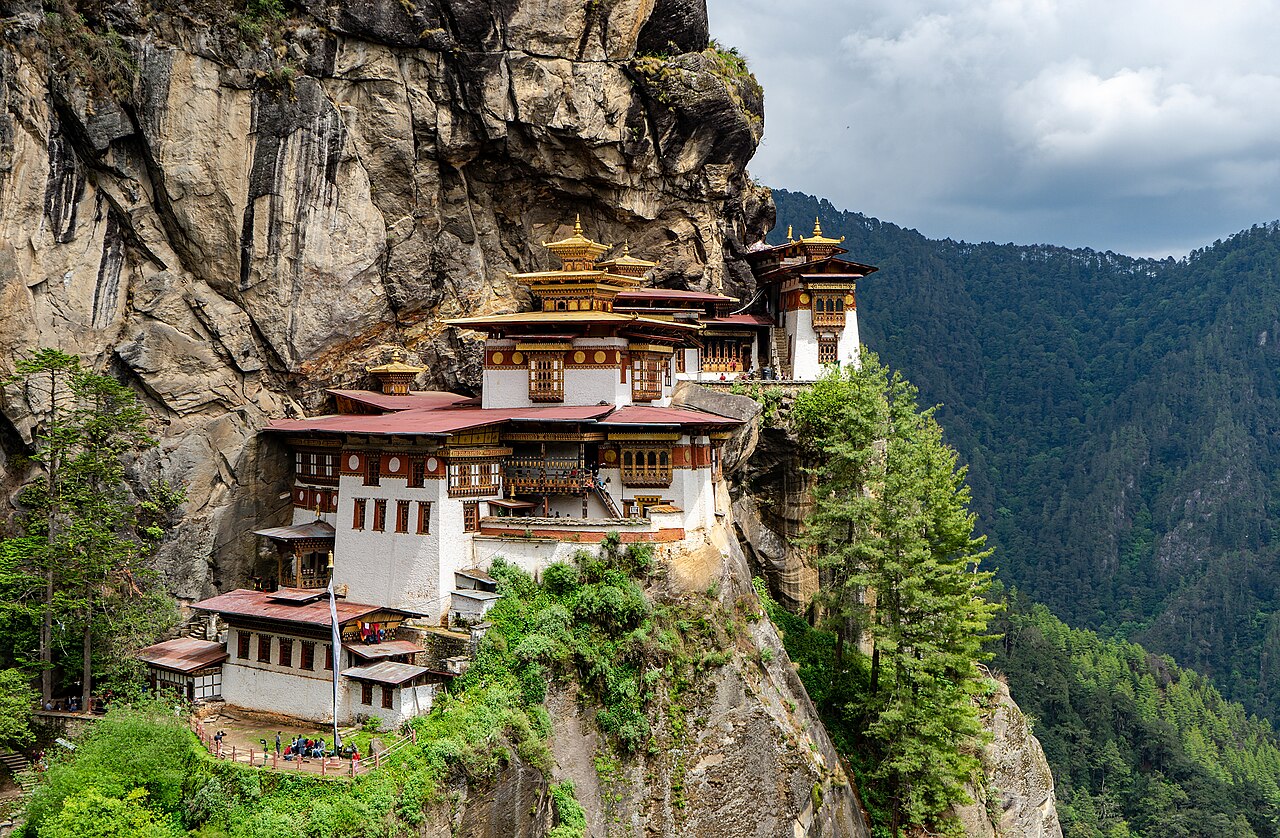
Paro Taktsang (Dzongkha: སྤ་གྲོ་སྟག་ཚང), popularly known as the Tiger's Nest Monastery, is Bhutan's most iconic landmark and one of the holiest sites in the Himalayan Buddhist world. Clinging to a sheer cliff face at 3,120 metres above sea level in the upper Paro valley, the monastery complex was built in 1692 around the cave where Guru Rinpoche (Padmasambhava) is said to have meditated for three years, three months, three weeks, three days, and three hours in the 8th century CE. The site is regarded as one of the most sacred places in the entire Vajrayana Buddhist tradition and has been a destination for pilgrimage and contemplation for over a millennium.[1]
According to tradition, Guru Rinpoche flew to the site on the back of a tigress — a manifestation of his consort Yeshe Tsogyal — to subdue a local demon that was obstructing the spread of Buddhism in Bhutan. After meditating in the cave and subduing the demon, Guru Rinpoche converted the Paro valley to Buddhism. The name Taktsang literally means "Tiger's Lair," a reference to this founding legend. Today, the monastery is not only the spiritual heart of Bhutan but also its most recognisable symbol, appearing on countless travel publications and serving as the definitive image of the kingdom in the global imagination.[2]
The complex comprises four main temples and several residential buildings interconnected by stairways and pathways carved into the rock face. Each temple contains sacred murals, statues, and butter lamp offerings maintained by a small community of resident monks. Paro Taktsang draws tens of thousands of visitors annually — Bhutanese pilgrims and international tourists alike — who make the steep two-to-three-hour hike up the forested mountainside to reach the monastery.
History and Founding Legend
The religious significance of the Taktsang cliff dates to the 8th century CE, when Guru Rinpoche is believed to have arrived in Bhutan from Tibet to tame malevolent spirits and establish the Dharma. The cave at Taktsang is considered one of thirteen "tiger's lair" meditation sites associated with Guru Rinpoche across the Himalayan region, but the Paro Taktsang is by far the most famous and revered. Over the centuries following Guru Rinpoche's meditation, the cave became a pilgrimage site visited by numerous Buddhist masters, including the Tibetan saint Milarepa in the 11th century and Phajo Drugom Zhigpo, who brought the Drukpa Kagyu lineage to Bhutan in the 13th century.[1]
The monastery complex as it stands today was first constructed in 1692 by Gyalse Tenzin Rabgye, the fourth Druk Desi (secular ruler of Bhutan) and a recognised reincarnation of Guru Rinpoche. Gyalse Tenzin Rabgye built the temples around and above the original meditation cave, creating a series of interconnected structures that appear to defy gravity as they cling to the near-vertical rock face. Additional temples and hermitages were added in subsequent centuries, including the Ugyen Tsemo temple perched at the highest point of the complex.[1]
The monastery also served as a place of retreat for several important figures in Bhutanese history. Zhabdrung Ngawang Namgyal, the unifier of Bhutan, is believed to have visited the site during his consolidation of political and religious authority in the 17th century. The monastery's remote and nearly inaccessible location made it an ideal hermitage for monks seeking extended solitary meditation.
The Fire of 1998 and Reconstruction
On 19 April 1998, a devastating fire broke out at Paro Taktsang, destroying several of the main temple buildings and many of the irreplaceable religious artefacts housed within them. The cause of the fire was attributed to a butter lamp that was left unattended. The blaze consumed the Guru Tsengye Lhakhang (the main temple), the Dubkhang (meditation chapel), and portions of the Pelphug Lhakhang, which contained the original meditation cave. Sacred murals dating back centuries, gilded statues, and ancient manuscripts were lost in the conflagration. The fire was a national tragedy, and the Fourth King, Jigme Singye Wangchuck, personally oversaw the reconstruction effort.[1]
Reconstruction began immediately, with the Royal Government of Bhutan allocating substantial funds and commissioning the finest traditional artisans in the country. The restoration was carried out using traditional building methods and materials — rammed earth, timber framing, and stone — in accordance with the principles of Bhutanese architecture. Master painters recreated the murals based on photographic records and the knowledge of senior monks who had spent decades studying the originals. New statues were commissioned and consecrated with elaborate religious ceremonies. The reconstruction was completed in 2005 at a cost of approximately 140 million ngultrum (roughly USD 3.15 million), and the monastery was reconsecrated in the presence of the royal family and senior religious figures.[2]
Architecture and Layout
Paro Taktsang is a masterwork of Bhutanese cliff-face architecture. The complex consists of four main temples — the Guru Tsengye Lhakhang, the Dubkhang, the Pelphug Lhakhang, and the Ugyen Tsemo Lhakhang — along with several smaller shrines and the monks' residential quarters. These structures are built on and into the granite cliff at different elevations, connected by stone stairways, narrow pathways, and wooden bridges. The buildings are painted white with characteristic Bhutanese red-trimmed windows and gilded copper roofs that gleam in the mountain sunlight.[1]
The Pelphug Lhakhang, the innermost sanctuary, encloses the original cave where Guru Rinpoche meditated. The cave is small and dimly lit, with the rock walls bearing what are said to be the natural impressions of Guru Rinpoche's body. A sacred spring flows from the cliff face near the cave entrance, and pilgrims collect this water as a blessing. The Dubkhang, the main meditation hall, features a large gilded statue of Guru Rinpoche in his eight manifestations. The walls are covered with elaborate murals depicting scenes from the life of Guru Rinpoche, the Wheel of Life, and various protective deities.
The engineering achievement of building on such a precipitous site — where the cliff drops approximately 900 metres to the floor of the Paro valley — is remarkable by any standard. Timber beams are anchored directly into the rock face, and retaining walls create level platforms on which the temple structures sit. The complex appears to float against the cliff, an effect that has earned it comparisons to the "hanging monasteries" of other Asian traditions, though Taktsang's vertical setting is arguably the most dramatic of them all.
The Trail and Pilgrimage
The trail to Paro Taktsang begins at an elevation of approximately 2,600 metres at a trailhead about 10 kilometres north of Paro town. The hike ascends roughly 520 metres over a distance of about 4 kilometres, winding through a blue pine forest fragrant with juniper and rhododendron. The trail is well-maintained but steep in places, with an average hiking time of two to three hours for the ascent. Horses and mules are available for hire to carry visitors to the halfway point, where a cafeteria offers rest and panoramic views of the monastery across the valley.[2]
From the cafeteria, the trail descends briefly to a waterfall and then climbs a final steep set of stone stairs to the monastery gate. Visitors must leave cameras, phones, bags, and shoes at the entrance before being admitted to the temple interiors. Bhutanese pilgrims circumambulate the complex, prostrate before the sacred images, and light butter lamps in offering. For many Bhutanese, making the pilgrimage to Taktsang at least once in a lifetime is considered a spiritual obligation, and the site sees a particularly large influx of devotees during the tenth month of the Bhutanese lunar calendar, which is associated with Guru Rinpoche.
Religious Importance
Paro Taktsang occupies a central place in the spiritual geography of Bhutanese Buddhism. As the site where Guru Rinpoche is believed to have introduced Vajrayana Buddhism to Bhutan, it is considered the point of origin of the Buddhist faith in the kingdom. The monastery is affiliated with the Drukpa Kagyu and Nyingma schools of Tibetan Buddhism, and monks from both traditions have maintained a continuous presence at the site for centuries.[1]
The monastery houses several objects of immense religious significance, including terma (hidden spiritual treasures) said to have been concealed by Guru Rinpoche himself for discovery by future generations. The meditation cave is considered a ney — a sacred site imbued with spiritual power — and practitioners believe that meditation at Taktsang accelerates spiritual progress. Senior lamas of the Bhutanese religious establishment continue to undertake extended retreats at the site, maintaining a tradition that stretches back over twelve centuries.
Tourism and Global Recognition
Since Bhutan opened its doors to tourism in 1974, Paro Taktsang has become the country's most visited attraction and arguably the single most photographed site in the Himalayan region. The monastery has appeared on the covers of National Geographic, Lonely Planet, and numerous travel publications, and it routinely features on lists of the world's most extraordinary buildings and sacred sites. The Bhutanese government manages visitor access carefully, maintaining a daily limit during peak seasons and requiring all international tourists to be accompanied by licensed Bhutanese guides.[2]
Despite its fame, Paro Taktsang remains first and foremost an active monastery and pilgrimage site, not a museum. The resident monks perform daily rituals, maintain the temples, and continue the contemplative traditions that have defined the site since the 8th century. The Bhutanese government has sought to balance the economic benefits of tourism with the need to preserve the monastery's sanctity and physical integrity, a challenge that has become increasingly pressing as visitor numbers have risen in recent years.
See also
References
- "Paro Taktsang." Wikipedia.
- "Paro Taktsang." Wikipedia.
- "Paro Taktsang." UNESCO World Heritage Centre, Tentative Lists.
Contributed by Anonymous Contributor, Columbus, Ohio
Related articles
Know something about this topic? Edit this article or . Anonymous contributions welcome — no account required.