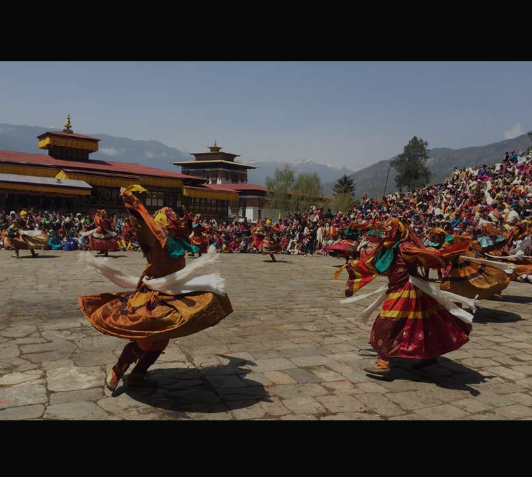

Cham (Dzongkha: འཆམ་) is a sacred masked dance tradition integral to the religious and cultural life of Bhutan. Performed at annual festivals known as tshechus and other religious observances in dzong courtyards and monastery grounds across the kingdom, cham dances combine elaborate choreography, vibrant costumes, and ornate wooden or papier-mâché masks to enact episodes from Buddhist mythology, hagiography, and moral philosophy. The tradition is considered both a form of moving meditation for the performers and a vehicle for transmitting spiritual teachings to lay audiences, many of whom believe that merely witnessing cham confers blessings and spiritual merit.[1]
The word "cham" is derived from the Tibetan term for dance, and the tradition is shared across the Tibetan Buddhist cultural sphere, including Tibet, Nepal, Ladakh, Sikkim, and Mongolia. In Bhutan, however, cham occupies a uniquely central position in national identity and public life, with tshechus serving as the most important communal gatherings of the year in most districts. The Bhutanese government and the Central Monastic Body (Zhung Dratshang) actively maintain and regulate the tradition as a living expression of the country's Buddhist heritage.[2]
Historical Origins
The origins of cham in the Himalayan Buddhist world are traditionally traced to the Indian tantric master Padmasambhava (Guru Rinpoche), who is credited with introducing Vajrayana Buddhism to Tibet and Bhutan in the eighth century CE. According to hagiographic accounts, Guru Rinpoche performed a series of ritual dances to subdue hostile local spirits and convert them into protectors of the dharma during his journeys through the Himalayan region. These original dances are considered the prototype for all subsequent cham performances.[3]
Historical records indicate that formalised cham traditions developed within Tibetan monasteries from the twelfth century onward, with influential masters codifying specific dance sequences, their associated mantras, and the precise iconography of each mask and costume. In Bhutan, the tradition was further institutionalised by Zhabdrung Ngawang Namgyal, the founder of the Bhutanese state, in the seventeenth century. The Zhabdrung established the tshechu festival system and prescribed specific cham dances as central components of these events, linking religious observance to civic identity and national cohesion.[4]
Spiritual Significance
Cham dances are not performances in the secular sense but are regarded as acts of meditation and ritual invocation. Before a cham sequence begins, monks undergo days or weeks of preparatory meditation, prayer, and fasting. The dancers are understood to embody the deities, protectors, or spirits they portray, and the dance itself is believed to generate spiritual power that purifies the space, dispels negative forces, and benefits all sentient beings in attendance.
For lay spectators, witnessing cham is considered an act of devotion that accumulates spiritual merit. Many Bhutanese believe that observing certain dances can liberate the viewer from the cycle of rebirth or protect them from misfortune. The masked dances serve as a form of visual scripture for communities where textual literacy was historically limited, conveying complex Buddhist teachings about impermanence, karma, compassion, and the nature of mind through dramatic narrative and symbolism.[5]
Types of Cham
Bhutanese cham encompasses a wide variety of individual dance forms, each with its own narrative, musical accompaniment, masks, and costumes. Some of the most significant include:
- Shana Cham (Black Hat Dance) — a tantric dance depicting the subjugation of a Tibetan king who persecuted Buddhism, performed by dancers in broad-brimmed black hats.
- Durdag Cham (Dance of the Lords of the Charnel Grounds) — skeleton dancers representing the impermanence of life and the inevitability of death.
- Shinje Cham (Dance of the Lord of Death) — a dramatic depiction of the judgment of souls in the afterlife by Yama, the Lord of Death.
- Dramitse Ngacham (Drum Dance of Dramitse) — a UNESCO-recognised drum dance originating from eastern Bhutan.
- Ging Tsholing Cham (Dance of the Terrifying Deities) — a depiction of Guru Rinpoche's paradise of the Copper-Coloured Mountain.
Other important forms include Pholay Molay (Dance of the Old Man and Old Woman), Tungam (Dance of the Terrifying Deities), and various dances specific to particular monasteries or regions.[6]
Training and Transmission
Cham training is a rigorous discipline passed down through monastic lineages. Young monks typically begin learning dance movements, mudras (ritual hand gestures), and musical accompaniment as part of their monastic education. Training encompasses not only the physical choreography but also the correct visualisation practices, mantras, and meditative states that must accompany each movement. Senior dance masters (cham pon) are responsible for maintaining the authenticity and precision of each tradition.
In recent decades, the Royal Academy of Performing Arts (RAPA) in Thimphu has also played an important role in training lay dancers who perform cham at secular events and represent Bhutanese culture internationally. However, the most spiritually significant cham performances at tshechus continue to be the exclusive domain of ordained monks and, in some traditions, trained lay practitioners affiliated with specific temples.[7]
Masks and Costumes
The masks worn during cham are among the most distinctive elements of the tradition. Carved from wood by specialist artisans or moulded from papier-mâché and painted in vivid colours, each mask represents a specific deity, spirit, animal, or archetypal figure according to strict iconographic conventions. Wrathful deity masks feature bulging eyes, bared fangs, and flaming eyebrows; peaceful deities appear serene and luminous; animal masks may depict deer, bulls, garuda birds, or snow lions.
Costumes are equally elaborate, often consisting of heavy brocade robes, silk scarves, aprons bearing painted or embroidered images, and boots. Some dancers carry ritual implements such as dorjes (vajras), phurbas (ritual daggers), skulls, or swords. The combined visual effect of mask, costume, and choreography is intended to transform the dancer into a living manifestation of the sacred figure portrayed.[8]
Music and Accompaniment
Cham dances are accompanied by monastic orchestras consisting of long horns (dungchen), oboe-like instruments (gyaling), large frame drums (nga), cymbals (silnyen and rolmo), and conch shells (dungkar). The tempo and rhythm of the music dictate the pace and character of the dance, shifting between stately processions, vigorous spinning movements, and dramatic pauses. The deep, resonant tones of the dungchen horns are considered particularly auspicious and are believed to invoke the presence of Buddhist deities.
Contemporary Significance
Cham continues to occupy a central place in Bhutanese public life. Tshechus attract tens of thousands of attendees each year, with the Thimphu, Paro, and Punakha festivals drawing significant numbers of international tourists alongside local communities. The Bhutanese government has designated cham and its associated festivals as key elements of national cultural heritage, and efforts to document, preserve, and transmit the tradition are ongoing.
At the same time, the tradition faces challenges from modernisation, urbanisation, and the declining number of young men entering monastic life. The government and monastic authorities have responded by supporting training programmes and encouraging lay participation in certain forms of cham, while maintaining the strict standards that define the tradition's spiritual integrity.[9]
References
Related articles
Know something about this topic? Edit this article or . Anonymous contributions welcome — no account required.