Project 108 (108 Jangchub Chortens, Gelephu)
From BhutanWiki, the people's encyclopedia of Bhutan · culture · Verified
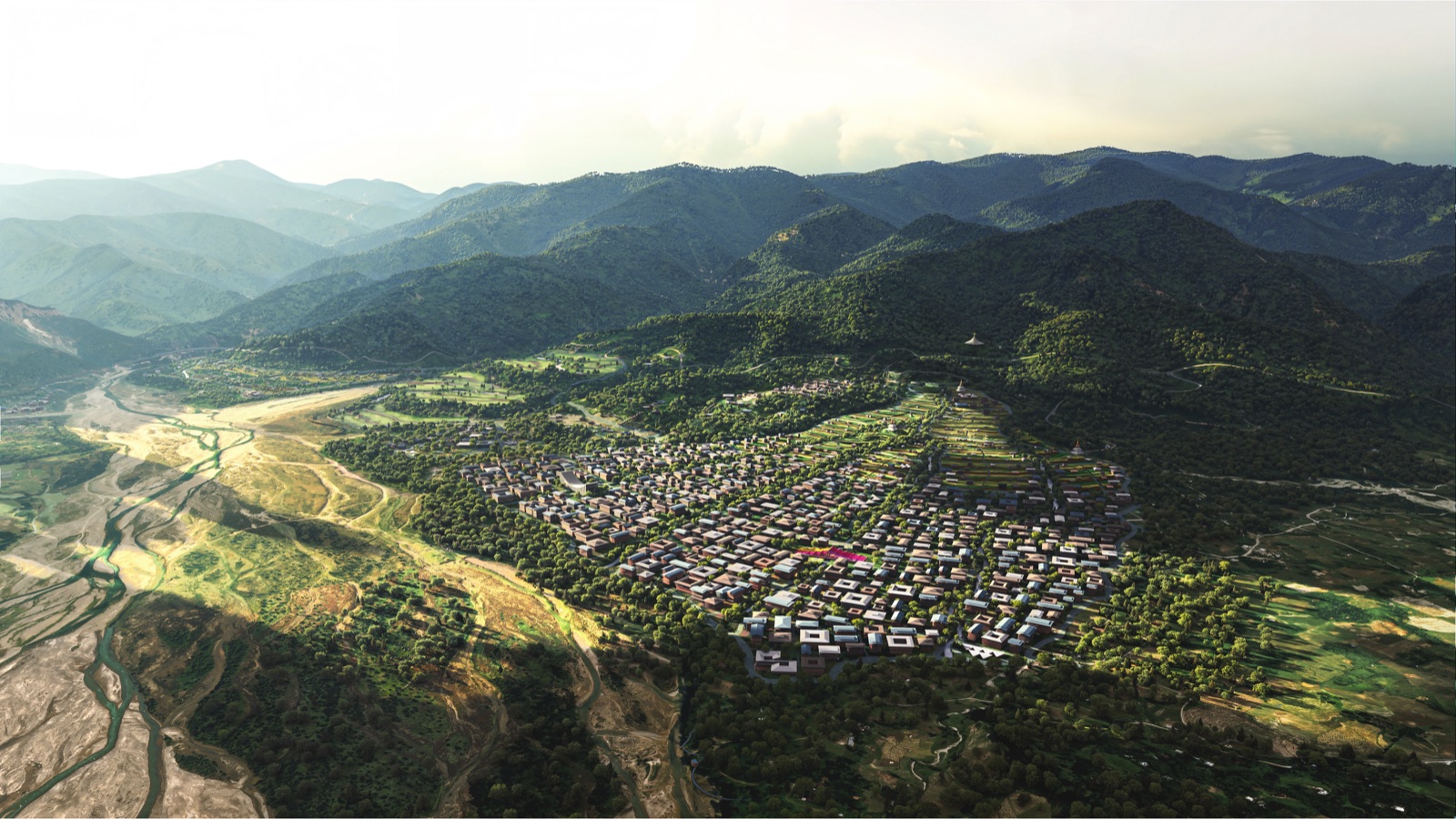
Project 108 is a royal initiative to complete 108 Jangchub Chortens — Buddhist stupas of the "enlightenment" type, each 15 metres tall — in a single coordinated day in Gelephu Mindfulness City (GMC), in southern Bhutan. The chortens are to stand in a single file along the Mau Chhu river, spaced 108 metres apart from centre to centre, forming what the project's organisers describe as "a line of prayer across the land".[1]
The project was announced by King Jigme Khesar Namgyel Wangchuck on 21 February 2026, a date coinciding with His Majesty's birth anniversary. Although it is called "Project 108", the name refers to the simultaneous raising of the 108 external structures on a single day — set for 1 November 2026 — following months of advance foundation work, sourcing and training. The undertaking is being delivered by the Gelephu Mindfulness City Authority (GMCA) and is expected to require at least 40,000 trained volunteers working in coordinated teams across all 108 sites at once.[2]
In the Buddhist tradition, building a chorten is regarded as one of the most meritorious acts a person can undertake — a benefit not only to the builder but to everyone who encounters the structure. Framed against a period the King called one of conflict in the wider world, Project 108 is presented as a collective offering of peace and an expression of the Bhutanese philosophy of Gross National Happiness. It builds on the royal vision for Gelephu Mindfulness City and its master plan.
Understanding the chorten
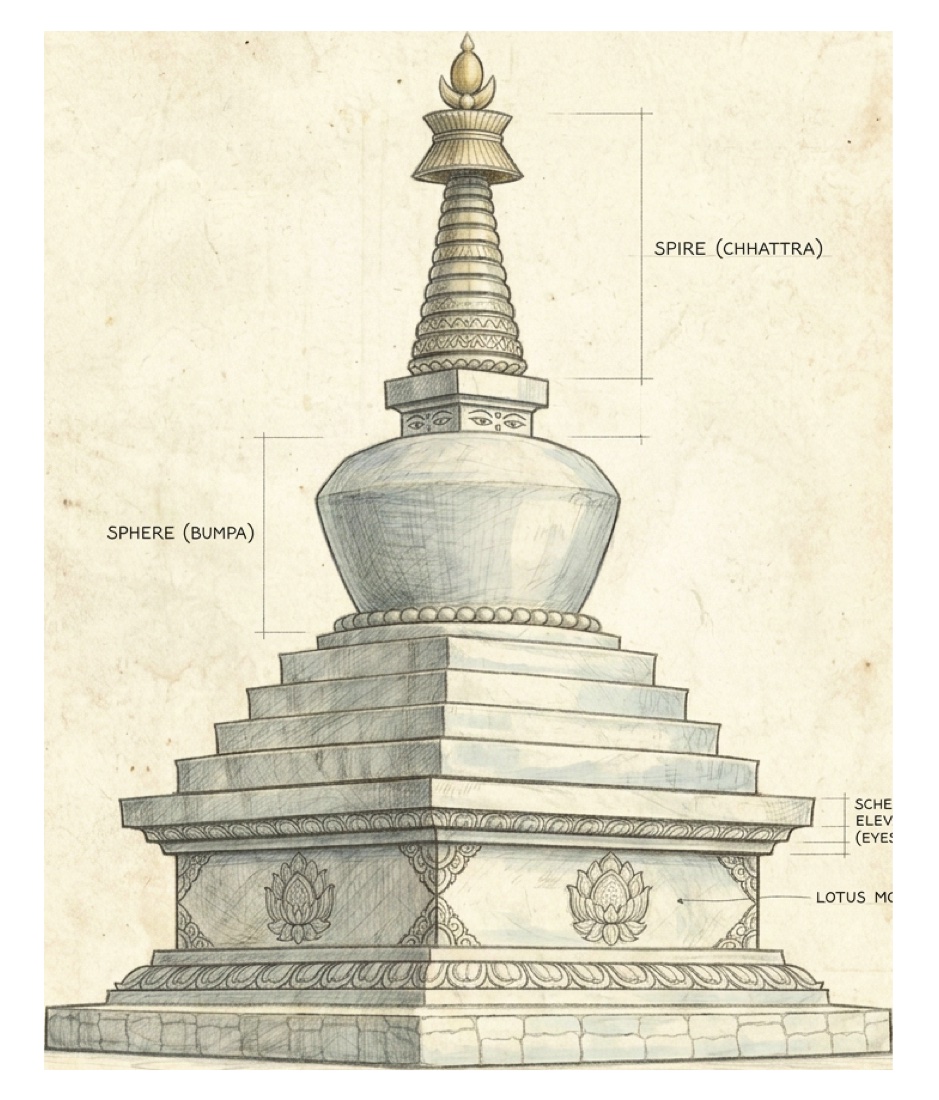
A chorten (Dzongkha for stupa; literally "basis of offering") is not a building in the conventional sense — no one lives or worships inside it. It is a sealed sacred structure, filled with prayers, blessings and consecrated texts, that is understood to radiate merit to all who pass it. Chortens are a familiar feature of the Bhutanese landscape, found on mountain passes, at village entrances and along pilgrimage routes. The form descends from the earliest stupas, built more than 2,500 years ago to enshrine relics of the Buddha.[1]
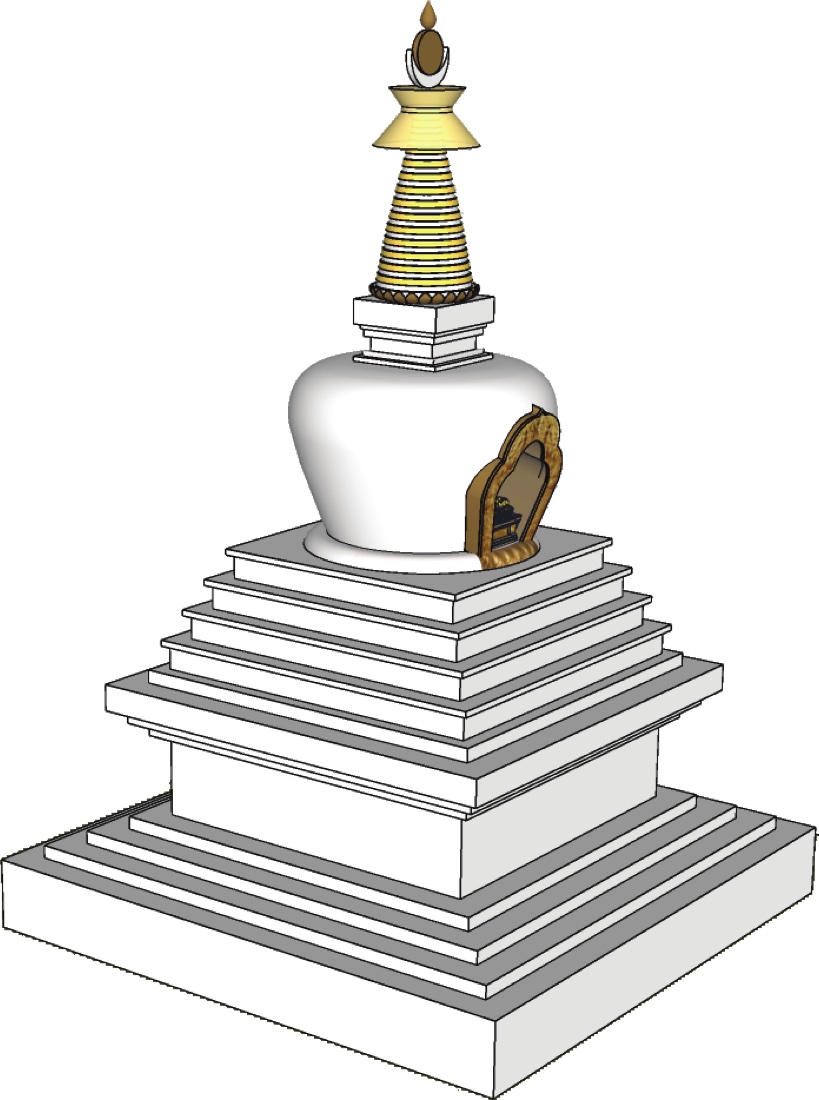
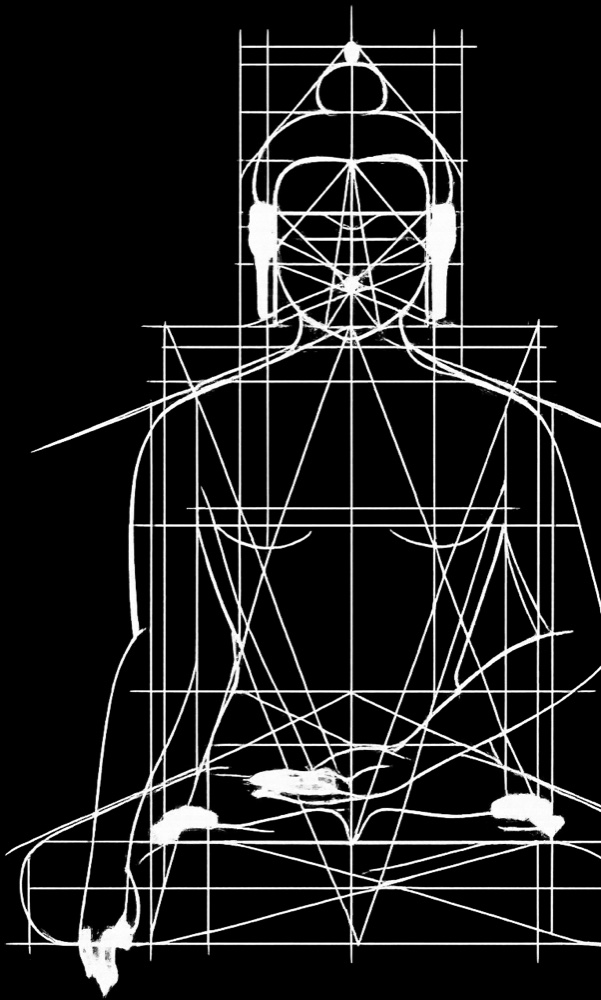
The structures raised for Project 108 are Jangchub Chortens, the "Stupa of Enlightenment" — the most significant of the eight classical stupa types, commemorating the Buddha's attainment of enlightenment. Each is composed, from the ground up, of a square base or pedestal (thri) symbolising the earth element; tiered steps (bangrim) representing the Four Noble Truths; the main rounded dome or vase (bumpa) that holds sacred relics; a niche (lhakhang) bearing an image of the Buddha; the thirteen rings of the spire (khorlo) for the thirteen stages to Buddhahood; the parasol (dhug); and the crowning sun, moon and flame (nyim-da).[1]
The formation
Rather than a cluster of monuments, the 108 chortens are arranged as a procession: a single file along the Mau Chhu, each 15 metres tall and 108 metres apart, centre to centre. The line stretches over roughly 12 kilometres of riverbank.[1] The organisers note the symmetry of the numbers — 108 chortens, 108 metres apart — as deliberate, and offer scale comparisons to convey the ambition: stacked vertically, 108 chortens at 15 metres each would rise about 1.62 kilometres, nearly twice the height of the Burj Khalifa.
The significance of 108
The number 108 recurs across spiritual and scientific traditions and is widely treated as a number of completeness. In Buddhism, the canonical teachings of the Buddha (the Kangyur) are preserved in 108 volumes; practitioners count 108 beads on a mala, circumambulate sacred sites 108 times, and ring temple bells 108 times. Hindu tradition counts 108 Upanishads and performs the sun salutation in cycles of 108. In astronomy, the Earth–Sun distance is roughly 108 times the Sun's diameter, and the Earth–Moon distance roughly 108 times the Moon's diameter. Mathematically, 108 is the product of 1¹ × 2² × 3³.[1]
A single coordinated day
The decision to raise all 108 external structures on one day draws on the Bhutanese tradition of zhabto — voluntary communal labour offered freely as a form of spiritual practice. In Vajrayana Buddhism, the tradition practised in Bhutan, there is a teaching that when intention, action and awareness are perfectly aligned, transformation can occur within a single moment; the coordinated act is the spiritual point, with physical labour becoming practice and united effort becoming shared merit.[1]
The brochure compares the scale of the one-day effort to history's great construction projects: the Great Pyramid of Giza (20,000–30,000 workers over some 20 years) and the Taj Mahal (around 20,000 artisans over about 22 years), against Project 108's target of 40,000 volunteers in a single day. Organisers stress that no specialist skills are required of volunteers, who are trained in advance so that each team knows its task on the day. Since the King's announcement, volunteers have been arriving in their thousands along the Mau Chhu to clear land and prepare the sites; a chartered flight of Bhutanese diaspora from Australia returned to take part.[3]
Progress and readiness
By the project's own account, the site (over 12 km along the Mau Chhu) and the Jangchub Chorten design are confirmed, while engineering, foundation preparation and vendor sourcing are under way and eminent Buddhist masters are providing spiritual guidance.[1] The King inspected the site on 25 March 2026, reviewing the progress and planning of the project.[4]
Sponsorship and participation
The GMCA opened the initiative to public contribution in May 2026, framing participation in two ways: sponsoring a chorten and joining the build. Sponsorship of a full chorten starts at USD 200,000, covering construction, sacred materials and consecration by Buddhist masters, with each chorten able to be dedicated in honour of a sponsor, a family, a community or all sentient beings; shared sponsorship is offered from a minimum of around USD 20,000, alongside open community offerings of any amount.[2]
By mid-May 2026 more than 50 chortens had been sponsored, with the majority of confirmed sponsors from outside Bhutan, according to Dasho Tashi Dorji, lead of the project's spiritual workstream. Domestic fundraising is being channelled through DK Bank, the Bank of Bhutan and a crowdfunding platform on the Royal Securities Exchange of Bhutan.[2] The Authority invites prospective sponsors and volunteers to make contact at 108@gmc.bt.
Historical parallel
Project 108 is consciously placed within a long Himalayan tradition of building networks of sacred structures. The 7th-century Tibetan king Songtsen Gampo is said to have established 108 temples across the region to anchor the Buddhist teachings, including the Kyichu Lhakhang in Paro and the Jambay Lhakhang in Bumthang, both of which still stand in Bhutan. Project 108 is presented as a continuation of that impulse: to build something sacred, together, as an offering of peace.[1]
References
- Project 108 — 108 Jangchub Chortens (project brochure, PDF). Gelephu Mindfulness City Authority. See also the project page at gmc.bt/108.
- "GMC opens 108 Jangchub Chorten initiative for public contribution". Bhutan Broadcasting Service, 13 May 2026.
- "Bhutanese Diaspora in Australia Returned Home to Support GMC Vision". Daily Bhutan.
- "Bhutan King Inspects Landmark 108 Jangchub Chorten Project in Gelephu". Bhutan Post, 26 May 2026.
- "Project 108: Bhutan's Ambitious Vision to Build a Line of Prayer Across the Land". Daily Bhutan.
Related articles
Know something about this topic? Edit this article or . Anonymous contributions welcome — no account required.