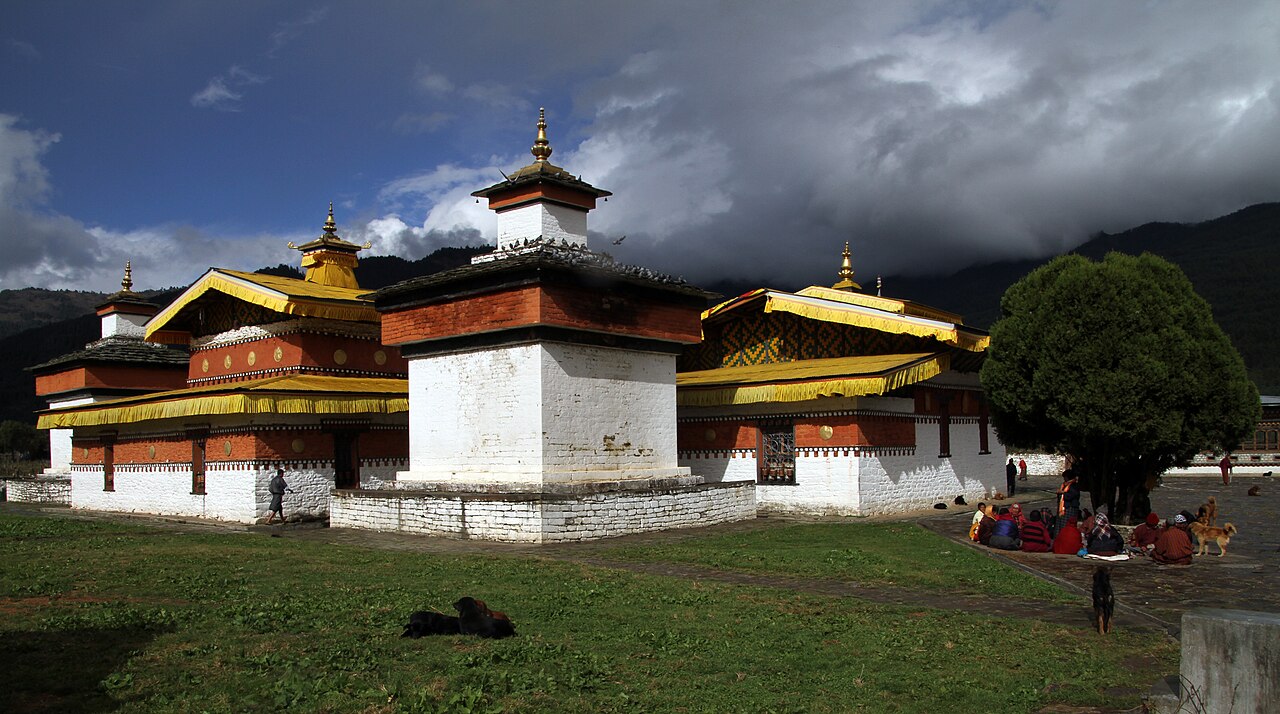

Jambay Lhakhang (Dzongkha: བྱམས་པའི་ལྷ་ཁང་), also known as Jampa Lhakhang, is one of the oldest and most revered temples in Bhutan. Situated in the Choekhor Valley of the Bumthang District in central Bhutan, the temple is traditionally dated to 659 CE and attributed to the Tibetan emperor Songtsen Gampo (604-650 CE). Like Kyichu Lhakhang in the Paro Valley, Jambay Lhakhang was constructed as part of Songtsen Gampo's geomantic project to subdue a giant demoness whose body lay across the Himalayan region, preventing the spread of Buddhism. Jambay Lhakhang was positioned to pin the demoness's left knee.[1]
The temple's name derives from Jamba (Maitreya), the Buddha of the future, to whom the original shrine was dedicated. Over the centuries, the temple has been expanded, renovated, and enriched by successive generations of rulers and religious figures, including Guru Rinpoche (Padmasambhava), who is said to have visited the site in the eighth century and added his spiritual imprint to the sacred landscape of the Bumthang Valley. The Sindhu Raja legend, a foundational narrative of Buddhism's arrival in Bhutan, is intimately connected to this temple and its surroundings.[2]
Jambay Lhakhang is renowned today not only for its antiquity but also for its extraordinary annual festival, the Jambay Lhakhang Drup, which features the famous "naked dance" (tercham) — a fire ceremony and ritual performance unique to Bumthang that draws pilgrims and visitors from across the country and beyond.[3]
History
The founding of Jambay Lhakhang belongs to the same tradition as the establishment of Kyichu Lhakhang in Paro. According to Tibetan historiographical tradition, Songtsen Gampo's Chinese queen Wencheng employed divination to determine that a giant supine demoness (Srinmo) lay across the Tibetan Plateau and its surrounding borderlands, obstructing the establishment of Buddhism. The emperor ordered the construction of 108 temples on the demoness's body to immobilise her, with the Jokhang in Lhasa at the heart. Jambay Lhakhang, built on the demoness's left knee, belonged to the outermost ring of "border-taming" (yangdul) temples.[4]
The eighth century brought a new chapter to the temple's history with the arrival of Guru Rinpoche. According to Bhutanese tradition, around 746 CE, Sindhu Raja (also known as Sendha Gyab), an Indian king who had established himself as ruler of Bumthang, fell gravely ill after offending a local deity. Guru Rinpoche was invited to Bumthang to heal the king. After performing rituals and subduing the offended deity, Guru Rinpoche restored Sindhu Raja to health and converted him and his subjects to Buddhism. Several sites in the Bumthang Valley, including Kurjey Lhakhang, are associated with these events.[5]
Over subsequent centuries, Jambay Lhakhang was expanded and restored by various rulers and lamas. The temple's importance grew as Bumthang became one of the principal centres of Buddhist culture in Bhutan. In the seventeenth century, Zhabdrung Ngawang Namgyal recognised the temple's significance and ensured its continued maintenance as part of his unification of Bhutan. Further restorations were carried out under the Wangchuck monarchy in the twentieth century.[6]
Architecture
The temple complex has evolved considerably from its seventh-century origins. The original structure, while modest in scale, has been enclosed within a larger compound that includes multiple chapels, a circumambulation path, and a courtyard for festival performances. The innermost sanctum retains elements consistent with the earliest period of Tibetan-influenced architecture, including thick stone walls and a compressed floor plan centred on the main altar.[7]
The main chapel houses a statue of Jamba (Maitreya), the future Buddha, reflecting the temple's original dedication. Additional chapels contain images of Guru Rinpoche, Chenrezig (Avalokiteshvara), and other Buddhist deities. Wall paintings in varying states of preservation depict scenes from Buddhist scripture, the lives of saints, and the Sindhu Raja legend. A notable feature is a stone slab in the floor of the inner sanctum, said to have been part of the original seventh-century construction.[8]
The temple compound is surrounded by a low wall and entered through a traditional gateway. A row of prayer wheels lines the circumambulation path, which pilgrims walk in the clockwise direction while reciting mantras. Several ancient chortens (stupas) stand within and near the compound, contributing to the site's atmosphere of accumulated sanctity.[9]
Religious Significance
Jambay Lhakhang holds a place of exceptional importance in Bhutanese Buddhism. As one of the two temples attributed to Songtsen Gampo on Bhutanese soil, it represents the earliest institutional presence of Buddhism in the country — predating even the arrival of Guru Rinpoche by approximately a century. The temple's dedication to Maitreya, the future Buddha, gives it an eschatological significance: it embodies the aspiration for the future flourishing of the dharma.[10]
The Bumthang Valley as a whole is considered one of the most sacred landscapes in Bhutan, with Jambay Lhakhang forming part of a constellation of holy sites that includes Kurjey Lhakhang, Tamshing Lhakhang, and numerous smaller temples and meditation caves. Pilgrimage to these sites is regarded as highly meritorious, and many Bhutanese aspire to visit the Bumthang temples at least once in their lives.[11]
Festivals
The Jambay Lhakhang Drup is one of the most distinctive and celebrated religious festivals in Bhutan. Held annually in October or November (on the 15th to 18th days of the ninth Bhutanese month), the festival spans several days and features a programme of sacred mask dances, rituals, and ceremonies unique to Bumthang.[12]
The highlight is the Mewang (fire ceremony) and the Tercham ("naked dance"), performed on the evening of the festival's main day. During the Mewang, participants pass through a blazing gate of fire, an act believed to cleanse sins and ensure good fortune. The Tercham, performed by monks wearing only small aprons in the darkness of the temple courtyard, is a sacred ritual rather than a public spectacle — traditionally, no lights or photography are permitted. The dance is believed to bestow blessings of fertility on barren women and to bring spiritual merit to all present.[13]
Visiting
Jambay Lhakhang is located in the Choekhor Valley of Bumthang, approximately a twenty-minute drive from the district headquarters at Jakar. The temple is accessible by road and is situated near other important Bumthang temples, making it convenient to visit as part of a broader pilgrimage or cultural tour of the valley. The temple is open to visitors, though access to certain chapels may be restricted during ceremonies. Photography is generally prohibited inside the sanctuaries. Bumthang is reached from Thimphu by road (approximately ten hours) or by domestic flight from Paro to Bathpalathang Airport near Jakar.[14]
References
- "Jambay Lhakhang." Wikipedia.
- "Jambay Lhakhang." Wikipedia.
- "Jambay Lhakhang." Wikipedia.
- "Jowo temples." Wikipedia.
- "Padmasambhava." Wikipedia.
- "Jambay Lhakhang." Wikipedia.
- "Jambay Lhakhang." Wikipedia.
- "Jambay Lhakhang." Wikipedia.
- "Jambay Lhakhang." Wikipedia.
- "Jambay Lhakhang." Wikipedia.
- "Bumthang." Wikipedia.
- "Jambay Lhakhang Drup." Wikipedia.
- "Jambay Lhakhang." Wikipedia.
- "Jambay Lhakhang." Wikipedia.
Related articles
Know something about this topic? Edit this article or . Anonymous contributions welcome — no account required.