Governance of Gelephu Mindfulness City
From BhutanWiki, the people's encyclopedia of Bhutan · politics · Verified
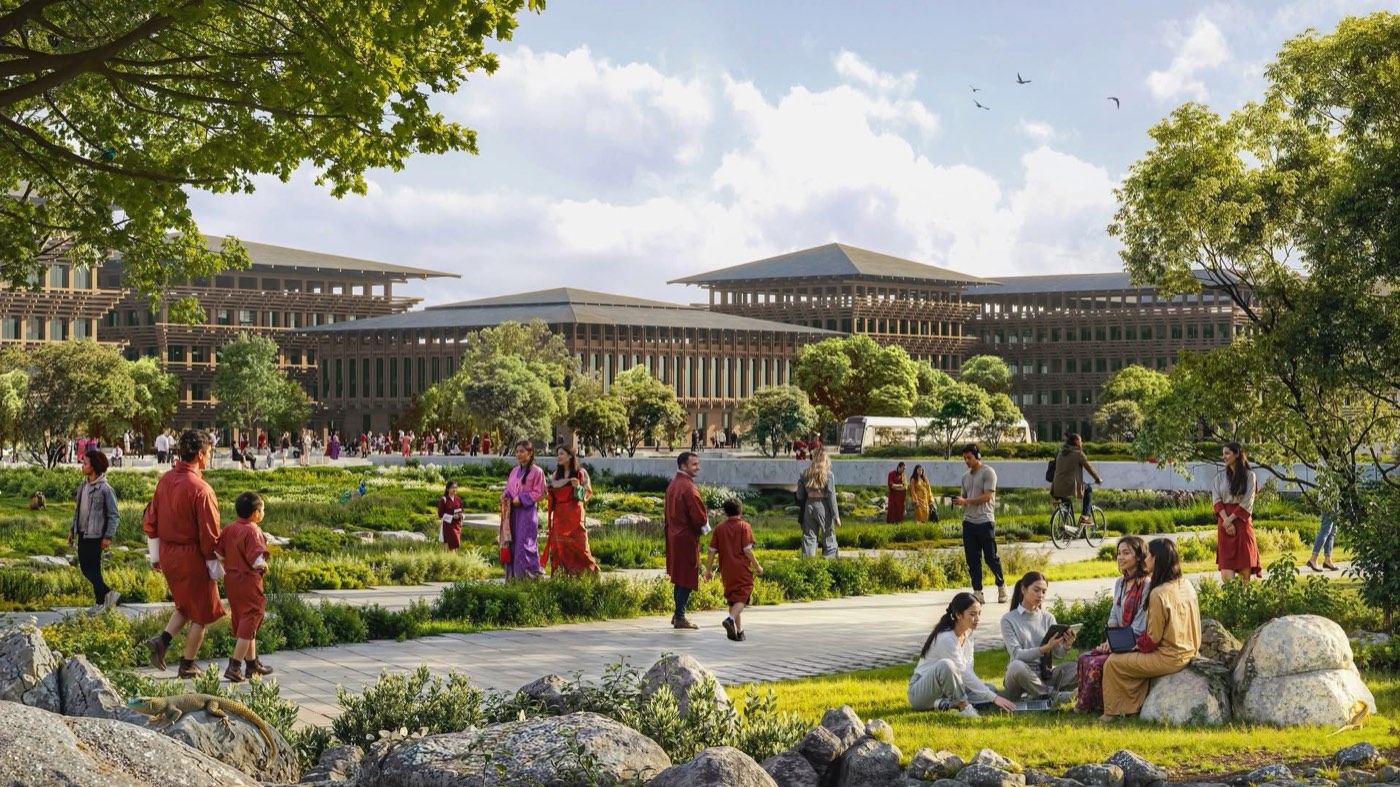
Gelephu Mindfulness City (GMC) is administered as a Special Administrative Region (SAR) of Bhutan, with a governing structure and legal framework set apart from the rest of the country. The region was created by Royal Charter on 13 February 2024 and is run by a Board of Directors chaired by His Majesty King Jigme Khesar Namgyel Wangchuck, a resident Governor responsible for domestic implementation, and a chief executive drawn from international business.[1]
The governance model deliberately mixes Bhutanese state authority with foreign expertise. Day-to-day administration sits with the Gelephu Mindfulness City Authority (GMCA), which under the charter holds executive, legislative and judicial powers within the region. The leadership announced in October 2024 was unusual for Bhutan in that most senior posts went to Singaporean and international figures with backgrounds in airports, real estate and infrastructure finance, while political and educational leadership remained Bhutanese.[2]
This article covers the institutions and office-holders that govern GMC. For the wider project, its master plan and economic ambitions, see the main article on Gelephu Mindfulness City; the original royal decree is covered in the 2023 royal kasho on Gelephu Mindfulness City.
Status as a Special Administrative Region
GMC is the first Special Administrative Region established in Bhutan. It was created under a Royal Charter granted on 13 February 2024, which carved out a jurisdiction in and around Gelephu, in the southern dzongkhag of Sarpang, with substantial autonomy from the rest of the Bhutanese state. The charter vests the region with its own executive, legislative and independent judicial powers, exercised through the Gelephu Mindfulness City Authority.[3]
The SAR remains part of Bhutan and subject to the King as head of state, but it is not governed by the ordinary laws passed by Bhutan's Parliament. Instead it operates under a separate body of imported and locally enacted law (see Legal framework, below). Until the Authority establishes standing executive and judicial bodies, the charter provides that those functions are carried out by the Authority itself or its authorised representatives.[4]
Chairman and the King's role
His Majesty King Jigme Khesar Namgyel Wangchuck serves as Chairman of the GMC Board of Directors. The project originated as a personal initiative of the King, set out in his National Day address of December 2023, and the monarch's direct chairmanship of the board is the principal channel through which royal direction is exercised over the region. Senior appointments to GMC have been made by the King in his capacity as Chairman.[5]
The board held its inaugural meeting on 1 October 2024, after which the King appointed the chief executive and the first directors, and on the board's recommendation named the Governor two days later.[6]
Governor: Lotay Tshering
Dasho Dr Lotay Tshering was appointed the inaugural Governor of Gelephu Mindfulness City on 3 October 2024. A surgeon by profession, he had served as Prime Minister of Bhutan from November 2018 to November 2023 as leader of the Druk Nyamrup Tshogpa party; he stepped down as the party's president to take up the governorship.[7]
The Governor leads the domestic side of the project. His remit covers local execution, policy and infrastructure delivery, and aligning the city's growth with Bhutanese values and the King's stated vision. In the division of labour set out at the launch, the Governor handles internal operations and coordination with the Royal Government, while the chief executive leads strategy and international investment. The Governor reports to the Board of Directors.[8]
Chief executives
In October 2024 the King appointed the Singaporean business leader Liew Mun Leong as the first Chief Executive Officer of GMC. Liew was the founding president and CEO of the property group CapitaLand, which he built into Southeast Asia's largest real estate company, and had also chaired Changi Airport Group and Surbana Jurong. As CEO he was credited with starting construction of Gelephu International Airport, a centrepiece of the master plan.[2]
Liew stepped down in 2025 because of an eye condition that required several operations. GMC then announced, in November 2025, the appointment of two Co-Chief Executive Officers in his place: Lee Seow Hiang and Pang Yee Ean. Lee was the founding chief executive of Changi Airport Group, where he oversaw the development of Jewel Changi Airport and the airport's repeated recognition as one of the world's best; he had earlier been principal private secretary to Lee Kuan Yew. Pang, already a GMC board member, is a former Director General of Investments at the Asian Infrastructure Investment Bank and former CEO of Surbana Jurong Capital, and founded the investment firm Urbina Capital; within GMC he had led work on the Science, Technology and Business Park and renewable energy projects.[9]
Board of Directors
The first Board of Directors, appointed alongside the CEO in October 2024 and chaired by the King, brought together international and Bhutanese members:
- Liew Mun Leong — CEO of GMC (later stepped down), former head of CapitaLand and Changi Airport Group.
- Joichi "Joi" Ito — technologist and former director of the MIT Media Lab; also named Chairman of the Gelephu Investment Development Corporation.
- Pang Yee Ean — infrastructure investment specialist, former AIIB Director General and founder of Urbina Capital; later appointed Co-CEO.
- Lee Seow Hiang — founding CEO of Changi Airport Group; later appointed Co-CEO.
- Dasho Arun Kapur — educationist who established the Druk Gyalpo's Institute in Paro; leads talent and education development for the project.
- Lauren Chung — Asia-Pacific chief executive of the advisory firm Teneo, advising on international relations and communications.
The concentration of foreign business figures on the board reflects the project's emphasis on attracting international investment and applying overseas models of urban and economic development to a greenfield Bhutanese region.[10]
Gelephu Investment Development Corporation
The Gelephu Investment Development Corporation (GIDC) is the body charged with attracting and channelling investment into the SAR and related ventures. Joi Ito was named its Chairman at the October 2024 launch. According to the project's announcements, GIDC's responsibilities extend beyond GMC to investment and economic development elsewhere in Bhutan and abroad, with a focus on digital connectivity, technology industries and green energy, including hydropower and solar generation.[2]
Legal framework
GMC does not run on Bhutan's ordinary statutes. The Application of Laws Act 2024, which came into operation on 26 December 2024, set the legal foundation for the region by importing two foreign bodies of law. Eighteen Singaporean laws form the general framework for matters such as company incorporation, taxation, employment and civil affairs, while ten financial regulations drawn from the Abu Dhabi Global Market govern company law, taxation and financial services. Where the two conflict, Singaporean law prevails unless the Authority decides otherwise.[11]
The Authority retains power under the Royal Charter to enact its own laws — including on land, taxation and criminal matters — and to amend, modify or disapply the imported laws to fit local conditions. Legal commentators have described the arrangement as an unusual hybrid that combines a common-law commercial code with a degree of legislative independence rare among special economic zones.[4]
See also
References
- Gelephu Mindfulness City — official website (gmc.bt)
- Bhutan Appoints Strategic Leaders to Propel Gelephu Mindfulness City to Global Prominence — PR Newswire
- The Legal Framework of Gelephu Mindfulness City: A New Paradigm for Special Administrative Regions — Basnet Law
- The Legal Framework of Gelephu Mindfulness City: Analysis of the Application of Laws Act 2024 — Basnet Law
- Bhutan Appoints Key Leaders to Drive Gelephu Mindfulness City and Adopts Singaporean Law — Daily Bhutan
- Former Prime Minister of Bhutan, Dasho Dr Lotay Tshering Appointed Governor of Gelephu Mindfulness City — Daily Bhutan
- Dr Lotay Tshering quits politics — Kuensel
- Meet GMC's new CEO, Governor and Board — The Bhutanese
- GMC announces appointment of new Co-Chief Executive Officers — BBS
- Bhutan appoints leaders to propel Gelephu Mindfulness City globally — The Nation (Thailand)
- GMC to be governed by 18 Singaporean and 10 Abu Dhabi laws — BBS
Related articles
Know something about this topic? Edit this article or . Anonymous contributions welcome — no account required.