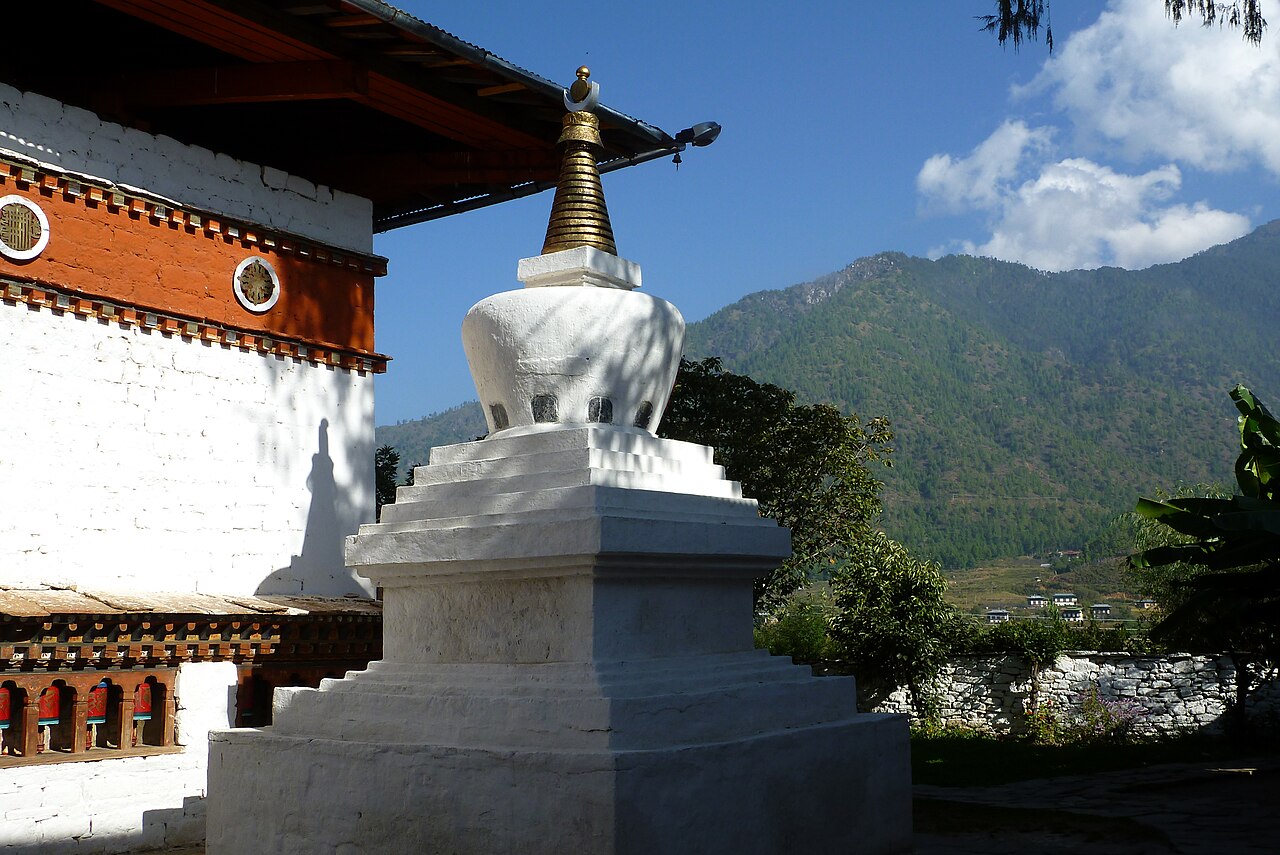

Kyichu Lhakhang (Dzongkha: སྐྱིད་ཆུ་ལྷ་ཁང་), also rendered as Kichu Lhakhang, is one of the oldest and most venerated Buddhist temples in Bhutan. Situated in the lower Paro Valley at an elevation of approximately 2,300 metres, the temple is believed to have been constructed in 659 CE by the Tibetan emperor Songtsen Gampo (604-650 CE) as part of a grand geomantic scheme to subdue a giant demoness whose body was thought to span across the Himalayan region and obstruct the spread of Buddhism.[1]
According to Tibetan Buddhist tradition, Songtsen Gampo ordered the construction of 108 temples across Tibet and the Himalayan borderlands, each positioned on a specific joint or pressure point of the supine demoness. Kyichu Lhakhang was built to pin her left foot, while Jambay Lhakhang in Bumthang was constructed to pin her left knee. If this dating is accurate, Kyichu Lhakhang predates the formal establishment of Buddhism in Bhutan by over a century and represents one of the earliest Buddhist structures in the entire eastern Himalayan region.[2]
The temple complex has been expanded significantly over the centuries, with major additions attributed to Guru Rinpoche (Padmasambhava) in the eighth century and to the queens of the Wangchuck dynasty in the twentieth century. It remains an active place of worship and pilgrimage, containing some of the most important sacred images in Bhutan, including a Jowo Shakyamuni statue believed to date from the seventh century.[3]
History
The founding legend of Kyichu Lhakhang is rooted in the geomantic tradition of Tibetan Buddhism. According to the Mani Kambum and other Tibetan historical texts, Songtsen Gampo — the first great Buddhist king of Tibet — determined that a giant supine demoness (Srinmo) lay across the Tibetan Plateau and the Himalayan region, preventing the establishment of the dharma. On the advice of his Chinese queen Wencheng, who was skilled in divination, he ordered the construction of a series of temples on the body of the demoness to pin her down and neutralise her malevolent influence.[4]
The outermost ring of these "border-taming" (yangdul) temples included Kyichu Lhakhang in Paro and Jambay Lhakhang in Bumthang, both in present-day Bhutan. The two Bhutanese temples thus belong to a geomantic network that extends across the Tibetan cultural sphere, linking them to the Jokhang in Lhasa and other sacred sites. Whether the temples were actually built under Songtsen Gampo's direct orders or were later attributed to him by historiographical tradition remains a matter of scholarly discussion, but the antiquity of Kyichu Lhakhang is not seriously disputed.[5]
In the eighth century, Guru Rinpoche is believed to have visited Kyichu Lhakhang and concealed sacred treasures (terma) within the temple. Significant renovations and expansions occurred in the thirteenth century under Lama Zhang, and again in 1839 under the 25th Je Khenpo (chief abbot of Bhutan). The most transformative modern additions were made by Ashi Kesang Choden Wangchuck, the queen grandmother of the fourth king, who commissioned a second temple (the Guru Lhakhang) adjacent to the original structure in 1968 and oversaw further restoration in the 1990s.[6]
Architecture
The Kyichu Lhakhang complex comprises two main temples set within a walled compound. The original seventh-century temple is a relatively small, simple structure — its compact form and thick walls are consistent with the earliest period of Tibetan Buddhist architecture. The inner sanctum houses the Jowo Shakyamuni, a statue of the historical Buddha as a young prince, which is considered one of the most sacred images in Bhutan. The statue is believed to have been installed at the time of the temple's founding and is similar in style to the famous Jowo Rinpoche of the Jokhang in Lhasa.[7]
The second temple, the Guru Lhakhang, was built in 1968 by the queen grandmother and reflects a more elaborate architectural programme. Its main image is a large statue of Guru Rinpoche (Padmasambhava), flanked by his two consorts. The temple also contains a statue of Kurukulla (a Buddhist deity of magnetism) and various other sacred images. The compound includes chortens, prayer wheels, and a venerable orange tree said to have been planted by the queen grandmother herself, which produces fruit year-round — a phenomenon regarded locally as miraculous.[8]
Religious Significance
Kyichu Lhakhang is regarded as one of the two most sacred temples in Bhutan, alongside Jambay Lhakhang in Bumthang. Its significance derives from multiple factors: its extreme antiquity, its place within the pan-Himalayan geomantic network of Songtsen Gampo's temples, its association with Guru Rinpoche, and the presence of the Jowo Shakyamuni statue. For Bhutanese Buddhists, a pilgrimage to Kyichu Lhakhang is considered an act of great merit.[9]
The temple has also served as a site of royal devotion. Members of the Wangchuck royal family have maintained a close personal connection with Kyichu Lhakhang, sponsoring its upkeep and visiting regularly for prayers and ceremonies. The late queen grandmother Ashi Kesang Choden was particularly devoted to the temple and spent significant time there in her later years. This royal patronage has ensured the temple's preservation and enhanced its status as a national treasure.[10]
Festivals
Kyichu Lhakhang hosts an annual tshechu featuring sacred mask dances performed in the temple courtyard. The Kyichu Tshechu is a relatively intimate affair compared to the larger dzong festivals, but it attracts devoted pilgrims from the Paro Valley and beyond. The dances include depictions of protective deities, episodes from the life of Guru Rinpoche, and the dance of the Black Hat (Shanag), which commemorates the assassination of the anti-Buddhist Tibetan king Langdarma in the ninth century.[11]
Visiting
Kyichu Lhakhang is located approximately eight kilometres from Paro town, a short drive or pleasant walk along the valley floor. The temple is open to visitors, and photography is generally prohibited inside the sanctuaries. Visitors are expected to remove shoes before entering and to circumambulate the temple in a clockwise direction. The compound's peaceful atmosphere, ancient walls, and sacred orange tree make it one of the most contemplative sites in the Paro Valley. It is commonly visited in conjunction with Tiger's Nest (Taktsang), which is located approximately ten kilometres to the north.[12]
References
- "Kyichu Lhakhang." Wikipedia.
- "Jowo temples." Wikipedia.
- "Kyichu Lhakhang." Wikipedia.
- "Jowo temples." Wikipedia.
- "Kyichu Lhakhang." Wikipedia.
- "Kyichu Lhakhang." Wikipedia.
- "Kyichu Lhakhang." Wikipedia.
- "Kyichu Lhakhang." Wikipedia.
- "Kyichu Lhakhang." Wikipedia.
- "Kyichu Lhakhang." Wikipedia.
- "Festivals." Wikipedia.
- "Kyichu Lhakhang." Wikipedia.
Related articles
Know something about this topic? Edit this article or . Anonymous contributions welcome — no account required.