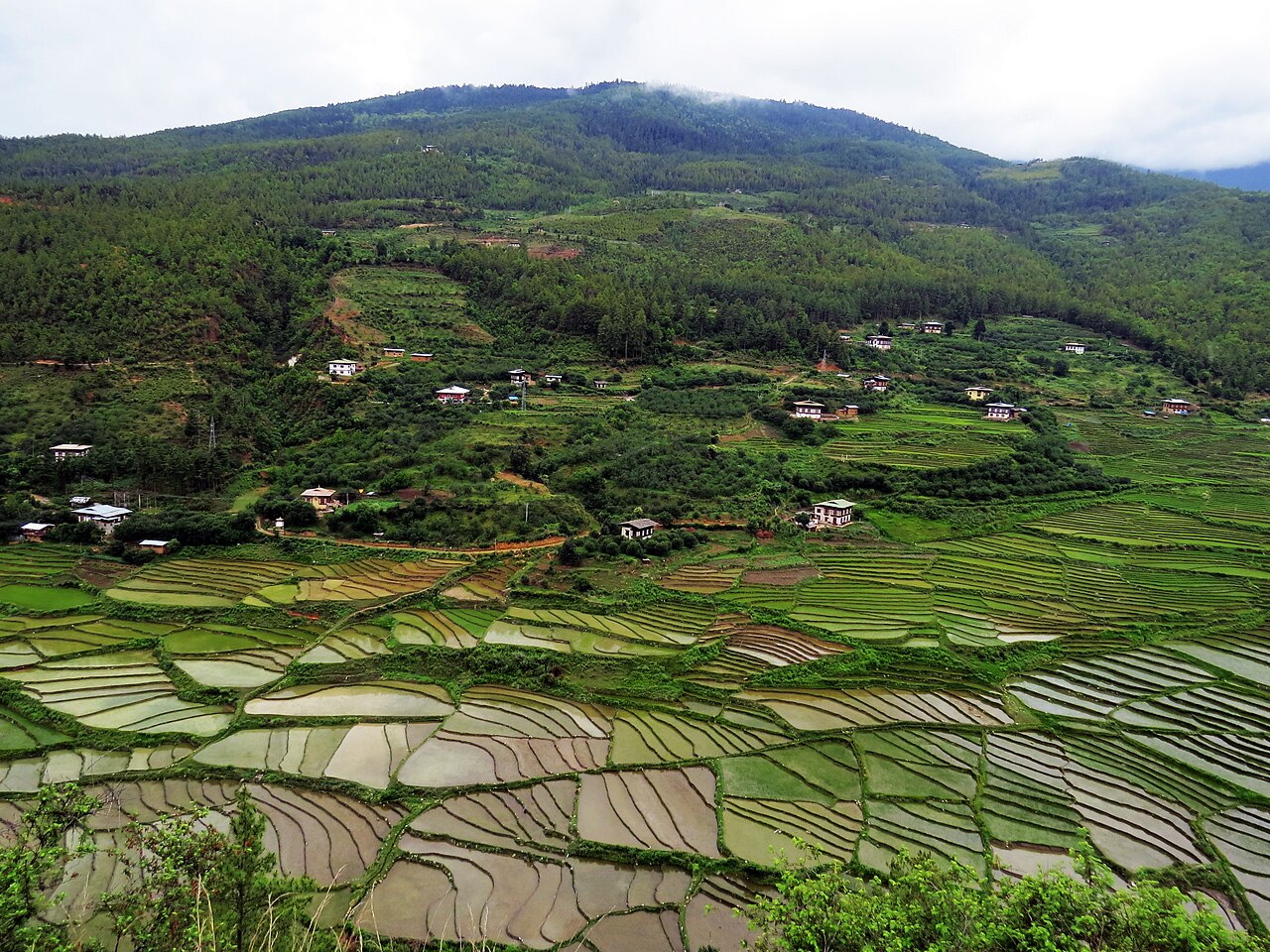

The Paro Valley (Dzongkha: སྤ་རོ) is one of the broadest, most fertile, and historically significant valleys in Bhutan, situated in the western Paro District at an average elevation of approximately 2,250 metres (7,380 ft) above sea level. Stretching along the Paro Chhu (river), the valley is flanked by forested mountains and terraced rice paddies, presenting a landscape that has become iconic in representations of Bhutan worldwide. The valley serves as the site of Paro International Airport, the country's sole international airport, making it the first point of entry for most visitors to the kingdom.[1]
With a recorded history stretching back over a millennium, the Paro Valley has been a centre of political power, religious learning, and agricultural productivity. It is home to some of Bhutan's most venerated religious sites, including the Tiger's Nest (Taktsang) monastery, perched dramatically on a cliff face at 3,120 metres, and Rinpung Dzong, a massive fortress-monastery that has served as the administrative and religious hub of the district since the 17th century. The valley's wide floor, unusual among Bhutan's predominantly narrow Himalayan valleys, supports extensive rice cultivation and has historically made Paro one of the wealthiest regions in the country.[2]
Today, the Paro Valley balances its role as Bhutan's primary gateway for international tourism with the preservation of its agricultural character and cultural heritage. The valley's towns have grown modestly, but the landscape remains dominated by rice fields, traditional farmhouses with whitewashed walls and ornate woodwork, and the forested slopes that rise steeply on all sides.[3]
Geography
The Paro Valley occupies a broad, relatively flat floodplain carved by the Paro Chhu, a major tributary of the Wang Chhu river system. The valley runs roughly north-south for approximately 30 kilometres, with its widest point spanning nearly 5 kilometres — making it one of the most spacious valleys in a country where most habitable land is confined to narrow river gorges. The valley floor sits at approximately 2,200–2,400 metres elevation, while the surrounding ridges rise to 4,000–5,000 metres, creating dramatic vertical relief.[4]
At its northern end, the valley narrows and rises toward the high passes leading to the Haa Valley and the Jomolhari region, while to the south it opens into the confluence with the Wang Chhu near the town of Chuzom. The climate is temperate, with warm summers, cold winters, and a distinct monsoon season from June to September that delivers the bulk of annual precipitation. Winter snowfall occasionally blankets the valley floor, though permanent snow is confined to the peaks above 4,500 metres.[5]
Cultural Significance
The Paro Valley's cultural importance to Bhutan is difficult to overstate. According to tradition, the valley was one of the first areas in Bhutan to receive Buddhism, with the arrival of Guru Rinpoche (Padmasambhava) in the 8th century. The legend holds that Guru Rinpoche flew to the site of Taktsang on the back of a tigress, meditating in a cave on the cliff face for three months to subdue a local demon. The Tiger's Nest monastery, built around this cave in 1692, is today the most sacred pilgrimage site in the country and a symbol of Bhutanese identity recognised around the world.[6]
Rinpung Dzong, constructed in 1646 by Zhabdrung Ngawang Namgyal, the unifier of Bhutan, served as the fortress from which the Paro Penlop (governor) administered the valley and defended it against Tibetan invasions. The dzong remains in active use as both a monastic community and the district administrative headquarters. The ruins of Drukgyel Dzong, at the valley's northern end, commemorate a celebrated victory over Tibetan invaders in the 17th century.[7]
The Paro Tshechu, an annual religious festival held at Rinpung Dzong, is one of Bhutan's largest and most colourful celebrations. Lasting five days, it features sacred mask dances (cham), the unfurling of a giant thangka (thongdrel) at dawn, and draws thousands of Bhutanese from across the country, dressed in their finest traditional garments. The festival is both a profound religious observance and a vital occasion for community gathering and cultural transmission.[8]
Economy
Agriculture remains the foundation of the Paro Valley's economy, with irrigated rice paddies covering much of the valley floor. The red rice variety grown in Paro is prized throughout Bhutan and has gained recognition in international gourmet markets. Apple orchards, introduced in the mid-20th century, also contribute significantly to the local economy, and Paro apples are considered among the finest in the country. Potatoes, wheat, and various vegetables round out the agricultural output.[9]
Tourism has become an increasingly important economic driver. As the location of Bhutan's only international airport and the gateway to the Tiger's Nest, Paro receives the vast majority of the country's international visitors. Hotels, guesthouses, restaurants, and guide services provide employment for a growing number of valley residents, though the government's Sustainable Development Fee policy ensures that tourism growth remains managed and its environmental impact controlled. The presence of the airport has also made Paro a hub for domestic commerce and government services.[10]
Tourism
The Paro Valley offers an exceptionally dense concentration of cultural and natural attractions. Beyond the Tiger's Nest and Rinpung Dzong, visitors can explore the National Museum of Bhutan (Ta Dzong), housed in a renovated 17th-century watchtower above Rinpung Dzong, which contains an extensive collection of Bhutanese art, textiles, weaponry, and natural history specimens. The Kyichu Lhakhang, one of the oldest temples in Bhutan dating to the 7th century, is another significant pilgrimage and tourist site.[11]
Trekking is a major attraction, with the Jomolhari Trek departing from the upper Paro Valley near Drukgyel Dzong and ascending through pristine alpine landscapes to base camps beneath Jichu Drake and Jomolhari. Day hikes to the Tiger's Nest, through forests of blue pine and rhododendron, remain the single most popular activity for visitors to Bhutan. The valley also serves as a base for mountain biking, river rafting on the Paro Chhu, and cultural tours of traditional farmhouses and weaving workshops.[12]
References
- "Paro, Bhutan." Wikipedia.
- "Paro." Wikipedia.
- "Paro Dzongkhag." Lonely Planet.
- "Paro District." Wikipedia.
- "Paro." Wikipedia.
- "Paro Taktsang." Wikipedia.
- "Rinpung Dzong." Wikipedia.
- "Paro Tshechu." Wikipedia.
- "Bhutan at a Glance." FAO.
- "Tourism Policy." Wikipedia.
- "National Museum of Bhutan." Wikipedia.
- "Trekking in Bhutan." Wikipedia.
Related articles
Know something about this topic? Edit this article or . Anonymous contributions welcome — no account required.