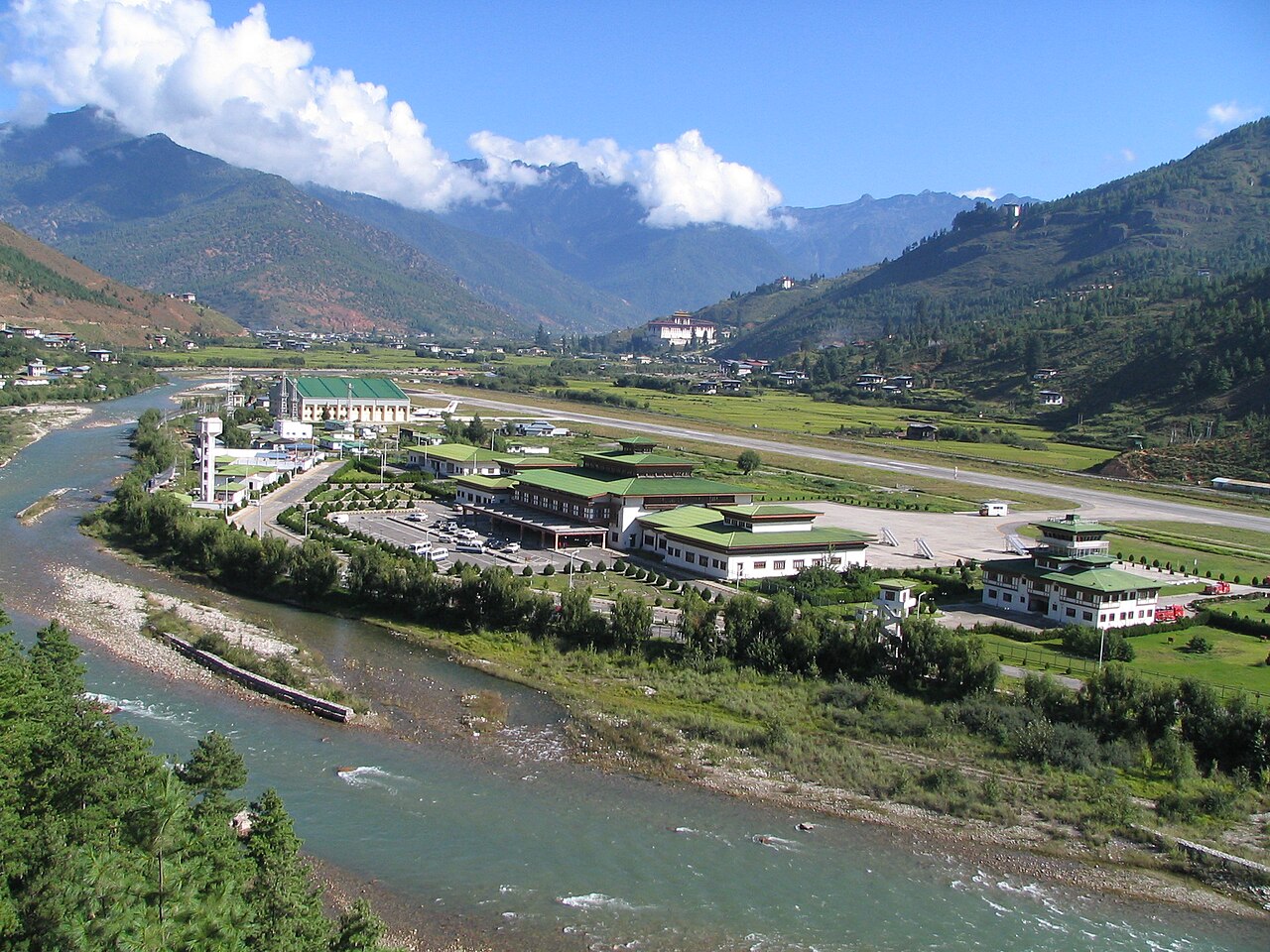

Paro International Airport (IATA: PBH, ICAO: VQPR) is the primary international airport in the Kingdom of Bhutan, situated in a deep valley on the banks of the Pa Chhu river in Paro District, approximately 3.5 kilometres from Paro town and 54 kilometres from the capital, Thimphu.[1] At an elevation of 2,235 metres (7,332 feet) above mean sea level, the airport is surrounded by Himalayan peaks reaching as high as 5,500 metres (18,000 feet), making it one of the most difficult airports in the world at which to land.[2] Only a small number of specially certified pilots are qualified to operate commercial aircraft into Paro.[3]
The airport serves as the gateway for the vast majority of international air travellers entering Bhutan, handling flights operated by the national airline Druk Air (Royal Bhutan Airlines) and the private carrier Bhutan Airlines (Tashi Air).[1] The airport's capacity constraints — both physical and operational — have historically functioned as a natural limitation on the volume of tourism entering the country, complementing the government's policy of managed, sustainable tourism. By 2018, Paro handled 397,599 passengers and 6,761 flights annually.[2]
The challenges of operating at Paro are not merely a matter of altitude. The approach requires aircraft to navigate a winding path through mountain valleys, executing steep turns between peaks before making a rapid descent into the narrow valley where the single runway lies. Crosswinds, turbulence, and rapidly changing weather conditions add further complexity. These factors restrict all operations to daylight hours — from sunrise to sunset — and visual meteorological conditions only, with additional restrictions during windy afternoon periods.[1]
History
In 1968, the Indian Border Roads Organisation constructed an airstrip in the Paro valley, which was initially used for on-call helicopter operations by the Indian Armed Forces on behalf of the Royal Government of Bhutan.[2] The development of the airstrip into an international airport came as part of broader modernisation efforts. Bhutan's national airline, Druk Air, was established by Royal Charter on 5 April 1981.[4] The first Dornier 228-200 aircraft landed at Paro on 14 January 1983, with the exact time of landing, number of passengers, and direction the aircraft was parked all predetermined by the high lama of Paro Dzong.[4] Scheduled commercial flights commenced on 11 February 1983, when Druk Air Flight 101 departed Paro for Kolkata.[4]
The introduction of jet aircraft marked a major milestone. Druk Air took delivery of its first BAe 146-100 on 21 November 1988, and a second entered service in 1992. The BAe 146 enabled Druk Air to expand its route network beyond Kolkata to include New Delhi, Bangkok, Kathmandu, and Dhaka.[4] In 1990, the runway was extended from 1,402 metres to its current length of 1,964 metres (6,445 feet) and reinforced to accommodate heavier aircraft.[2] In October 2004, Druk Air received its first Airbus A319, and the two BAe 146 aircraft were subsequently sold to Star Peru in 2007.[4]
A new terminal building was commissioned in 1999, designed in traditional Bhutanese dzong architectural style.[2] The terminal interior was revamped in 2022, with the addition of works by young Bhutanese artists, including photography and paintings, to showcase Bhutanese art and culture to arriving and departing travellers.[2]
Bhutan Airlines (initially operating as Tashi Air) launched on 4 December 2011, becoming the country's second carrier and ending Druk Air's monopoly on Bhutanese aviation. After initially operating domestic routes, the airline resumed operations on 10 October 2013 as Bhutan Airlines, commencing international flights to India and Thailand with wet-leased Airbus A319 and A320 aircraft.[5]
Approach and Landing
The approach into Paro is frequently described as one of the most spectacular and demanding in commercial aviation. Aircraft must navigate through a series of mountain valleys, descending rapidly while executing sharp turns to align with Runway 15/33, which is oriented at 151/331 degrees along the valley floor.[6] Pilots typically only sight the runway when they are one to two miles out, giving them only seconds to finalise their approach — compared with other airports where the runway may be visible from ten miles away.[3]
There is no instrument landing system (ILS) and no radar at Paro. Pilots must navigate by visual reference to terrain features.[3] RNAV (RNP) approach procedures using satellite-based GPS guidance have been implemented to provide additional precision, with an RNP-0.30 specification requiring the aircraft navigation system to maintain positional accuracy within three-tenths of a nautical mile.[7] However, visual meteorological conditions remain mandatory for all operations.[1]
Pilot certification for Paro requires extensive specialised training. Candidates must hold an Airline Transport Pilot (ATP) certificate with a minimum of 1,500 total flight hours, including at least 500 hours of mountain flying time.[3] Training includes dedicated Paro approach simulator sessions with airport-specific scenarios and supervised actual approaches. Both Druk Air and Bhutan Airlines maintain rigorous internal standards for Paro certification. The small number of certified pilots — estimated at around 50 — means that crew scheduling is one of the most critical operational challenges for both airlines.[3]
Infrastructure and Facilities
The airport features a single asphalt runway (15/33) measuring 1,964 metres (6,445 feet) in length, with a slope of 0.81 per cent towards the south-east.[1][6] The runway length, combined with the airport's elevation and surrounding terrain, limits the types and weights of aircraft that can operate. The airport does not accommodate widebody aircraft, and operational limitations on maximum take-off weight during hot weather or high-density altitude conditions can result in payload restrictions.
The terminal building serves both international departures and arrivals. Designed in traditional Bhutanese dzong architectural style, it features ornate woodwork, sloping roofs, and Buddhist motifs, ensuring that the airport blends with the surrounding valley landscape.[2] The terminal remains modest by international standards, with limited gate capacity and basic passenger amenities. Immigration and customs processing is handled within the single building.
Ground facilities include a fire station, a meteorological office, and a control tower. Aviation fuel must be transported by road from India, as there is no pipeline or refinery in Bhutan. This logistical chain adds to the cost of aviation operations and can occasionally cause supply constraints.
Airlines and Destinations
Druk Air operates the majority of flights from Paro, serving international destinations including Delhi, Kathmandu, Kolkata, Bangkok (via Guwahati), Singapore (via Guwahati), Dhaka, and Dubai, as well as domestic routes to Bumthang, Gelephu, and Yonphula.[8] Bhutan Airlines operates services to destinations including Kolkata, New Delhi, Kathmandu, and Bangkok.[5] Charter operations have also been conducted, including by Nepal's Buddha Air from August 2010.[2]
Incidents
Although Paro's challenging approach has earned it a reputation as one of the world's most dangerous airports, the airport's safety record has been relatively strong, with no fatal accidents recorded in its history of commercial operations. Nonetheless, several notable incidents have occurred:
On 29 July 2011, a Druk Air Airbus A319 sustained a bird strike during operations at Paro.[9] On 16 April 2016, Druk Air Flight KB140, an Airbus A319-115 (registration A5-RGG) operating from Paro to Bangkok via Guwahati with 90 passengers on board, flew into a severe hailstorm over the Garo Hills of Meghalaya during its approach to Guwahati. The aircraft's nose cone and right engine sustained significant damage, but the crew managed a safe landing with no injuries to passengers or crew.[10]
In July 2021, a Boeing 737-300SF cargo aircraft (registration PK-YGW), operated by the Indonesian carrier Tri-MG Intra Asia Airlines on behalf of UNICEF's COVAX initiative to deliver Moderna COVID-19 vaccines to Bhutan, executed a notably hard landing on Runway 33 at Paro after an unstabilised approach. Cockpit footage, which later went viral, showed multiple cockpit alarms including "bank angle" and "sink rate" warnings during the approach. The aircraft did not sustain significant structural damage and departed for Bangkok after 16 hours on the ground.[11]
Operational Constraints
Paro Airport operates under significant constraints that affect airline scheduling and reliability. All commercial flights must operate during daylight hours — from sunrise to sunset — and only when visual meteorological conditions prevail, with additional restrictions during windy afternoon periods.[1] Cloud cover, fog in the valley, high winds, and monsoon weather frequently cause delays and cancellations, particularly during the summer monsoon season from June through September and during winter mornings when valley fog is common.
The airport handles a limited number of aircraft movements per day, constrained by the single runway, the narrow operational window, and the need for adequate spacing between arrivals and departures given the complex approach procedure. During peak tourism seasons in spring (March to May) and autumn (September to November), the airport operates near its practical capacity, and flight availability often becomes a bottleneck for tourism growth.
Future Developments and Gelephu
Plans for expanding Paro Airport's capacity have been discussed for years but are constrained by the valley's geography. There is limited space for runway extension, and the surrounding terrain makes the construction of parallel taxiways or additional runways impractical without massive earthworks. Incremental improvements to terminal capacity, apron space, and navigation systems continue to be implemented.
The most significant development in Bhutanese aviation infrastructure is the construction of Gelephu International Airport at Gelephu Mindfulness City in southern Bhutan. The existing Gelephu domestic airport was upgraded to international status on 16 September 2023, and Druk Air commenced international flights from Gelephu to Kolkata in December 2025.[12] A new purpose-built international terminal, designed to accommodate up to 1.3 million passengers annually, is planned for completion by 2029. Unlike Paro, Gelephu's flatter terrain near the Indian border will allow conventional instrument approaches, night operations, and larger aircraft.[12]
Paro International Airport nonetheless remains the primary aerial gateway to the Kingdom of Bhutan — a status that has made it simultaneously one of the country's most critical assets and one of its most significant infrastructure constraints. The airport's unique combination of breathtaking natural setting, architectural beauty, and operational challenge continues to make arriving at Paro one of the most memorable aviation experiences in the world.
References
- Department of Air Transport, Royal Government of Bhutan. "Paro International Airport: Quick Facts."
- Wikipedia. "Paro International Airport."
- CNN Travel. "This Bhutan airport landing is so tricky only 50 pilots can do it."
- Wikipedia. "Drukair."
- Wikipedia. "Bhutan Airlines."
- Airports Worldwide. "Paro International Airport."
- SKYbrary Aviation Safety. "Required Navigation Performance (RNP)."
- Drukair. "Destinations."
- The Aviation Herald. "Incident: Druk Air A319 at Paro on Jul 29th 2011, bird strike."
- The News Mill. "Lucky escape: Druk Air flight broken by hailstorm over Garo Hills." 16 April 2016.
- Mentour Pilot. "INCIDENT: Paro Bhutan 737 Unstabilized Approach!" 2021.
- CNN Travel. "Bhutan's new airport aims to transform the country forever." 14 March 2025.
Contributed by Anonymous Contributor, Akron
Related articles
Know something about this topic? Edit this article or . Anonymous contributions welcome — no account required.