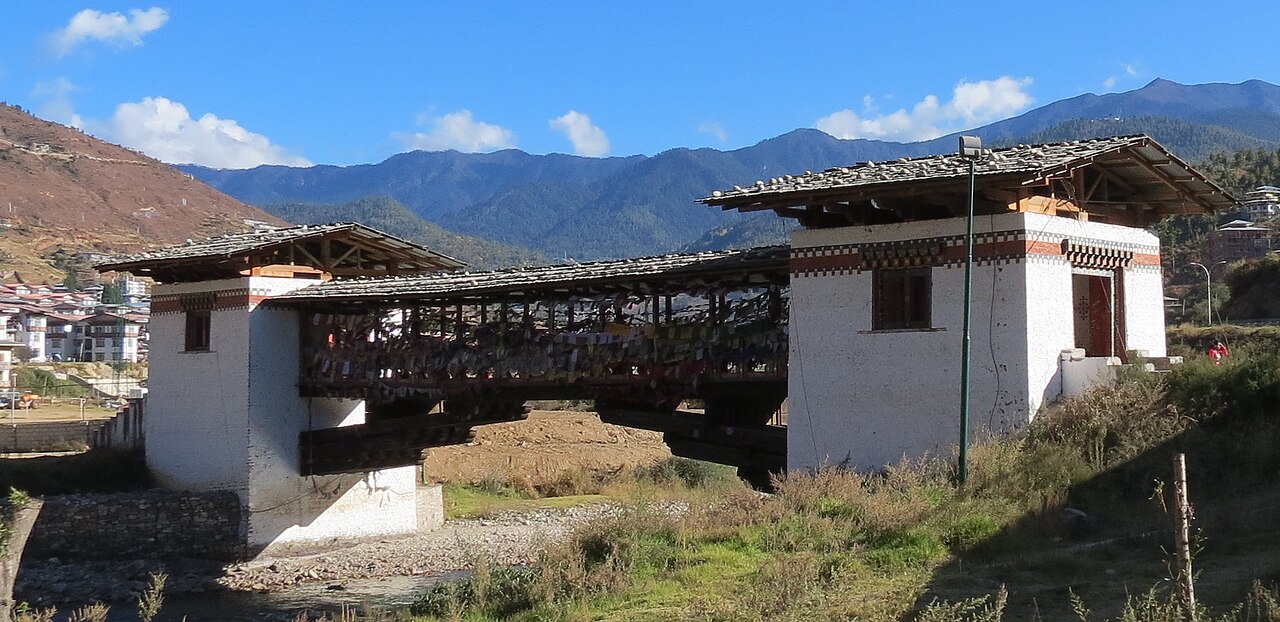

The Wang Chhu (Dzongkha: ཝང་ཆུ; also spelled Wangchu, Wang Chu, or Raidak in India) is one of the principal rivers of western Bhutan, flowing approximately 370 kilometres from its headwaters in the mountains north of Thimphu through the capital city, the Chhukha District, and across the Indian border into West Bengal, where it is known as the Raidak River before joining the Brahmaputra system. The Wang Chhu is the river most closely associated with Bhutan's capital and its modern development, and its waters power some of the largest hydroelectric installations in the country, making it a cornerstone of the national economy.[1]
Rising from glacial sources and fed by numerous tributaries including the Paro Chhu and the Haa Chhu, the Wang Chhu drains a catchment area of approximately 4,590 square kilometres — one of the largest river basins in Bhutan. The river's course takes it through dramatically varied terrain, from alpine meadows and temperate forests near its source above 4,000 metres to subtropical gorges near the Indian border at elevations below 200 metres. This extreme elevation gradient, combined with substantial monsoon rainfall, gives the Wang Chhu the hydrological characteristics that have made it ideal for large-scale hydropower development.[2]
The river flows through the heart of Thimphu, where it is spanned by several bridges and bordered by the capital's expanding urban development. Downstream, the Wang Chhu enters a series of deep, narrow gorges in Chhukha District that provide the steep gradients exploited by the Chhukha and Tala hydroelectric projects. These installations, built with Indian technical and financial assistance, collectively generate over 1,000 megawatts of installed capacity, with the majority of the electricity exported to India under bilateral agreements that represent Bhutan's single largest source of revenue.[3]
Hydrology
The Wang Chhu originates from several small glacial streams and springs in the mountains north and west of Thimphu, at elevations above 4,500 metres. The river is joined by the Thimphu Chhu as it passes through the capital, and its most significant tributary, the Paro Chhu, merges at Chuzom (meaning "confluence" in Dzongkha), a strategically important junction approximately 30 kilometres southwest of Thimphu. Below Chuzom, the Haa Chhu also contributes its flow, and the combined river enters the deeply incised gorges of the lower Wang Chhu basin.[4]
The river's flow regime is dominated by the Indian summer monsoon (June–September), which delivers approximately 70–80 percent of annual precipitation. Peak flows typically occur in July and August, when monsoon rains combine with glacial and snowmelt to produce substantial discharge. During the dry winter months (November–March), flows diminish significantly but remain sufficient to sustain hydropower generation year-round. Climate change projections suggest that glacial retreat in the upper catchment may initially increase dry-season flows due to accelerated melt, but will eventually reduce them as glacier mass declines, posing long-term challenges for water resource management and hydropower planning.[5]
Economy
The Wang Chhu's economic significance to Bhutan centres overwhelmingly on hydropower. The Chhukha Hydropower Plant, commissioned in 1988 with an installed capacity of 336 MW, was Bhutan's first major hydroelectric project and transformed the national economy by establishing electricity exports to India as a primary revenue source. The project was financed largely through Indian grants and loans, and it set the template for subsequent Bhutan-India hydropower cooperation. The Tala Hydropower Plant, commissioned in 2007 with a capacity of 1,020 MW, is located downstream on the same river and is one of the largest hydroelectric installations in the Himalayan region.[6]
Together, the Chhukha and Tala plants account for a substantial share of Bhutan's total hydropower generating capacity and electricity export revenue. Hydropower earnings constitute roughly 40 percent of Bhutan's government revenue and approximately 25 percent of GDP, and the Wang Chhu basin's contribution to this sector is outsized relative to its geographic extent. Additional projects have been studied for the Wang Chhu system, though environmental and social impact concerns, as well as the complexities of bilateral negotiation with India, have influenced the pace of new development.[7]
Ecology
The Wang Chhu basin supports a range of ecosystems corresponding to its dramatic elevation gradient. The upper catchment, within and adjacent to Jigme Dorji National Park, harbours temperate broadleaf and conifer forests rich in biodiversity, including populations of takin, red panda, and various pheasant species. The middle reaches, flowing through the Thimphu Valley, have experienced increasing pressure from urbanisation, with the expanding capital city generating sewage, construction runoff, and solid waste that have degraded water quality in recent decades.[8]
The lower gorges in Chhukha District transition to subtropical broadleaf forests and support species more characteristic of the Indian subcontinent's lowlands, including several fish species of ecological and economic importance. Hydropower dams on the river have altered natural flow regimes and created barriers to fish migration, prompting environmental studies and mitigation efforts. The Royal Government of Bhutan has introduced environmental assessment requirements for hydropower projects, and the National Environment Commission monitors water quality and ecological health in the Wang Chhu and other major river basins.[9]
Cultural Significance
Rivers hold deep spiritual significance in Bhutanese culture, and the Wang Chhu is no exception. The confluence at Chuzom, where the Paro Chhu meets the Wang Chhu, is marked by three chortens (stupas) built in Bhutanese, Tibetan, and Nepali architectural styles — a symbolic acknowledgement of the cultural streams that converge in Bhutanese civilisation. The chortens are also believed to protect travellers and subdue harmful spirits at this geographically and spiritually potent junction point.[10]
In Thimphu, the Wang Chhu's banks host several important religious and civic structures. Tashichho Dzong, the seat of the government and the central monastic body, stands near the river's northern approach to the capital. The river figures in local festivals and rituals, and its waters are considered sacred in the Buddhist tradition of honouring natural features as abodes of naga spirits and water deities. The practice of releasing prayer flags and performing water offerings along the Wang Chhu continues as a living element of Thimphu's religious culture.[11]
Tourism
While the Wang Chhu itself is not a primary tourist destination, it forms the scenic backdrop for many of Bhutan's most-visited sites. The drive from Paro International Airport to Thimphu follows the Paro Chhu before passing through the Chuzom confluence and ascending along the Wang Chhu into the capital — an introduction to Bhutan that showcases the country's river-carved landscapes, terraced hillsides, and riverside settlements. Within Thimphu, riverside walks and parks along the Wang Chhu have been developed as recreational spaces, and the river is visible from many of the capital's principal landmarks.[12]
White-water rafting on sections of the Wang Chhu and its tributaries has emerged as a niche adventure tourism activity, with operators offering half-day and full-day trips on Class II–IV rapids during the post-monsoon season (September–November). The Chhukha gorge section, though not commercially rafted due to the hydropower infrastructure, is renowned among kayakers and river enthusiasts for its dramatic scenery. As Bhutan continues to diversify its tourism offerings beyond cultural sightseeing, the Wang Chhu and other major rivers are likely to play an increasing role in adventure and eco-tourism programmes.[13]
References
- "Wang Chhu." Wikipedia.
- "Wang Chhu." Wikipedia.
- "Chhukha Dam." Wikipedia.
- "Wang Chhu." Wikipedia.
- "Water Resources in Bhutan." ICIMOD.
- "Tala Hydroelectric Power Station." Wikipedia.
- "Hydropower in Bhutan." Wikipedia.
- "Water Quality." National Environment Commission, Bhutan.
- "Environmental Assessment." National Environment Commission, Bhutan.
- "Thimphu." Wikipedia.
- "Thimphu." Wikipedia.
- "Thimphu." Wikipedia.
- "Adventure Activities." Wikipedia.
Related articles
Know something about this topic? Edit this article or . Anonymous contributions welcome — no account required.