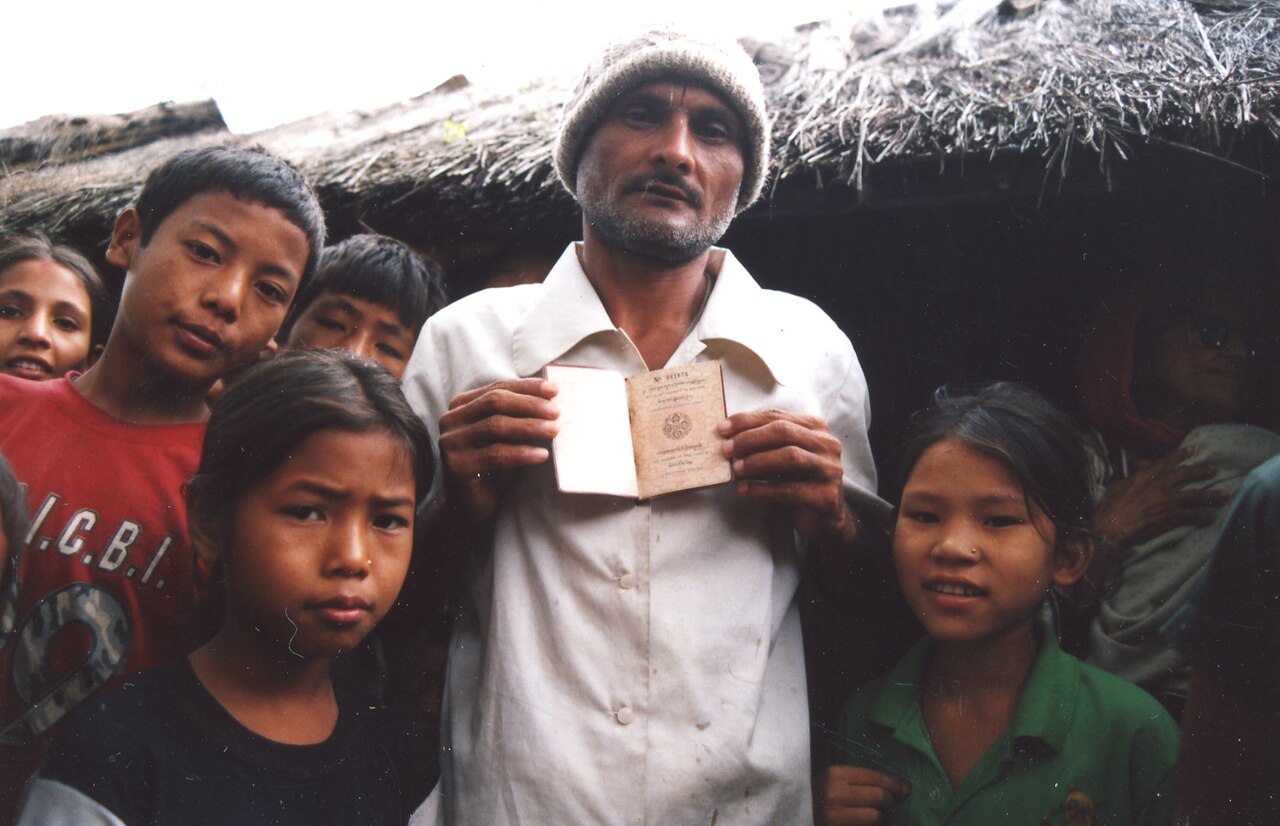

The Bhutanese refugee crisis is the forced displacement of an estimated 80,000–100,000 ethnic Nepali-speaking Lhotshampa from southern Bhutan between 1990 and 1993, their confinement for more than two decades in seven UNHCR-administered camps in the Jhapa and Morang districts of eastern Nepal, and the third-country resettlement programme that, between 2007 and 2016, moved more than 113,000 people to eight Western countries. It is the largest sustained refugee outflow in modern South Asian history outside partition, and it remains the single most contested episode in the historiography of contemporary Bhutan.[1]
The crisis is structured by three sharply divided bodies of framing. The Royal Government of Bhutan (RGoB) has maintained, consistently since 1990, that the population in the camps consisted largely of illegal immigrants from Nepal and India who had entered Bhutan after 1958, that departures from 1990 onward were in substantial part voluntary, and that those with genuine citizenship claims were eligible for return through a joint verification mechanism. Human Rights Watch, Amnesty International, the UNHCR, and a body of academic work led by the anthropologist Michael Hutt have documented forced evictions, coerced "voluntary migration forms", citizenship stripping, torture, custodial deaths, and the demolition of homes, and have framed the episode as an ethnically targeted expulsion. Camp-based advocacy bodies and exiled political parties treat the events as ethnic cleansing and a continuing right-of-return case. The article below presents the documentary record and attributes contested claims to their sources.[2]
The crisis has three chapters and a contemporary tail. The first chapter is the expulsion itself, compressed into roughly thirty months between late 1990 and mid-1993. The second is the camp years, 1992 to 2016, during which the population stabilised at around 107,000, a single bilateral verification round at Khudunabari camp collapsed in December 2003, and the governments of Bhutan and Nepal produced no durable bilateral settlement. The third is the third-country resettlement programme led by the United States through the Core Working Group, announced in 2006, operationally launched in 2008, and formally closed by UNHCR at the end of 2016. The tail, beginning in March 2025, is the removal by US Immigration and Customs Enforcement of resettled Lhotshampa, some of them naturalised US citizens and many of them lawful permanent residents, to a Bhutan that escorted them across the southern border to India within hours of arrival and refused to acknowledge them as citizens.[3]
The remainder of the article follows those four chapters in order, with separate sections on terminology, the RGoB position, and the diaspora politics that shaped resettlement. Contested figures are presented as ranges with sources attached rather than as single values, and the absence of domestic Bhutanese coverage at key moments is noted as a pattern worth recording.
Background: southern Bhutan and the Lhotshampa presence
Bhutan's population is conventionally divided into three broad ethno-linguistic groupings: the Ngalop of the western and central valleys, who speak Dzongkha and follow the Drukpa Kagyu school of Vajrayana Buddhism and who have historically dominated the state and monastic apparatus; the Sharchop of the east, speakers of Tshangla and also predominantly Buddhist; and the Lhotshampa ("southerners"), an ethnically Nepali-speaking, predominantly Hindu population of the southern foothills bordering the Indian states of West Bengal and Assam. Nepali settlement in southern Bhutan began in the late nineteenth century, initially under informal arrangements and then, from the early twentieth century, under contractor-mediated invitations by the Bhutanese state to clear malarial lowland forest for paddy cultivation, a process documented at length in Michael Hutt's Unbecoming Citizens: Culture, Nationhood, and the Flight of Refugees from Bhutan (2003).[4]
The Nationality Law of 1958, enacted under King Jigme Dorji Wangchuck, formally extended Bhutanese citizenship to ethnic Nepalis resident in Bhutan who met residence and land-ownership thresholds. Large numbers of Lhotshampa entered state service, taught in the public school system, held commissions in the Royal Bhutan Army, and represented southern dzongkhags in the National Assembly. By the mid-1980s, population estimates for the Lhotshampa share of the Bhutanese total ranged from about 28 per cent (official Bhutanese figures) to as high as 45 per cent (some advocacy estimates). Academic treatments including Hutt (2003) and Rose (1977) treat the lower end of that range as plausible; the higher-end figures relied on inflated base population assumptions later abandoned by the RGoB itself.
The 1985 Citizenship Act and the 1988 census
The Bhutan Citizenship Act of 1985 re-wrote the legal basis of nationality. Citizenship by birth required that both parents be Bhutanese; citizenship by registration was available only to those who could document residence in Bhutan on or before 31 December 1958 and who satisfied additional proficiency, cultural-knowledge and loyalty tests. Applied retroactively, the Act required many southern Bhutanese to produce written records — tax receipts, citizenship identity cards, land records — documenting pre-1958 presence, a burden many rural households could not meet. Human Rights Watch and Amnesty International have argued the documentary threshold was designed to strip citizenship from a population whose presence before 1958 was administratively ill-recorded but factually uncontested. The RGoB has maintained the thresholds were proportionate responses to post-1958 illegal immigration.[5]
In 1988 the Ministry of Home Affairs conducted a targeted census in the six southern dzongkhags, principally Chirang (since renamed Tsirang), Samchi (now Samtse), Sarpang, Geylegphug, Dagana and Samdrup Jongkhar. Enumerators assigned residents to seven categories ranging from F1 ("genuine Bhutanese") through F7 ("non-nationals"). Hutt (2003) and HRW's 2007 report Last Hope describe Lhotshampa households with decades of tax-paying history reclassified as non-national, citizenship identity cards confiscated on the spot, and members of the same household placed in different categories. The full census returns were never published. The RGoB has treated the census as an evidentiary exercise that correctly identified large-scale illegal immigration; successive HRW and Amnesty reports treat it as the administrative mechanism that rendered large numbers of long-standing citizens stateless.[2]
Driglam Namzha and "One Nation, One People"
From 1989 the government of King Jigme Singye Wangchuck enforced a uniform cultural code — Driglam Namzha — across the civil service, schools and public spaces, and publicly articulated a policy framed in official documents as "One Nation, One People". The code mandated Dzongkha as the sole national language in instruction and administration, required Ngalop dress (gho and kira) in schools, government offices and public events, and removed Nepali-language instruction from the school curriculum in the southern dzongkhags. Non-compliance was subject to fines and, for civil servants, dismissal. Lhotshampa intellectuals and the nascent Bhutan Peoples' Party (BPP) characterised the policies as cultural coercion targeting the south; the RGoB framed them as the protection of a small Himalayan state's identity in the face of demographic and cultural pressure from the plains.[2]
The 1990 southern Bhutan demonstrations
In September and October 1990, large public demonstrations took place in the southern dzongkhags. Participants carried petitions calling for the repeal of the 1985 Citizenship Act, an end to the 1988 reclassifications, the restoration of Nepali-language instruction and recognition of the Hindu religious calendar in the south. The demonstrations were concentrated in Chirang, Samchi, Sarpang and Geylegphug. The government characterised them as an insurgency organised by "ngolops" (anti-nationals) in collaboration with Nepali-speaking political groupings in India and Nepal, and responded with a security operation conducted by the Royal Bhutan Army and police. Amnesty International's 1992 and 1994 reports documented mass arrests, closures of schools and clinics in the south, and widespread allegations of beatings, sexual violence and custodial deaths. The principal Lhotshampa advocate Tek Nath Rizal, a former Royal Advisory Councillor, had been arrested in Nepal in November 1989 and handed back to Bhutanese custody; he was tried under the National Security Act and spent most of the subsequent decade in Chemgang Central Jail. The UN Working Group on Arbitrary Detention later declared his detention arbitrary.[5]
Expulsions, 1990–1993
From late 1990 and accelerating through 1991 and 1992, tens of thousands of Lhotshampa left southern Bhutan in a sustained movement that combined administrative coercion, property confiscation, violence and, in a smaller number of cases, voluntary departure. HRW's Last Hope (2007), based on refugee testimony collected over fifteen years, describes a recurrent pattern: households summoned to local administrative offices; presentation of "voluntary migration forms" (also rendered as "No Objection Certificates") for signature under threat of arrest; confiscation of citizenship cards and land documents; demolition or occupation of dwellings; escort to truck convoys and transport across the Indian border to transit points in West Bengal and Assam; onward movement, facilitated by Nepali community networks, to the Mai river banks in Jhapa and Morang districts of eastern Nepal, where informal encampments formed before UNHCR took over. Amnesty's 1994 report Bhutan: Forced Exile reached the same broad conclusion. The Association of Human Rights Activists, Bhutan (AHURA Bhutan), founded by expelled Lhotshampa, compiled a testimony archive that has since fed into the academic record through Hutt and others.[2]
The RGoB's position has been consistent: those who departed either had never been Bhutanese citizens under the 1985 Act or chose to leave and, in doing so, formally renounced their citizenship through the migration forms, consistent with the 1985 Act's provisions on loss of nationality. The Ministry of Foreign Affairs held that the "law and order situation in southern Bhutan" had been created by "anti-national elements" orchestrated from Nepal and India, and that Bhutan had exercised its sovereign right to address illegal immigration. The principal RGoB figure in this period was Dago Tshering, who served as Home Minister through much of the expulsion and, from 1994, as Bhutan's ambassador to India; refugee and exile-press accounts name him as the political architect of the southern operation, though the RGoB has never released internal documents that would allow independent verification of command responsibility.[6]
The total number expelled is itself disputed. UNHCR's camp registration figures, which peaked at approximately 107,000 in the late 1990s, represent the most defensible single data point because they reflect individual biometric and documentary registration under international supervision. The higher figure of "more than 100,000 expelled" used by HRW, Amnesty and exile bodies includes those who did not register in camps; lower RGoB figures treating only those eventually classed as "bonafide" under the 2001–2003 verification process are an order of magnitude smaller. Hutt (2003, 2005) treats a range of 80,000 to 100,000 as the most honest summary of what is known.
The camps in eastern Nepal, 1992–2016
UNHCR assumed responsibility for the population in 1992 and, together with the Government of Nepal, established seven camps in Jhapa and Morang districts: Beldangi I, Beldangi II, Beldangi II Extension, Goldhap and Khudunabari in Jhapa, and Sanischare in Morang, plus Timai in Jhapa; a smaller transit site at Pathri in Morang operated in the early 1990s. Implementing partners included the World Food Programme (general rations), the Lutheran World Federation (camp management and shelter), Caritas Nepal (education, Class 1 to Class 10 in English and Nepali), AMDA Nepal (health), and Oxfam GB (water and sanitation in the initial years). Nepal is not a party to the 1951 Refugee Convention; residents held refugee identification cards issued under a bilateral administrative arrangement with UNHCR, were not permitted to work legally outside the camps, and required permission to leave the camp perimeter. UNHCR Global Reports through the 1990s and 2000s record the population stabilising at about 105,000 to 108,000.[1]
Camp life was austere but relatively stable. Households occupied bamboo-frame huts with thatch and plastic roofing on raised earth platforms; rations were standardised WFP items (rice, pulses, oil, salt, sugar, blended food), with periodic cuts from 2012 as donor funding declined. The Caritas-run school system became a defining feature: by the early 2000s the camps were producing school-leavers fluent in English and Nepali and, in many cases, passing the Nepal School Leaving Certificate. Access to tertiary education was barred except through a small number of scholarships, and formal employment outside the camps was prohibited; informal day labour in the surrounding Jhapa–Morang economy was widespread and legally ambiguous. Susan Banki's work on camp governance (Refuge, 2008; 2013) describes the camps as unusually well-organised by comparison with other UNHCR protracted-situation contexts, with elected camp committees, women's groups and child-protection structures.[7]
The camps suffered recurrent dry-season fires. In March 2008 a fire in Goldhap destroyed approximately 1,600 shelters and displaced most of the camp's population, who were relocated within Goldhap and, subsequently, to Beldangi. A further fire struck Sanischare in 2011. Both events accelerated consolidation into the Beldangi cluster, a process that reached completion between 2011 and 2013 as Timai, Khudunabari and Goldhap residents were progressively moved out and those camps wound down.
The Joint Verification Team and the Khudunabari round, 2001–2003
Between 1993 and 2003 the governments of Nepal and Bhutan held ten rounds of bilateral ministerial talks on the refugee question. The tenth, in December 2000, produced an agreement to form a Joint Verification Team (JVT) to screen the residents of one pilot camp — Khudunabari — with a view to establishing a framework applicable to the other six. The JVT comprised five members from each side, drawn on Bhutan's side from the Ministry of Home Affairs with security accompaniment, and on Nepal's side from the Refugee Coordination Unit of the Ministry of Home Affairs.[2]
Screening began at Khudunabari in March 2001 and continued for about two years. The JVT produced a classification into four categories agreed at the 2000 ministerial meeting: F1, bonafide Bhutanese who had been forcibly evicted; F2, Bhutanese who had emigrated voluntarily and, under the 1985 Act, lost their citizenship; F3, non-Bhutanese; and F4, Bhutanese who had committed criminal acts. Results were communicated to residents in June 2003. The Bhutanese government's figures, released after the results, classed approximately 2.5 per cent of the roughly 12,000 to 12,500 screened residents — about 293 individuals — in category F1, approximately 70 per cent in F2, approximately 24 per cent in F3 and the remainder in F4. These figures are the Bhutanese government's own; camp residents, the BPP, HRW and Hutt rejected both the methodology and the F1 share. Hutt's 2005 analysis ("The Bhutanese Refugees: Between Verification, Repatriation and Royal Realpolitik") treats the four-category framework as functionally designed to reject the great majority of claimants by routing almost all households to F2 or F3.
In December 2003, during a results-communication and appeals exercise at Khudunabari, members of the Bhutanese delegation were attacked by residents rejecting the classification and the additional conditions — an oath of loyalty, a probationary period, and a renewed citizenship application — attached to prospective return even for F1 cases. The JVT withdrew. The process was suspended indefinitely and never resumed. No verification was ever conducted at the other six camps. By 2006 all parties to the question — UNHCR, the Government of Nepal, the Core Working Group of prospective resettlement states, and a fractured but exhausted camp leadership — treated bilateral repatriation as functionally over.
The third-country resettlement programme, 2006–2016
In 2006 seven, later eight, resettlement states formed the Core Working Group on Bhutanese refugees: the United States, Canada, Australia, Norway, Denmark, the Netherlands and New Zealand, with the United Kingdom joining subsequently. In October 2006 UNHCR publicly announced a third-country resettlement offer. In 2007 Ellen Sauerbrey, US Assistant Secretary of State for the Bureau of Population, Refugees, and Migration, visited Nepal and publicly signalled that the United States was prepared to resettle up to 60,000 Bhutanese refugees, with additional places possible if required; the first arrivals were announced as expected in the United States by January 2008.[8]
Operational architecture: UNHCR conducted refugee status determination and made resettlement-submission referrals; the International Organization for Migration (IOM) ran cultural orientation, medical screening and travel; the Resettlement Support Centre–Nepal (RSC Nepal, operated by IOM under the US Refugee Admissions Program) handled US case processing. On arrival, cases were distributed across US states through the nine US Voluntary Agencies — the International Rescue Committee, the US Committee for Refugees and Immigrants, Lutheran Immigration and Refugee Service, Church World Service, HIAS, Episcopal Migration Ministries, the USCCB Migration and Refugee Services, World Relief and the Ethiopian Community Development Council — producing large concentrations in Pennsylvania (Harrisburg, Philadelphia, Pittsburgh), Ohio (Columbus, Akron), Texas (Dallas–Fort Worth, Houston), New York (Syracuse, Buffalo), Georgia (Atlanta, Clarkston), Arizona (Phoenix, Tucson), Washington state (Seattle, Tukwila), North Carolina (Charlotte, Greensboro) and Vermont (Burlington).[9]
Departures began in March 2008 with the first IOM charter flights from Kathmandu. IOM reported the 40,000th departure in 2010 and the 100,000th in 2015. UNHCR and IOM formally closed the programme at the end of 2016, with UNHCR ceasing to submit new Bhutanese cases for resettlement consideration on 31 December 2016 and final residual departures continuing into early 2017. The consolidated totals by receiving country, as published in UNHCR and IOM closure communications and subsequently cross-checked against receiving-state refugee programme reports, are approximately:
| Country | Approximate total resettled, 2008–2016 |
|---|---|
| United States | ~92,000 |
| Canada | ~6,700 |
| Australia | ~6,200 |
| New Zealand | ~1,075 |
| Denmark | ~875 |
| Norway | ~570 |
| United Kingdom | ~360 |
| Netherlands | ~330 |
| Total | More than 113,000 |
UNHCR's own closure communications describe the programme as "one of the largest and most successful resettlement operations" in its history. The Forced Migration Review issue on the case (Ghimire, 2018) treats it as an important precedent for the use of third-country resettlement as the primary durable solution in a protracted situation where repatriation was politically blocked.[10]
Opposition to resettlement and intra-camp politics
The resettlement programme was not uniformly accepted inside the camps. The Bhutan Peoples' Party, the Druk National Congress (DNC) under Rongthong Kunley Dorji, the Human Rights Organisation of Bhutan (HUROB) founded by Tek Nath Rizal and elements of the camp youth leadership publicly opposed resettlement on the grounds that it amounted to de facto international acceptance of the 1990s expulsion, foreclosed the right of return, and relieved Bhutan of responsibility for its own citizens. Banki (2013) and Hutt (multiple essays) describe an intra-camp division between "stayers" and "goers" that crystallised during 2007 and 2008. In the winter of 2008 and through 2009, a cluster of assaults and at least one killing — the most-cited single incident being the murder of the pro-resettlement camp organiser Hari Bangaley in Beldangi in 2009 — produced a period during which UNHCR cultural-orientation and counselling staff reported a chilling effect on RST referrals. Nepal Police investigations followed, though few prosecutions resulted. Contemporary accounts attributed the violence variously to Maoist-aligned youth groups within the camps and to individual political operators; the precise chain of responsibility has not been established in any published judicial or academic source with the specificity the subject deserves, and this article therefore treats the cluster generically.[7]
The residual caseload, 2017–present
UNHCR's 2017 operational reporting placed the residual camp population at approximately 6,500, consolidated into Beldangi II, Beldangi II Extension and Sanischare after the closure and dismantling of the other sites. The residual group was composed, in broad terms, of residents who had declined resettlement on political grounds, those whose applications had been excluded on medical or security criteria, elderly residents without family anchors in the receiving countries, and children born in the camps to parents in those categories. Subsequent UNHCR Nepal factsheets (2022, 2023, 2024) have tracked a slow decline through mortality, natural attrition and small private-sponsorship departures, principally to Canada; UNHCR's submission to the Universal Periodic Review of Nepal puts the figure precisely at 6,365 as of 31 December 2024, out of a total refugee population in Nepal of 19,914.[11][21]
The residual population's legal status has not been resolved. Bhutan does not recognise them as citizens and has consistently declined to revisit the 1985 Act framework. Nepal is not a party to the 1951 Convention and has not opened a naturalisation pathway for the camp population. Children born in the camps after 2007 are de facto stateless under the practice of both states — the cleanest contemporary protection finding in the case, flagged in HRW's 2021 follow-up reporting and in UNHCR's Global Trends on statelessness. UNHCR's operational footprint in the camps has contracted since 2016, WFP rations have been cut on several occasions, Caritas Nepal has scaled down the school system, and AMDA Nepal remains the principal health partner on a reduced budget. Periodic appeals from residual-camp committees for either a reopened resettlement window or naturalisation in Nepal have not produced a policy change from either government. UNHCR has publicly stated that the large-scale resettlement programme will not resume.[12]
The 2025 Bhutanese-American deportation crisis
The contemporary tail of the crisis is the removal, beginning in March 2025, of Lhotshampa resettled in the United States between 2008 and 2016 under the US Refugee Admissions Program. Most of those removed had adjusted status to lawful permanent residence; a smaller number had naturalised and then lost that status, and a few held older final removal orders. US Immigration and Customs Enforcement characterised the operation as a removal of non-citizens with criminal convictions rendering them removable under US immigration law. Advocacy organisations including Asian Law Caucus, Asian Refugees United and United Stateless characterised the removals as the refoulement in substance of persons to a state that had expelled them on ethnic grounds and refused to recognise them; the legal-strict refoulement claim is complicated by the criminal-conviction exception in Article 33(2) of the 1951 Convention and by disputes about which state is the "country of return" for persons whose original country of origin disowns them.[13]
The structural pattern established by the first cohort, deported on 27 March 2025, became the template. ICE flights landed at Paro International Airport; Bhutanese authorities received the deportees and, within hours, transported them by road — approximately six and a half hours — to Phuentsholing, escorted them across the southern border to Jaigaon in West Bengal, and left them in Indian territory. From there, Indian security personnel reportedly facilitated their onward transit by road roughly 166 kilometres to the Panitanki crossing, where they entered Nepal, typically via the Khoribari crossing, before being detained by Nepali authorities in Jhapa district for irregular entry. The first cohort of ten reached the former Beldangi camp area on 28–29 March 2025; three men — Roshan Tamang, Asish Subedi and Santosh Darji — were arrested by Nepali police that Saturday, and a fourth, Ashok Gurung, was added in the following days.[3]
On 17 April 2025 the Supreme Court of Nepal, hearing a habeas corpus petition filed by the advocate Narayan Kumar Subedi, issued an interim order directing the government not to deport the four men and requiring them to be produced in court on 23 April. Justice Hari Prasad Phuyal wrote the order. The stay froze their onward removal but did not resolve their legal status in Nepal; subsequent reporting in the Kathmandu Post, NEPYORK, Global Press Journal and Inter Press Service tracked the four men and a broader set of arrivals through further proceedings.[14]
Cumulative figures through 2025 are contested. Pennsylvania-focused reporting by WITF and WESA documented twelve removals from Pennsylvania alone by late April. Asian Law Caucus, in its 26 June 2025 Freedom of Information Act request against ICE and the State Department, cited at least 60 arrests and at least 27 removals nationally. CNN and NPR in July cited "more than two dozen" through that month, and AsAmNews by mid-December referenced figures of at least 53 Nepali-speaking Bhutanese removed. No comprehensive official count has been released; the ranges above reflect different cutoff dates and different counting methodologies, not disagreement over whether the removals took place.[15]
Bhutan's on-record 2025 communications addressed a separate cohort: "undocumented Bhutanese nationals" in the United States alleged to have overstayed visas. In June 2025 the Ministry of Foreign Affairs and External Trade issued an advisory urging such persons to return voluntarily; in July 2025 Prime Minister Tshering Tobgay, speaking to BBS, estimated the overstayer population in the US at four to five thousand, with about 1,500 officially registered, and urged them to return. Neither the MFAET advisory nor the Prime Minister's statements engaged the resettled-Lhotshampa returnees as a category: no public statement from the RGoB in 2025 acknowledged the 27 March cohort, the Phuentsholing handovers, or the citizenship status of resettled refugees. Kuensel coverage in the same period confined the discussion to the overstayer question and the climate of fear among Bhutanese in the United States under ICE enforcement; BBS followed the same line. The pattern matches a longer archival observation about Bhutanese domestic coverage of the refugee population: Kuensel print issues from 1992 to 2003 record the camp population principally in the form of Ministry of Foreign Affairs statements and reports on bilateral talks, usually described as "people in the camps in Nepal" or "so-called refugees", not as Bhutanese citizens. No Kuensel article in available archives reports the more-than-113,000 figure as a story about Bhutanese citizens. The absence is itself a pattern worth recording.[16]
Bhutan's position across the crisis
The Royal Government of Bhutan's legal and political position has been consistent from 1992 through 2025. It holds that the 1985 Citizenship Act is the governing instrument of Bhutanese nationality and that its retroactive application to pre-1958 residence is a lawful and proportionate measure. It holds that the 1988 census accurately identified a large population of illegal immigrants. It holds that persons who signed migration forms in 1990–1993 did so voluntarily and, in doing so, lost their citizenship under the 1985 Act. It holds that the JVT's Khudunabari results are the correct application of the agreed four-category framework. It holds that resettlement in the West discharged any residual obligation toward persons the 1985 Act had already excluded from nationality. And it has treated the 2025 returnees as a matter for the United States rather than for Bhutan, maintaining silence on their identity as former residents of southern Bhutan. Each of these positions is contested by HRW, Amnesty, the OHCHR through successive Universal Periodic Reviews, and the academic literature led by Hutt and Banki. None of these positions has been revised in the public record.
Diaspora politics and advocacy
The resettlement programme produced a geographically dispersed diaspora of more than 100,000 people, concentrated in the United States but with substantial communities in Canada and Australia. Political and advocacy organisations active in the diaspora include the Bhutanese Community in America umbrella and its state and city affiliates, the Global Campaign for the Release of Political Prisoners in Bhutan (GCRPPB), the Bhutan News Service, Bhutan Watch, AABANA (the Association of Bhutanese in America Nationwide Affairs), the Association of Press Freedom Activists Bhutan (APFA-Bhutan), and the Bhutanese Community of Central Ohio. Historical political formations — the Bhutan Peoples' Party, the Druk National Congress, and the United Front for Democracy — continue to exist in exile but have diminished operational presence. Advocacy has focused on the right of return, the release of political prisoners still held in Chemgang Central Jail and other facilities, and international documentation of the 1990s expulsion; the 2024 UN Working Group on Arbitrary Detention Opinion 60/2024 on a contemporary Bhutanese political prisoner represents the most recent formal international finding touching the longer arc of the case.
Terminology and historiography
Terminology in this case is itself evidence of framing. The RGoB uses "ngolops" or "anti-nationals" for Lhotshampa protest leaders; "people in the camps" or "so-called refugees" or "voluntary migrants" for the camp population; the "southern problem" or the "law and order situation in southern Bhutan" for the expulsion itself. HRW, Amnesty and the academic literature use "Lhotshampa refugees", "Bhutanese refugees of Nepali origin", "forced eviction", "expulsion" and — in HRW's Last Hope (2007) and more explicitly in later advocacy writing — "ethnic cleansing". Hutt's Unbecoming Citizens (2003) is the foundational academic treatment and remains the most cited single work on the case; it treats the events as the product of an ethnically exclusive nation-building project pursued by the Bhutanese state, documented through refugee testimony, archival research and extensive fieldwork in both Bhutan and the camps. Banki (2008, 2013) is the strongest source on camp governance and resettlement politics. Pulla (2016), Evans (2010), and Rose (1977, for pre-1990 context) are secondary anchors. The Kuensel print archive for 1990 through 1993 is a significant and still-open gap in the historical record accessible to outside researchers.
See also
- Lhotshampa
- Bhutan Citizenship Act 1985
- Driglam Namzha
- Tek Nath Rizal
- Dago Tshering
- Michael Hutt
- Beldangi refugee camp
- Khudunabari refugee camp
- Sanischare refugee camp
- Goldhap refugee camp
- Timai refugee camp
- List of Bhutanese political prisoners
- Global Campaign for the Release of Political Prisoners in Bhutan
- WGAD Opinion 60/2024
- Chemgang Central Jail
- National Security Act (Bhutan)
- Tsirang (formerly Chirang)
- Samtse (formerly Samchi)
- Sarpang
- Bhutanese refugee suicide crisis
References
- "Resettlement of Bhutanese refugees surpasses 100,000 mark." UNHCR News, 2015.
- Human Rights Watch, Last Hope: The Need for Durable Solutions for Bhutanese Refugees in Nepal and India, May 2007.
- Parbat Portel, "Bhutan sends US-deported 10 individuals to Nepal, three arrested", Kathmandu Post, 30 March 2025.
- Michael Hutt, Unbecoming Citizens: Culture, Nationhood, and the Flight of Refugees from Bhutan, Oxford University Press, 2003.
- Amnesty International, Bhutan: Forced Exile, ASA 14/004/1994.
- Bhutan News Network / Bhutan News Service, archive on the 1990–1993 expulsion.
- Susan Banki, "Bhutanese refugees in Nepal: anticipating the impact of resettlement", Refuge, 2008.
- "Assistant Secretary Sauerbrey with Bhutanese refugees", US Department of State Archive, Bureau of Population, Refugees and Migration, 2007.
- Migration Policy Institute, "Bhutanese Refugees in the United States".
- Anita Ghimire, "A 'successful' refugee resettlement programme: the case of Nepal", Forced Migration Review, 2018.
- UNHCR, "Nepal Factsheet, March 2023", ReliefWeb.
- "UNHCR says the resettlement programme will not resume", Onlinekhabar English.
- Asian Law Caucus, "Asian Law Caucus Seeks Records on Arrests and Deportations of Bhutanese American Refugees", 26 June 2025.
- "Supreme Court stays deportation of four Bhutanese refugees", Kathmandu Post, 17 April 2025.
- Jordan Wilkie, "ICE confirms additional deportations of refugees to Bhutan", WITF, 24 April 2025.
- "PM urges Bhutanese overstaying in U.S. to return home voluntarily", Bhutan Broadcasting Service, 4 July 2025.
- Rhea Mogul et al., "Forced from Bhutan, deported by the US: these stateless Himalayan people are in a unique limbo", CNN, 18 July 2025.
- "Bhutanese Refugees Deported From the US Find Themselves Stateless Once More", The Diplomat, April 2025.
- "Bhutan's refugees to be resettled from Nepal within months", UNHCR News, 2007.
- "Transitions without Justice: Bhutanese Refugees in Nepal", International Journal of Transitional Justice, 2024.
- Submission by the United Nations High Commissioner for Refugees to the Universal Periodic Review of Nepal, 51st session. UNHCR, July 2025.
Related articles
Know something about this topic? Edit this article or . Anonymous contributions welcome — no account required.