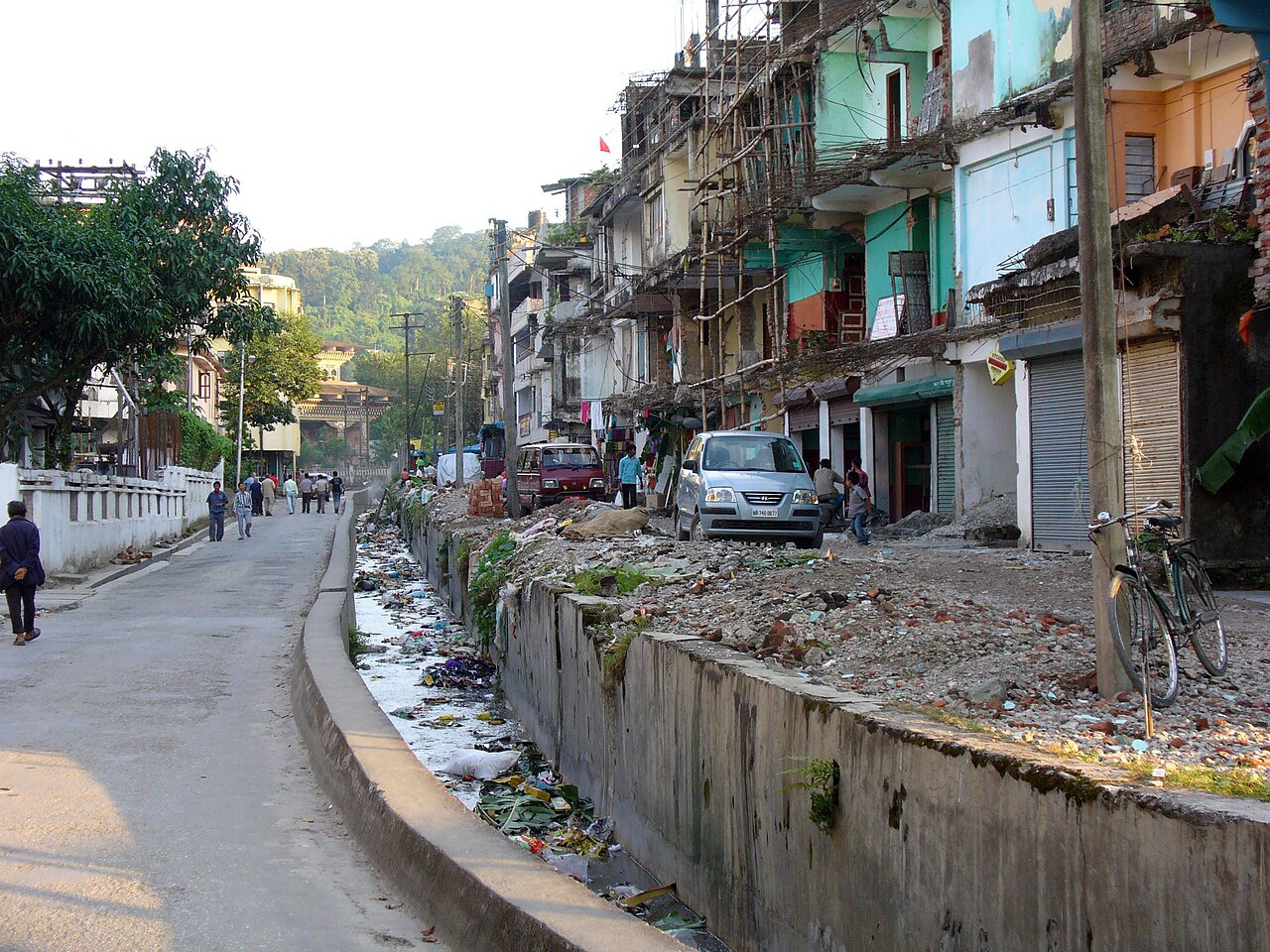

Phuentsholing (Dzongkha: ཕུན་ཚོགས་གླིང, meaning "Land of Prosperity") is the second-largest city in Bhutan and the country's primary commercial and trade hub, located in the southern foothills at the border with India. The city lies at the base of the Himalayan foothills at an elevation of approximately 300 metres, directly adjacent to the Indian town of Jaigaon in the Alipurduar district of West Bengal. Phuentsholing serves as the administrative headquarters of Chukha District and is Bhutan's most important point of entry for goods and travellers arriving overland from India.[1]
With a population exceeding 27,000 in the 2017 census — and substantially larger if the surrounding thromde (municipality) area is included — Phuentsholing is Bhutan's second most populous urban centre after Thimphu. The city handles an estimated 80 percent of Bhutan's total import-export trade, making it the country's de facto financial capital. Its subtropical climate, lowland location, and direct road connection to India give it a character markedly different from Bhutan's highland towns, and it is often described as the most cosmopolitan city in the country.[1]
The Bhutan Gate, an ornate traditional-style archway marking the border crossing between Phuentsholing and Jaigaon, is one of the most recognisable landmarks of the Bhutan-India border. Indian nationals can cross freely into Phuentsholing and vice versa under the provisions of the Indo-Bhutan friendship treaty, while third-country nationals require permits processed through the immigration office at the border.[1]
History
Phuentsholing's development as a major urban centre is a relatively modern phenomenon, closely tied to the expansion of trade between Bhutan and India in the 20th century. Before the construction of the national highway connecting it to Thimphu and the interior, the area was a small border settlement. The construction of the 174-kilometre Phuentsholing-Thimphu Highway, completed in stages from the 1960s with Indian assistance, transformed Phuentsholing into Bhutan's primary trade corridor and drove rapid urbanisation.[1]
The city's growth accelerated further with the development of the Chukha Hydropower Plant in the 1980s and the Tala Hydropower Plant in the 2000s, both located in the Chukha District along the Wang Chhu river above Phuentsholing. These hydropower projects, which export electricity to India, brought infrastructure investment, skilled workers, and associated commercial activity to the region. Today, Phuentsholing is a bustling commercial centre with banks, hotels, government offices, and industrial enterprises lining its orderly grid streets.[2]
Economy and Trade
Phuentsholing is the commercial engine of the Bhutanese economy. The city hosts the offices of the Bank of Bhutan, the Bhutan National Bank, the Bhutan Chamber of Commerce and Industry, and numerous trading firms. The Phuentsholing Industrial Estate, located on the outskirts of the city, houses manufacturing enterprises producing processed foods, beverages, chemicals, and other goods for both domestic consumption and export to India. The Bhutanese ngultrum, pegged at par to the Indian rupee, facilitates seamless cross-border trade.[1]
The city's customs and immigration checkpoint processes thousands of trucks and vehicles daily, carrying construction materials, consumer goods, fuel, and foodstuffs into Bhutan, and ferrosilicon, cement, processed fruit, and electricity tariff payments in the reverse direction. Revenue from customs duties collected at Phuentsholing constitutes a significant portion of government income. The opening of a dry port facility has further enhanced the city's capacity to handle growing trade volumes.[3]
Urban Character and Infrastructure
Phuentsholing's urban landscape differs markedly from other Bhutanese towns. While traditional Bhutanese architectural mandates apply — all buildings must incorporate elements of traditional design, including the characteristic trefoil window motifs and sloping roofs — the city has a distinctly commercial and lowland character. Multi-storey concrete buildings house shops and offices, and the streets are busier and more congested than those of highland towns. The subtropical climate, with hot and humid summers and temperatures regularly exceeding 30°C, further distinguishes the city from the temperate and alpine environments of interior Bhutan.[1]
Key landmarks include the Bhutan Gate, Zangto Pelri Lhakhang (a temple representing the celestial abode of Guru Rinpoche), Kharbandi Goemba (a hillside monastery offering panoramic views of the plains below), and the Amo Chhu Crocodile Breeding Centre, which houses gharial and mugger crocodiles as part of a conservation programme. The city is also the starting point for the dramatic drive up the national highway to Thimphu, a six-hour journey that climbs from near sea level through subtropical forests, temperate woodlands, and high mountain passes.[1]
Cross-Border Dynamics
The Phuentsholing-Jaigaon border is one of the most porous and active international boundaries in South Asia. Indian and Bhutanese citizens cross freely in both directions, and the two towns function in many respects as a single economic zone. Many Phuentsholing residents shop in Jaigaon's larger and more varied markets, while Indian workers commute daily into Phuentsholing for employment in construction, services, and commerce. This interdependence, while economically beneficial, also poses challenges related to urban planning, waste management, public health, and security.[1]
During the COVID-19 pandemic, the border was closed for an extended period beginning in March 2020, severely disrupting trade and daily life on both sides. The closure highlighted Bhutan's dependence on the Phuentsholing corridor for essential supplies and accelerated discussions about alternative trade routes and the diversification of supply chains.[4]
See also
References
Related articles
Know something about this topic? Edit this article or . Anonymous contributions welcome — no account required.