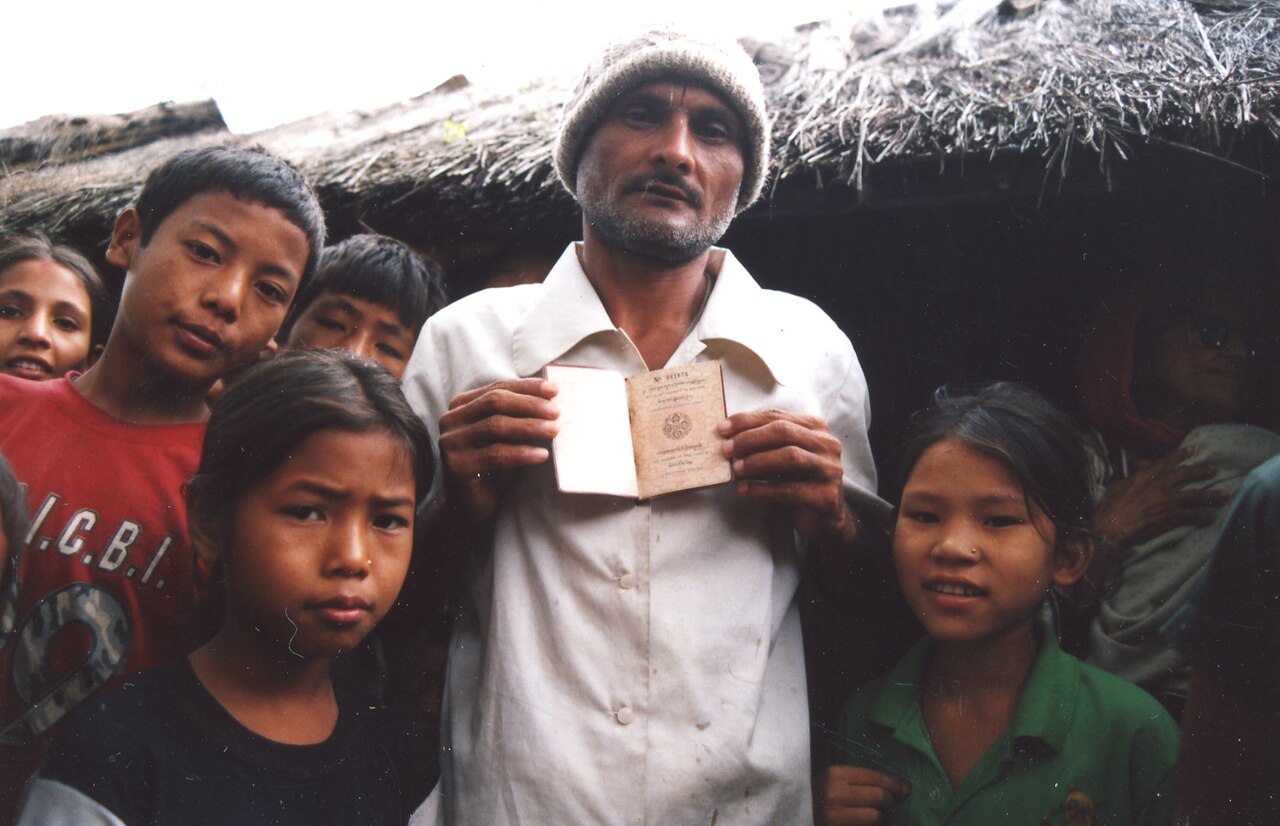

Beldangi Refugee Camp is the largest of the settlements established in Jhapa district, south-eastern Nepal, to shelter Lhotshampa refugees expelled from Bhutan during the early 1990s. It is not a single camp but a complex of three adjacent sub-camps — Beldangi I, Beldangi II, and Beldangi II Extension (the latter informally referred to as Beldangi III) — laid out on agricultural land near the municipality of Damak, in the Terai lowlands. Opened in 1992 under the coordination of the United Nations High Commissioner for Refugees (UNHCR), the Beldangi complex became the centre of political organisation, cultural life and humanitarian operations for the stateless Bhutanese community throughout the protracted refugee crisis.[1]
At its steady-state peak in the late 1990s and early 2000s, the three sub-camps together housed close to 50,000 registered refugees — roughly half of the total Bhutanese refugee caseload in Nepal. Beldangi was where the main refugee political bodies, agency field offices and camp schools were based, and most outside reporting on life in the camps used Beldangi as the frame of reference. It remains, more than three decades after the first arrivals, the largest residual site of the caseload that neither returned to Bhutan nor departed under the third-country resettlement programme.[2]
Of the seven UNHCR-managed camps, three — Beldangi II, Beldangi II Extension, and Sanischare in neighbouring Morang district — remained operational into the 2020s. Beldangi I was progressively wound down as its population departed for resettlement and was effectively closed by around 2017, its remaining residents transferred into the two adjoining sub-camps. Residents of the closed camps of Goldhap, Khudunabari, Timai and Pathri were progressively consolidated into the Beldangi complex between 2011 and 2013.[3]
Establishment and physical layout
Beldangi I opened in early 1992 on leased farmland near Damak, as the first wave of Lhotshampa expelled from Bhutan overwhelmed the capacity of transit camps at Maidhar and Kakarvitta along the Mechi river. Arrivals continued through 1992 and into 1993 — at peak, several thousand people crossed into Nepal each week — and UNHCR opened Beldangi II on adjoining land later that year, followed by Beldangi II Extension. The three sub-camps together covered roughly 80 hectares of flat, subtropical terrain bordered by rice paddies and small Nepali villages.[2]
Each sub-camp was divided into numbered sectors and sub-sectors. Narrow unpaved lanes separated rows of bamboo-and-thatch shelters, each typically 15 to 20 square metres and housing a family of five to eight. Density was extreme: in the peak years, the residential footprint of the complex exceeded 45,000 persons per square kilometre, comparable to the densest urban slums in South Asia. Thatch was gradually replaced by plastic sheeting and later corrugated metal; bamboo remained the standard structural material throughout.[4]
Central facilities included a main distribution centre for World Food Programme rations, a UNHCR field office, health posts operated by the Association of Medical Doctors of Asia (AMDA), primary and secondary schools run by Caritas Nepal, community halls, temples and sports fields. The Lutheran World Federation managed water, sanitation and shelter works across the complex. Each sector had its own water points — initially tube wells, later piped distribution — communal latrine blocks, and a sector office where elected sub-sector heads handled local affairs.
Daily life and community
Life in Beldangi followed rhythms dictated by the humanitarian schedule and the subtropical climate. Mornings began before dawn, with families collecting water, cooking over wood or kerosene stoves and preparing children for school. The main meal was rice and lentils — the WFP staple ration — supplemented by vegetables grown in small kitchen gardens or bought from local markets when money was available.
The Government of Nepal formally barred refugees from working outside the camps, though enforcement was inconsistent. An informal camp economy developed: small shops selling snacks and household goods, tailoring workshops, bicycle repair stalls, tutoring services. Some residents found day labour on surrounding farms during planting and harvest. From 2008 onwards, remittances from relatives resettled abroad became an increasingly important income source, visibly altering material conditions for families with overseas connections.
Social life revolved around family, religious observance and community organisations. Hindu festivals — Dashain, Tihar and Teej in particular — were major communal events. Bamboo-built temples and community halls served as gathering points. Youth clubs organised sports tournaments, debate competitions and theatrical performances. A literary scene produced poetry, essays and short stories in Nepali exploring themes of displacement, identity and longing for a homeland most younger refugees had never seen.
Political organisation
Beldangi was the political nerve centre of the Bhutanese refugee movement. The Bhutanese Refugee Representative Repatriation Committee (BRRRC) maintained its headquarters in Beldangi I. Other organisations — the Bhutan People's Party, the Human Rights Organisation of Bhutan (HUROB), student and women's associations — also operated from the complex.
Political life was intense and, at times, fractious. The central question — whether to hold out for repatriation to Bhutan with full restoration of citizenship and property, or to accept third-country resettlement — split the community deeply. Pro-repatriation activists viewed resettlement as a capitulation that would let the Bhutanese government escape accountability for the expulsions. Pro-resettlement advocates argued that after more than fifteen years of failed bilateral talks, resettlement was the only realistic path to a dignified life.[3]
The division turned violent between 2008 and 2009. Refugees who registered for resettlement reported intimidation, threats and physical assaults, and several pro-resettlement organisers were killed. The most widely cited case is the murder of Hari Bangaley, a Beldangi community leader associated with the pro-resettlement camp, in 2009; Nepal Police investigations opened but produced few prosecutions. Refugees International field notes from the period describe a chilling effect on resettlement counselling that persisted for several months before the programme regained momentum.[3]
Camp Management Committees elected by the refugee population ran daily affairs, mediating disputes, liaising with humanitarian agencies and organising community activities. The committees were imperfect — poorly funded, frequently politicised — but they provided a form of self-governance unusual in protracted refugee situations and an important training ground for civic leadership.
Health and welfare
Health services were provided through sector-level posts staffed by trained refugee health workers and supervised by AMDA clinicians. Services included outpatient consultations, maternal and child health care, immunisation, tuberculosis treatment and reproductive health. Serious cases were referred to hospitals in Damak, Birtamod and Bhadrapur, with UNHCR covering costs.
Overcrowding meant respiratory and diarrhoeal diseases spread easily, particularly during the monsoon when flooding contaminated water sources and standing water bred malaria- and dengue-carrying mosquitoes. Malnutrition among children under five and pregnant women remained a concern despite supplementary feeding. Mental health was the least-served area: depression, anxiety and post-traumatic stress were widespread, and documented suicide rates in the camps ran notably higher than in surrounding Nepali communities — a pattern that also emerged sharply among Bhutanese resettled to the United States, as documented by the US Centers for Disease Control and Prevention in a 2012–13 investigation.[4]
Resettlement, consolidation and the 2016 closure
The third-country resettlement programme, formally announced by UNHCR and a core working group of resettlement countries in 2006 and operational from March 2008, transformed Beldangi from a static settlement of indefinite waiting into a community in rapid transition. The first IOM charter departures from Kathmandu under the United States Refugee Admissions Programme took place in March 2008. The 40,000th resettlement departure was recorded in 2010, and the 100,000th in 2015.[2]
A fire that destroyed roughly 1,600 shelters at Goldhap in March 2008 forced UNHCR into a mass relocation, with a large share of Goldhap's population moved into Beldangi rather than rebuilt on the original site. A smaller fire at Sanischare in March 2011 produced further shelter losses. Between 2011 and 2013, UNHCR and the Government of Nepal wound down Timai, Khudunabari and Goldhap progressively, transferring residents into the Beldangi cluster. By 2015, Beldangi II and Beldangi II Extension, together with Sanischare in Morang, were the only functional camps remaining.[3]
IOM and UNHCR formally announced the closure of the third-country resettlement programme in November 2016, with final scheduled charters running into early 2017. More than 113,000 Bhutanese refugees had been resettled by that point, with the United States taking the overwhelming majority and smaller numbers going to Canada, Australia, New Zealand, Norway, Denmark, the Netherlands and the United Kingdom. Approximately 6,500 refugees remained in Nepal at closure — the residual caseload — concentrated in Beldangi II, Beldangi II Extension and Sanischare.[3]
Beldangi I was effectively closed around 2017, its remaining residents transferred into the two adjoining sub-camps. The physical footprint of Beldangi I was progressively returned to landowners. The BhutaneseRefugees.com community archive and UNHCR Nepal operational updates describe the period between 2017 and 2023 as one of reduced agency presence, ration cuts and repeated advocacy by the residual population for either a reopened resettlement window or a recognised right of return to Bhutan.[5]
Residual caseload and current status
As of UNHCR Nepal operational updates in the 2023–2024 period, the residual population in Beldangi II, Beldangi II Extension and Sanischare is most commonly cited as between 6,000 and 7,000 people. The composition is well documented in HRW follow-up reporting: those who declined resettlement on political grounds; those whose claims were excluded for security or medical reasons; elderly residents without family ties in resettlement countries; and children born in the camps after their parents had declined or been excluded. Children born in Beldangi after 2007 are de facto stateless under both Nepali and Bhutanese practice, a protection gap repeatedly flagged by Human Rights Watch and Amnesty International.[6]
From 2024 the residual caseload has been complicated by a parallel crisis: the deportation by United States Immigration and Customs Enforcement of Bhutanese-origin nationals, some of whom were resettled from Beldangi more than a decade earlier and had since lost legal status. Several deportees have re-entered Nepal and approached the residual camp population, adding a new category to an already fraught caseload and producing renewed international attention to the unresolved status of the remaining refugees.[7]
Legacy
Beldangi's legacy is double-edged. It was a site of prolonged deprivation — tens of thousands of people confined for decades without citizenship, freedom of movement, or the right to work — and at the same time a site where an entire generation of educated, politically conscious, culturally rooted Bhutanese came of age. The camp produced teachers, writers, activists and community leaders who carried the habits and institutions developed in exile into the global Bhutanese diaspora now established in the United States, Canada, Australia, the United Kingdom and continental Europe. The democratic traditions, educational achievements and cultural organisations forged in Beldangi remain foundational to the identity of resettled Bhutanese communities worldwide, and a live reference point in continuing arguments about accountability for the expulsions.
References
- UNHCR. "Bhutanese Refugees in Nepal." https://www.unhcr.org/asia/bhutanese-refugees
- Michael Hutt, Unbecoming Citizens: Culture, Nationhood, and the Flight of Refugees from Bhutan, Oxford University Press, 2003.
- Human Rights Watch. "Last Hope: The Need for Durable Solutions for Bhutanese Refugees in Nepal and India." May 2007. https://www.hrw.org/reports/2007/bhutan0507/
- US Centers for Disease Control and Prevention. "Suicide and Suicidal Ideation Among Bhutanese Refugees — United States, 2009–2012." MMWR, 62(26), 2013. https://www.cdc.gov/mmwr/preview/mmwrhtml/mm6226a2.htm
- "Life in the Camps." BhutaneseRefugees.com. http://bhutaneserefugees.com/life-in-the-camps
- Human Rights Watch. "Bhutan: Events of 2021." World Report 2022. https://www.hrw.org/world-report/2022/country-chapters/bhutan
- CNN. "Forced from Bhutan, deported by the US." 18 July 2025. https://edition.cnn.com/2025/07/18/asia/bhutan-refugees-trump-deportations-nepal-intl-hnk
Related articles
Know something about this topic? Edit this article or . Anonymous contributions welcome — no account required.