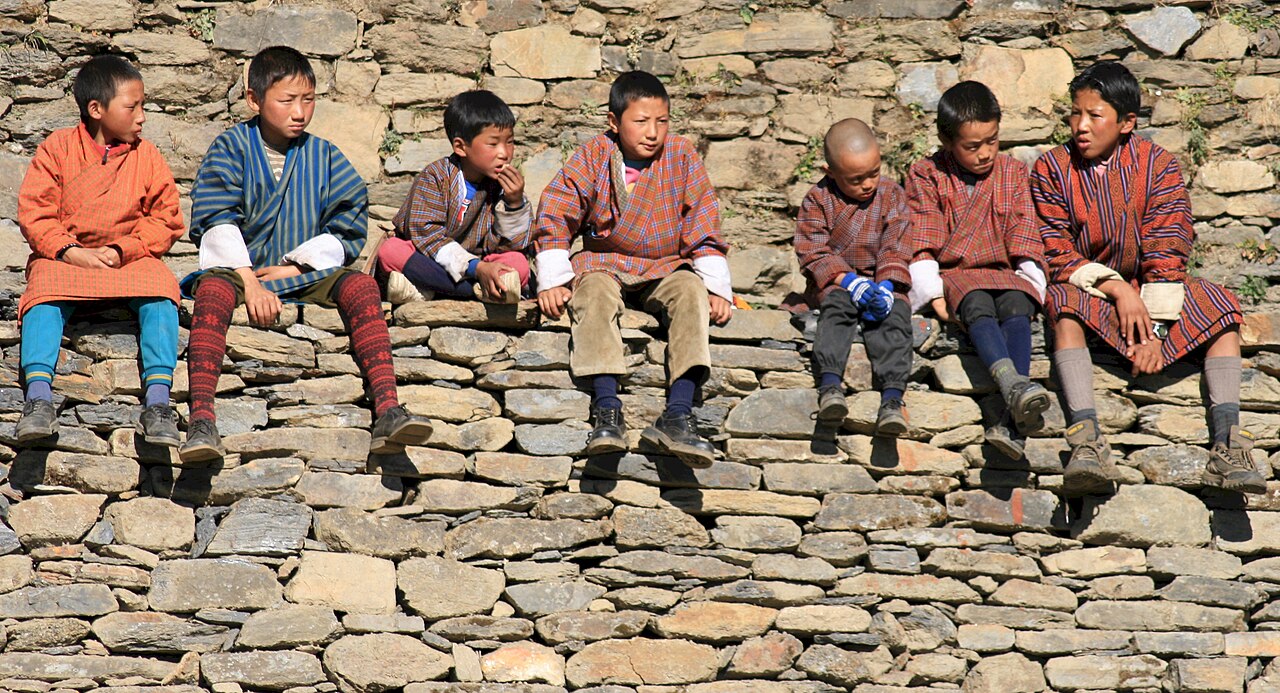

Driglam Namzha (Dzongkha: སྒྲིག་ལམ་རྣམ་གཞག་, sgrig lam rnam gzhag) is the formal code of dress, etiquette and public conduct of the Kingdom of Bhutan. The term is most often rendered in English as "the rules of disciplined behaviour" or "the way of harmony and conformity". It governs how citizens dress in government offices, schools, dzongs and official functions, how they address superiors and monastics, and how they comport themselves in ceremonial settings.[1]
In its traditional form the code is traced to Zhabdrung Ngawang Namgyal (c. 1594–1651) and the monastic and courtly order he established in the 17th century as part of the unification of Bhutan. For most of the next three centuries it was observed principally by monks, officials and the aristocracy inside dzongs and at court. On 16 January 1989 the Fourth King, Jigme Singye Wangchuck, issued a kasho (royal decree) extending formal enforcement of Driglam Namzha nationwide under the banner of a "One Nation, One People" policy. For the detailed primary-source article on the 1989 decree see Kasho on Driglam Namzha (1989).[2]
The framing of Driglam Namzha is strongly contested. The Royal Government of Bhutan presents it as a measure of cultural preservation and as one expression of the Gross National Happiness framework. Human Rights Watch, Amnesty International, the anthropologist Michael Hutt, and exile Lhotshampa organisations have argued that, as applied in southern Bhutan after 1989, the code functioned as an instrument of forced cultural assimilation and was one of the grievances that triggered the 1990 southern Bhutan protests and the subsequent expulsion of more than 100,000 Nepali-speaking southern Bhutanese documented in the Bhutanese refugee crisis.[3][4]
Term and etymology
In Dzongkha, drig (སྒྲིག་) denotes order, discipline, arrangement or regulation; lam (ལམ་) denotes a path or way; and rnam gzhag (རྣམ་གཞག་) means a system or established order. The full compound is conventionally glossed as "the system of disciplined conduct" or "the established rules of order". English-language usage in Bhutanese official publications, tourism literature and academic writing has settled on "Driglam Namzha" as an untranslated proper noun, sometimes paired with the phrase "the official etiquette and dress code of Bhutan".[1]
The code is distinct from, though historically linked to, the Tsa Yig (བཅའ་ཡིག་), the legal code promulgated by Zhabdrung Ngawang Namgyal and codified at Cheri and Ralung monasteries by 1620, which set out rules for monastic and civil administration and for social and moral conduct. Academic treatments, including the 2017 Springer volume chapter "Law, 'Tradition' and Legitimacy: Contesting Driglam Namzha", describe Driglam Namzha as an outgrowth of the broader Tsa Yig tradition that was later repackaged as a national standard in the 20th century.[5]
Historical origins
Zhabdrung Ngawang Namgyal arrived in Bhutan from Ralung in Tibet in 1616 and, over the following decades, consolidated the country's western valleys into a single Drukpa Kagyu state. As part of this state-building project he established the chöyi nyiden or dual system of government, which combined religious authority under the Je Khenpo with civil authority under the Druk Desi. Driglam Namzha, in its earliest form, was a set of rules of monastic discipline and court etiquette that regulated how officials, monks and laypeople were to conduct themselves inside dzongs and in the presence of senior clergy. It drew on Tibetan Buddhist monastic tradition (vinaya) and on the courtly etiquette of the Tibetan aristocracy.[6]
For most of the period from the 17th to the 20th century, Driglam Namzha was observed as an elite code. It applied principally to monks, to the gentry, and to officials acting in formal settings — not to the daily life of ordinary villagers across Bhutan's diverse regions. Rural populations, including the Sharchop of eastern Bhutan, the Khengpa of Zhemgang, and the Nepali-speaking Lhotshampa of the southern foothills, maintained their own dress, language and customs.[7]
Traditional scope before 1989
In the pre-1989 period, Driglam Namzha regulated several overlapping domains:
- Monastic conduct inside dzongs and monasteries, including the proper manner of offering ceremonial scarves to lamas and of prostrating before religious images.
- Court etiquette in the presence of the Druk Desi, the Je Khenpo, penlops and dzongpons, including forms of address, the manner of serving tea and food, and the physical posture required when seated in council.
- Ceremonial dress for officials attending tshechus, state rituals and audiences, with the ceremonial scarf (kabney for men, rachu for women) indicating rank.
- Architecture of dzongs, lhakhangs and, to a lesser degree, residential buildings, which were expected to observe traditional proportions, wood frontages and small arched windows.
Outside these contexts, the code did not typically intrude on private life. Officials travelling on horseback, villagers at home, and southern farmers in the Duars plains were not, as a rule, required to wear the gho or kira in the fields or at local markets.[2]
National dress
The gho is a knee-length robe worn by men. It is tied at the waist with a cloth belt (kera) and folded so that the upper portion of the garment forms a large pouch (hemchu) across the chest, which historically served as a pocket for carrying a wooden cup, betel nut or documents. It is worn over a white or coloured long-sleeved shirt (tego) whose cuffs are turned back over the wrists. For everyday wear the gho is woven in plain cotton or wool checks in earth tones; for formal occasions heavier patterned silks are used.
The kira is a full-length rectangular woven cloth worn by women. It is wrapped around the body and fastened at the shoulders with silver brooches (koma) and held at the waist with a woven belt. The kira is worn over an inner blouse (wonju) with a short outer jacket (tego). Like the gho, the kira has a range of grades: simple cotton kushuthara-style patterns for daily wear, and heavy hand-woven silk kushutharas for ceremony and celebration.[8]
Kabney and rachu
On formal occasions men wear a long unstitched ceremonial scarf (kabney) draped over the left shoulder and across the body. The colour of the kabney denotes the wearer's rank in the state hierarchy, and is one of the more visible elements of Driglam Namzha in practice:
- Saffron-yellow — worn by the Druk Gyalpo (the King) and the Je Khenpo.
- Orange — cabinet ministers (Lyonpos).
- Blue — members of the National Council and the National Assembly.
- Green — judges of the Royal Courts of Justice.
- Red — senior officials of the rank of Dasho and ordained monks of the Central Monastic Body.
- White with red stripes — Gups (village heads) and holders of certain district-level offices.
- Plain white — ordinary citizens.
Women wear the rachu, a narrow woven ceremonial cloth draped over the left shoulder, generally red with embroidered patterns; as of the early 21st century the colour of the rachu is less formally differentiated by rank than the kabney.[1]
Language and literacy
Driglam Namzha is closely connected to the policy of promoting Dzongkha, the Tibeto-Burman language of the Ngalop population of western Bhutan, as the national language. Dzongkha is the medium of parliamentary business, of royal addresses and of many official documents, and it uses an elaborate honorific register (zhe sa) for addressing superiors, monks and members of the royal family. In the years after the 1989 kasho, Dzongkha was prioritised as the medium of instruction in schools, and Nepali was withdrawn from the curriculum in southern districts where it had previously been taught.[9]
Etiquette and public behaviour
Beyond dress, Driglam Namzha prescribes an extensive set of rules for ceremonial and everyday conduct. Recurring elements include:
- Forms of greeting — bowing slightly with the hands joined at the chest when meeting officials and elders; a full three-point prostration when received by the King or the Je Khenpo.
- Seating by rank — in formal halls and audiences the most senior figure occupies the highest seat; junior officials arrange themselves in descending order along the flanks.
- Service of food and drink — guests are served before hosts; it is customary to decline tea or ara (distilled liquor) three times before accepting.
- Circumambulation — stupas (chortens), lhakhangs and mani walls are circumambulated clockwise; hats are removed inside religious buildings and religious texts are not placed on the floor.
- Honorific speech — Dzongkha distinguishes between an ordinary register and a formal honorific register, the latter required when addressing members of the royal family, senior officials and monks.
Many of these rules are monastic in origin and are observed most strictly inside dzongs, at tshechus and during state ceremonies.[1]
The 1989 kasho and "One Nation, One People"
On 16 January 1989, in the context of the Sixth Five-Year Plan (1987–1992) and rising concern in Thimphu about the demographic growth of the Nepali-speaking population of southern Bhutan, the Fourth King issued a kasho making the observance of Driglam Namzha compulsory for all citizens during business hours in public places, in government offices, in schools and at official functions. Penalties for non-compliance ranged from fines to denial of access to government services.[10]
The kasho was bundled, in contemporaneous Bhutanese government language, with the slogan "One Nation, One People". This was not an official Dzongkha name but an English-language framing used in government speeches and press statements to justify the nationwide extension of a northern Drukpa cultural standard. Amnesty International's 1992 report on the human rights situation in southern Bhutan, Human Rights Watch's 2007 report Last Hope, and the Writenet country report prepared for UNHCR in 1995 all treat the Driglam Namzha kasho as one component of a broader package that also included enforcement of the 1985 Citizenship Act, the 1988 census in southern Bhutan, and the withdrawal of Nepali-language instruction. Detailed analysis of the decree itself is carried in the Kasho on Driglam Namzha (1989) article.[11]
Enforcement in southern Bhutan and the Lhotshampa crisis
The most contested element of Driglam Namzha is its enforcement in the Lhotshampa belt of southern Bhutan after 1989. The Lhotshampa community had historically worn the daura-suruwal and dhaka topi (men) and the sari or gunyo-cholo (women), spoken Nepali at home and in daily life, and practised mainly Hindu forms of worship. The extension of gho and kira requirements, the removal of Nepali from the curriculum, and the expectation that Lhotshampa citizens observe Drukpa Buddhist etiquette in official settings were experienced in the region as a direct challenge to existing cultural practice.[9]
Amnesty International's 1992 report documented cases of Lhotshampa being fined, detained or denied access to government services for failing to wear the national dress. Human Rights Watch and the Writenet report for UNHCR similarly recorded the Driglam Namzha kasho as one of the grievances raised at the September and October 1990 demonstrations in Samtse, Chirang (Tsirang), Geylegphug (Sarpang) and Samdrup Jongkhar. Those demonstrations, and the security response that followed, triggered arrests, the classification of demonstrators as ngolops ("anti-nationals"), and the subsequent expulsion of more than 100,000 southern Bhutanese to refugee camps in eastern Nepal over the period 1990–1993.[3]
The anthropologist Michael Hutt, in his 2003 monograph Unbecoming Citizens: Culture, Nationhood, and the Flight of Refugees from Bhutan, argued that the 1989 kasho and its enforcement in the south should be understood as part of a nation-building project that defined Bhutanese identity in specifically Drukpa terms and left Nepali-speaking southerners without a secure place in that identity. A 2021 article in the journal Social Identities described the code as functioning to "silence ethnicity" within Bhutan's political framework. The Royal Government of Bhutan has consistently rejected these readings, maintaining that Driglam Namzha applies equally to all citizens and is aimed at the preservation of a small country's distinctive culture against assimilationist pressures from much larger neighbours.[12]
Contested framings
Writing on Driglam Namzha divides along three broad lines:
- The Royal Government of Bhutan position treats Driglam Namzha as a living expression of national identity and as one of the four pillars of Gross National Happiness concerned with cultural preservation. In this view, enforcement in southern Bhutan after 1989 was a legitimate effort to ensure a single, shared public culture and was neither aimed at nor had the effect of ethnic exclusion.
- Human rights organisations and the exile Lhotshampa community — including Human Rights Watch, Amnesty International, the Minority Rights Group, and the resettled Bhutanese Nepali diaspora in the United States, Canada, Australia and elsewhere — describe the enforcement as a programme of forced cultural assimilation whose practical effect was to make Lhotshampa identity incompatible with Bhutanese citizenship.
- Academic commentators, including Michael Hutt, Leo Rose, Susan Banki and the contributors to the 2017 Springer volume Bhutan: The Politics of Reform, tend to sit between these two positions, treating Driglam Namzha as a genuine traditional code that was repurposed in the 1980s as an instrument of nation-building in ways that had documented negative consequences for the Lhotshampa.
These readings are not always mutually exclusive. Several authors accept both that Driglam Namzha has deep roots in 17th-century Bhutanese statecraft and that its nationwide enforcement under the 1989 kasho was directed at a specific demographic anxiety about southern Bhutan.[5]
Contemporary practice
Driglam Namzha remains in force. The gho and kira are required in schools, in government offices, in dzongs and monasteries, in the chambers of the National Assembly and National Council, at tshechus and at state ceremonies. Members of parliament wear the appropriate kabney during sessions; civil servants wear the gho with a white kabney to work; students across the country wear the gho and kira as school uniform.[1]
In everyday private life, particularly in Thimphu, Paro and the larger towns, enforcement has become more relaxed. Younger urban Bhutanese are frequently seen in jeans, t-shirts and Western dress at cafes, in the market and on weekends, and no systematic penalties are reported for ordinary clothing worn outside official settings. Tourists are exempted from the dress code but are expected to dress modestly when visiting religious sites, with long trousers or skirts and covered shoulders.[8]
For the roughly 15–20 per cent of Bhutan's resident population who are Lhotshampa — those who were not expelled in 1990–1993 and who retained or later regained documentation — the dress code is generally observed in public and official settings. Whether this compliance represents cultural adoption, pragmatic accommodation or continued caution varies among individuals and is poorly documented in Bhutan-based media, where press freedom constraints limit public discussion of the Lhotshampa experience.[13]
Legacy and international reception
Outside Bhutan, Driglam Namzha is one of the features most frequently cited in foreign coverage of the country. Travel guides and tourism literature present the gho and kira as evidence of a living cultural tradition that has survived into the 21st century, and the code is regularly invoked in discussions of Bhutan as a rare example of a small Himalayan state that has resisted the homogenising pressures of globalisation. This framing draws heavily on the Royal Government of Bhutan's own presentation of the code as part of the Gross National Happiness framework.[14]
Within the Bhutanese diaspora — in Nepal, in eastern India, and in the third-country resettlement communities in the United States, Canada, Australia, the United Kingdom, the Netherlands, Denmark, Norway and New Zealand — Driglam Namzha is more often remembered as the name of the 1989 kasho and as shorthand for the cultural policy that, on most exile accounts, made continued life in Bhutan impossible for tens of thousands of Nepali-speaking southerners. The two framings co-exist in international writing about Bhutan and have yet to be reconciled.[4]
See also
- Kasho on Driglam Namzha (1989)
- Bhutanese refugee crisis
- Lhotshampa
- Bhutanese Citizenship Act 1985
- Zhabdrung Ngawang Namgyal
- Gross National Happiness
- Jigme Singye Wangchuck
- Michael Hutt
References
- "Driglam namzha" — Wikipedia
- "Customs and Etiquette in Bhutan: Manners and Driglam Namzha" — Facts and Details
- "Bhutan: Human Rights Violations against the Nepali-speaking Population in the South" — Amnesty International, ASA 14/04/1992
- "Last Hope: The Need for Durable Solutions for Bhutanese Refugees in Nepal and India" — Human Rights Watch, 2007
- Richard W. Whitecross, "Law, 'Tradition' and Legitimacy: Contesting Driglam Namzha" — in Bhutan: The Politics of Reform, Springer, 2017
- "Zhabdrung Ngawang Namgyal" — Wikipedia
- "Driglam Namzha" — MAP Academy Glossary
- "Gho" — Wikipedia
- "Lhotshampa" — Wikipedia
- "Freedom in the World 2001 — Bhutan" — Freedom House / Refworld
- "The Exodus of Ethnic Nepalis from Southern Bhutan" — Writenet / UNHCR, 1995
- "Driglam Namzha and silenced ethnicity in Bhutan's monarchical democracy" — Social Identities, 2021
- "Lhotshampas and Nepalese in Bhutan" — Facts and Details
- "Driglam Namzha: The Living Code of Bhutanese Etiquette and Cultural Identity" — Bhutan Travelog
- Michael Hutt, Unbecoming Citizens: Culture, Nationhood, and the Flight of Refugees from Bhutan, Oxford University Press, 2003
- Universal Periodic Review submission on Bhutan — OHCHR
- Bhutanese Refugees in Nepal (AHURA Bhutan) — HURIGHTS Osaka
- Bhutanese refugees: rights to nationality, return and property — Forced Migration Review
- Bhutan's Human Rights Record Defies 'Happiness' Claim — The Diplomat
Related articles
Know something about this topic? Edit this article or . Anonymous contributions welcome — no account required.