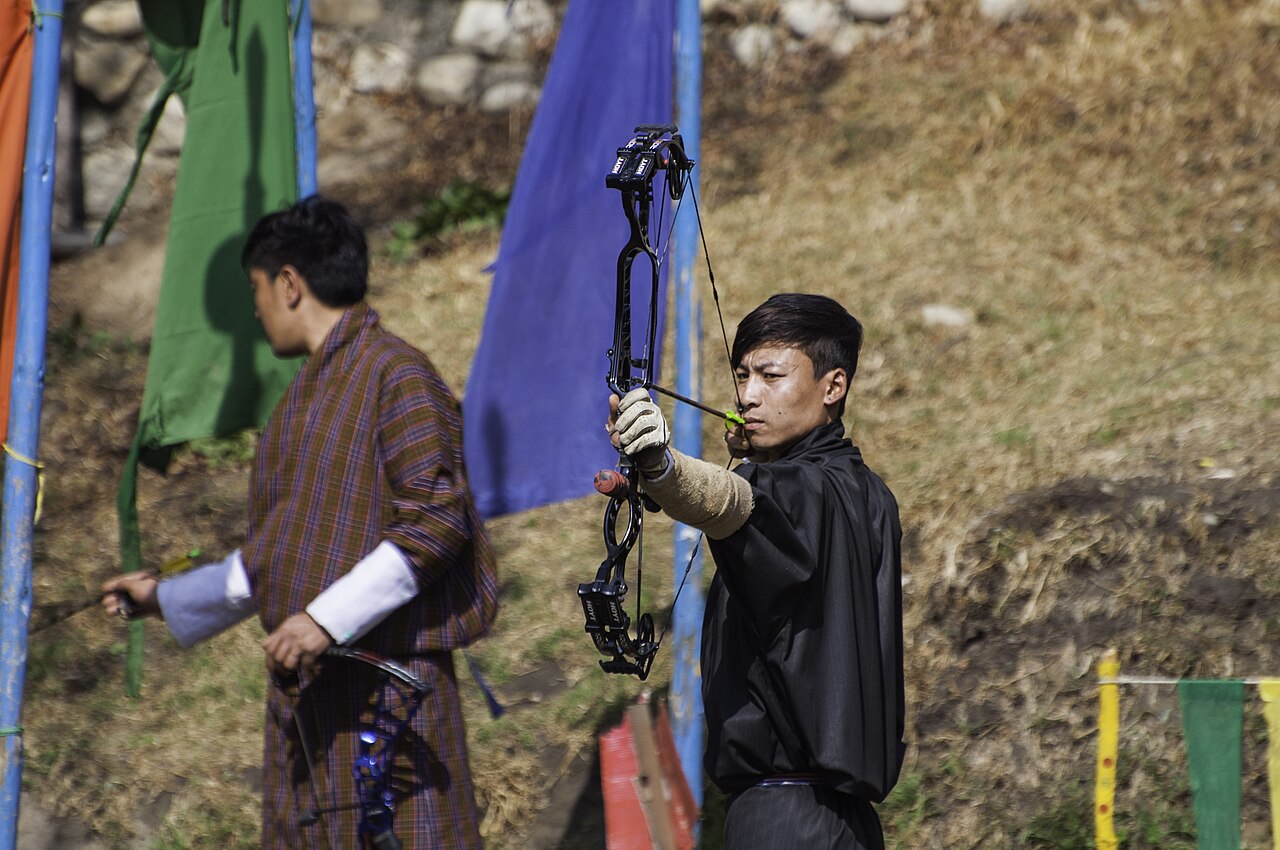

Archery, known as Dha (Dzongkha: མདའ་) in Dzongkha, is the national sport of Bhutan and one of the most visible expressions of Bhutanese cultural identity. Designated as the national sport in 1971 when Bhutan became a member of the United Nations, archery pervades every level of Bhutanese society, from village festivals and local rivalries to national championships and Olympic competition. Unlike in most countries where archery is a niche pursuit, in Bhutan it functions as a mass social activity intertwined with religion, community bonding, alcohol consumption, singing, dancing, and spirited competition.[1]
Archery ranges are found in virtually every village, town, and dzongkhag (district) in the country. Matches are major social events that can last entire days, drawing spectators, supporters, and performers. The sport occupies a unique position in Bhutanese life: it is simultaneously a traditional practice with roots stretching back centuries, a vehicle for community identity, and an arena of modern international competition.[2]
History and Origins
Archery has been practised in Bhutan for centuries, originally as a hunting and military skill essential to survival in the Himalayan terrain. Historical records indicate that Bhutanese warriors were renowned archers, and the bow was a primary weapon in the numerous inter-valley conflicts and territorial disputes that shaped the country's pre-unification history. The transition from martial tool to sport occurred gradually as centralised governance reduced inter-clan warfare, though the exact timeline remains poorly documented.[3]
During the era of Zhabdrung Ngawang Namgyal in the seventeenth century, archery was already established as a social and ceremonial activity. The Zhabdrung's unification of Bhutan under a dual system of governance gave greater structure to festivals and public events at which archery was featured. By the time the Wangchuck monarchy was established in 1907, archery tournaments were a fixture of tsechu festivals and other public celebrations across the country.[4]
Traditional Archery
Traditional Bhutanese archery uses bows crafted from bamboo, a material abundantly available in the country's subtropical and temperate forests. These bamboo bows are typically between 1.5 and 1.8 metres long and require considerable strength and skill to draw accurately. Arrows are also made from bamboo shafts, fletched with feathers and tipped with metal points. The craftsmanship of bows and arrows is itself a respected skill, with certain villages and families known for producing particularly fine equipment.[5]
The traditional shooting distance is approximately 140 metres (460 feet), far greater than the 70 metres used in Olympic recurve archery. Targets are small wooden boards, typically about 30 centimetres wide and 1.2 metres tall, painted with colourful designs. The extreme distance combined with the relatively low power and inconsistent performance of bamboo bows makes traditional archery a game of extraordinary skill. Hitting the target at all is an achievement, and a direct hit on the small board at 140 metres is celebrated with exuberant singing and dancing by the shooter's teammates.[6]
Modern Compound Bow Archery
Beginning in the 1990s, modern compound bows and recurve bows began to appear in Bhutanese archery, fundamentally altering the sport. Compound bows, with their pulley systems and precision engineering, are dramatically more powerful and accurate than bamboo bows. Their adoption sparked heated debate within Bhutanese society about authenticity, tradition, and fairness. By the early 2000s, most formal competitions had divided into separate categories for traditional bamboo bows and modern compound bows.[7]
The standard distance for compound bow competitions is approximately 50 metres, reflecting the far greater accuracy achievable with modern equipment. National tournaments organised by the Bhutan Archery Federation follow standardised rules, with teams typically composed of eleven to thirteen members. The federation oversees both the traditional and modern formats, working to preserve the cultural dimensions of archery while also developing competitive standards aligned with international norms.[8]
Rituals and Social Customs
What distinguishes Bhutanese archery most strikingly from archery elsewhere is the elaborate social and ritual framework surrounding every match. Competitions are not merely athletic contests but communal celebrations involving singing, dancing, feasting, and the liberal consumption of ara (locally distilled rice wine) and, increasingly, commercial beer and whisky. Before matches, teams often consult astrologers and conduct prayers to ensure favourable outcomes.[9]
When a team member scores a hit, the entire team erupts into a choreographed victory dance, singing traditional songs that praise the shooter and mock the opposing team. Supporters standing near the target perform their own dances and songs. Opposing teams engage in ritualised taunting and distraction, attempting to break the concentration of shooters through shouts, songs, and gestures. This atmosphere of boisterous celebration and competitive banter is considered an integral part of the sport, not a distraction from it.[10]
Spiritual elements also permeate the sport. Some archers wear protective amulets or consult monks before important matches. Rituals to ward off bad luck or to neutralise spiritual interference from opponents are widely practised. The targets themselves may be blessed, and the archery range is considered a semi-sacred space during competition.[11]
International Competition
Bhutan has participated in Olympic archery since the 1984 Summer Olympics in Los Angeles, making archery the country's primary vehicle for Olympic participation. Notable Bhutanese Olympic archers include Tshering Choden, who represented Bhutan at the 2004 Athens Olympics, and Sherab Zam, who competed at the 2012 and 2016 Olympics. The Bhutan Archery Federation continues to develop athletes for international competition, though the gap between Bhutanese traditional archery and the precision demands of Olympic recurve archery remains significant.[12]
Cultural Significance
Archery's role in Bhutanese society extends well beyond sport. It serves as a vehicle for community identity, with villages and districts fiercely loyal to their local teams. Inter-village and inter-dzongkhag archery tournaments are among the most anticipated events of the year, drawing crowds that rival any other form of public entertainment. The sport also reinforces social bonds, as teams are assembled across class and occupational lines, and participation in archery — whether as a competitor, supporter, or organiser — is a marker of community belonging.[13]
In the context of Gross National Happiness and Bhutan's broader effort to preserve its cultural heritage against the pressures of globalisation, archery holds particular importance. The government and monarchy actively promote the sport as a pillar of national identity, and archery tournaments are central features of national celebrations, including coronations, royal weddings, and National Day festivities.
Major Tournaments
The most prestigious archery competitions in Bhutan include the Coronation National Archery Tournament, the Yangphel Tournament, and competitions held during Losar (New Year) celebrations and national festivals. Archery matches are also a standard feature at tshechu (annual religious festivals) and community celebrations throughout the country. Historically, some matches continued for weeks or even months; modern tournament formats have shortened the duration while retaining the traditional rules and ceremonies.
References
- "Archery in Bhutan." Wikipedia.
- "An Olympic flagbearer: In the Land of the Thunder Dragon." World Archery, 2021.
- "Archery in Bhutan." Wikipedia.
- "Archery: The National Sport." Kuensel, 2019.
- "Archery in Bhutan." Wikipedia.
- "Archery in Bhutan." Wikipedia.
- "Archery: The National Sport." Kuensel, 2019.
- "Archery in Bhutan." Wikipedia.
- "Archery in Bhutan." Wikipedia.
- "An Olympic flagbearer: In the Land of the Thunder Dragon." World Archery, 2021.
- "Archery: The National Sport." Kuensel, 2019.
- "Bhutan." Olympedia.
- "Archery in Bhutan." Wikipedia.
Related articles
Know something about this topic? Edit this article or . Anonymous contributions welcome — no account required.