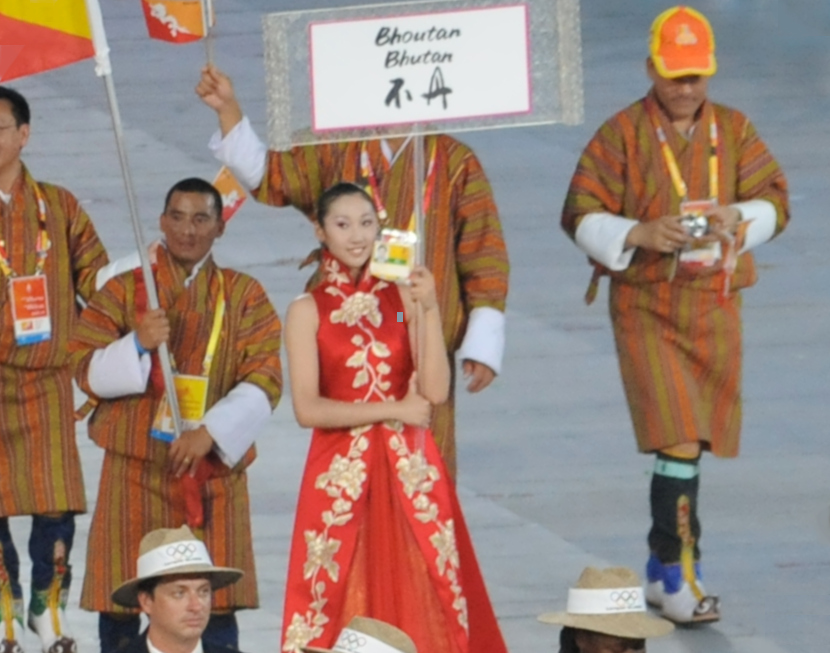

Bhutan has been a participant in the Summer Olympic Games since 1984, when it debuted at the Los Angeles Olympics. Over four decades of Olympic participation, Bhutan has sent small delegations — typically between two and six athletes — and has never won an Olympic medal. The country's Olympic efforts have focused primarily on archery, Bhutan's national sport, along with shooting, athletics, and more recently taekwondo and judo. Despite the absence of medals, Bhutan's participation carries deep symbolic significance as a statement of national identity and international engagement.[1]
The Bhutan Olympic Committee (BOC) was established in 1983 and recognized by the International Olympic Committee (IOC) the same year, paving the way for Bhutan's debut at the following year's Games. The BOC is responsible for selecting athletes, coordinating training, and managing Bhutan's relationship with the international Olympic movement.[2]
History of Participation
1984 Los Angeles Olympics
Bhutan made its Olympic debut at the 1984 Summer Olympics in Los Angeles, sending a small delegation of athletes to compete in archery and shooting. The participation was historic for a country that had only joined the United Nations in 1971 and remained one of the most isolated nations in the world. While none of the Bhutanese athletes advanced past the early rounds, the mere act of competing on the world stage was a landmark moment for the kingdom.[1]
1988-2000: Continued Participation
Bhutan did not participate in the 1988 Seoul Olympics but returned for the 1992 Barcelona Games, sending athletes in archery and shooting. The country continued to participate at subsequent Olympics — Atlanta 1996 and Sydney 2000 — with similarly small delegations. Throughout this period, Bhutan's Olympic athletes were largely self-trained or had limited access to international-standard coaching and facilities. Most trained at basic facilities in Thimphu, and their qualification for the Games often came through universality places — reserved spots allocated by the IOC to ensure broad geographic representation rather than competitive qualification.[1]
2004-2016: Expanding the Range of Sports
Beginning with the 2004 Athens Olympics, Bhutan began diversifying the sports in which its athletes competed. In addition to archery, Bhutanese athletes participated in shooting, athletics (track and field), and taekwondo. The 2008 Beijing Olympics were notable for the participation of Bhutanese athletes in the marathon and 10,000 meters, events that tested endurance — a quality well suited to athletes from a high-altitude country.
At the 2012 London Olympics, Bhutan sent a delegation of two athletes: an archer and a shooter. At the 2016 Rio Olympics, Karma, a Bhutanese archer, competed in the individual recurve event, drawing attention to the strong cultural connection between Bhutan and archery.[2]
2020 Tokyo Olympics and Beyond
At the 2020 Tokyo Olympics (held in 2021 due to the COVID-19 pandemic), Bhutan was represented by Karma and Lenchu Kunzang in archery and Tandin Lhamo in shooting. The team carried the Bhutanese flag at the opening ceremony in a memorable moment that was broadcast globally. While none of the athletes advanced deep into their competitions, their participation was celebrated at home as a source of national pride.[2]
At the 2024 Paris Olympics, Bhutan continued its tradition of sending a small delegation, once again centered on archery.
Archery: The National Sport
Archery occupies a unique position in Bhutanese culture and Olympic ambitions. Traditional Bhutanese archery is the national sport, with competitions held at festivals and community gatherings across the country. However, the traditional form — which uses bamboo bows and targets placed at distances of up to 145 meters — differs significantly from the Olympic recurve archery format, which uses modern equipment and standardized distances.
The Bhutan Archery Federation has worked to develop Olympic-style archery alongside the traditional form, sending athletes to international training camps and competitions. Despite these efforts, the gap between Bhutanese archers and the world's top competitors — from South Korea, the United States, and other nations with well-funded archery programs — remains substantial. The challenge lies in bridging the cultural passion for traditional archery with the technical demands of the Olympic format.
Challenges and Development
Bhutan faces significant challenges in developing competitive Olympic athletes. The country's small population (approximately 780,000), limited sports infrastructure, mountainous terrain, and modest budget for athletic development all constrain the talent pipeline. There are no Olympic-standard facilities for most sports, and athletes often train at basic venues. Access to international competition — essential for development — is limited by geography and funding.[1]
The Bhutan Olympic Committee has partnered with the IOC's Olympic Solidarity program, which provides financial and technical support to developing nations. This program has funded coaching visits, training scholarships for Bhutanese athletes at international centers, and equipment purchases. The government has also invested in improving sports facilities in Thimphu and other towns, though progress has been slow.
Cultural Significance
For Bhutan, the Olympics serve less as a venue for medal contention than as a platform for national representation and cultural exchange. Bhutanese athletes at the Olympics, dressed in national attire during opening ceremonies, serve as ambassadors for their country's unique identity. The sight of the Bhutanese flag carried into an Olympic stadium is a source of pride for a nation that values its distinctiveness in the global community.
The Olympic movement also intersects with Bhutan's broader approach to sports and wellbeing. In a country governed by the philosophy of Gross National Happiness, sport is valued not primarily for competitive achievement but for its contribution to physical health, community bonding, and personal fulfillment. This perspective shapes Bhutan's approach to the Olympics — participation and representation matter more than medals.
See also
References
- Wikipedia. "Bhutan at the Olympics." https://en.wikipedia.org/wiki/Bhutan_at_the_Olympics
- Olympics.com. "Bhutan." https://olympics.com/en/athletes/noc/bhutan
Related articles
Know something about this topic? Edit this article or . Anonymous contributions welcome — no account required.