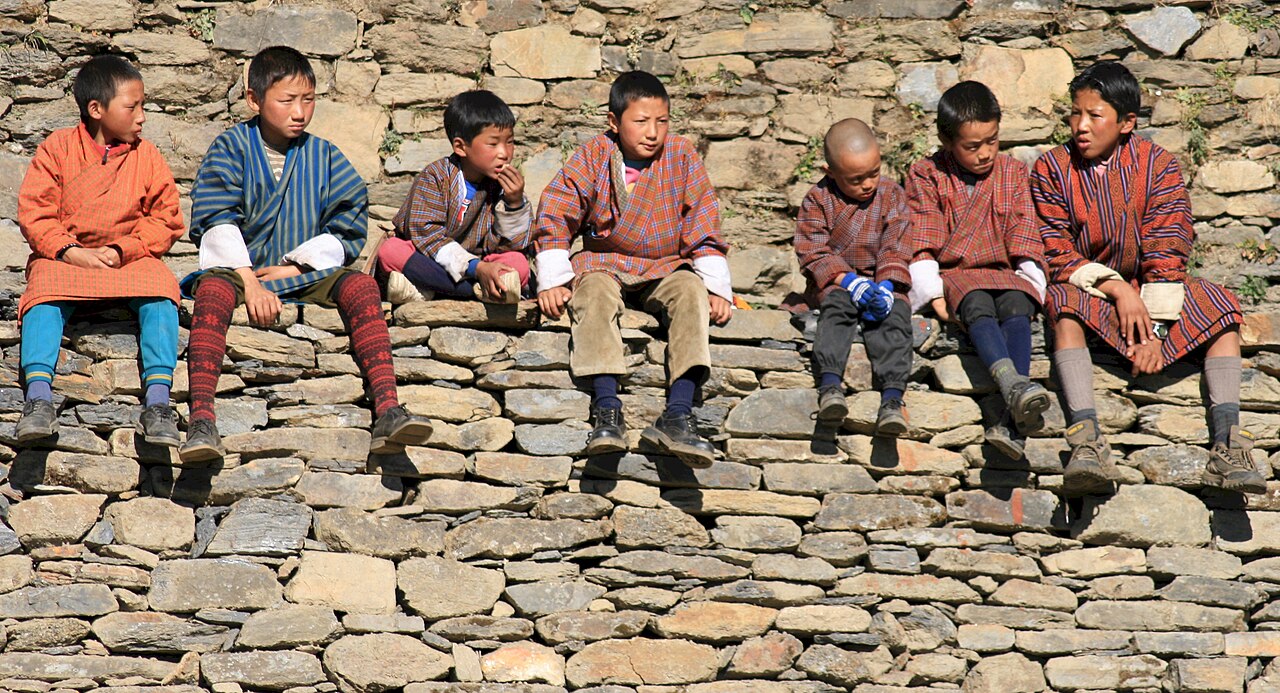

The gho (Dzongkha: གོ) is the national dress for men in Bhutan, worn as everyday attire throughout the country and required by law in government buildings, schools, monasteries, and during official functions. It is a knee-length robe made from woven fabric, pulled up and folded at the waist to form a large pouch at the front, and secured by a woven cloth belt known as a kera. The resulting silhouette — broad shoulders, a prominent pouch, and knee-length hemline worn with knee-high socks — is instantly recognisable and serves as one of the most important markers of Bhutanese cultural identity.[1]
The gho bears a structural resemblance to the Tibetan chuba, from which it is believed to have evolved, though the Bhutanese garment is distinctly shorter and worn with white cuffs folded back at the wrists. Historians trace the codification of the gho as national dress to the seventeenth century, when Zhabdrung Ngawang Namgyal unified Bhutan and established the Driglam Namzha code of etiquette and conduct that included dress regulations. The gho has since remained central to the country's efforts to preserve a distinct national identity, particularly in the face of cultural influences from neighbouring India and China.[2]
Today, wearing the gho is not merely a matter of tradition but of law. The 1989 royal decree reinforcing Driglam Namzha made the gho compulsory for all male citizens in public spaces and government settings. While enforcement has relaxed somewhat in private life and informal urban contexts, the gho remains ubiquitous across Bhutan, worn by farmers, civil servants, schoolboys, and the king alike.[3]
Construction and Materials
A traditional gho is made from a single rectangular piece of fabric, typically measuring about three metres in length. The cloth is folded in half, stitched at the sides to form a tunic, and then dressed by pulling the fabric up to knee level, creating a deep pouch (hemchu) across the front of the body above the kera belt. This pouch historically served as a carrying space for food bowls, betel nut, and personal belongings, and it continues to be used for carrying wallets, mobile phones, and other items in modern daily life.[4]
The fabric used for the gho varies according to the wearer's means, the occasion, and regional tradition. Everyday ghos are typically made from cotton or a cotton-polyester blend, often in simple checks, stripes, or plaid patterns. For formal occasions and festivals, men wear ghos woven from raw silk or fine wool, featuring intricate patterns in rich colours. The most prized ghos are handwoven on traditional backstrap looms by women artisans, particularly those from eastern Bhutan, where textile weaving traditions are strongest.[5]
White cuffs, folded back at the wrist, are a required element of formal gho-wearing. The cuffs are typically made from a separate white cloth and must be visible in formal settings. Knee-high socks, traditionally woven but now commonly purchased, complete the ensemble below the knee.
The Kera Belt
The kera is the woven belt used to secure the gho at the waist. It is wrapped tightly several times around the midsection to hold the folded fabric in place and maintain the characteristic pouch. Keras are typically woven in colourful patterns and may feature traditional motifs. The quality and decoration of the kera, like the gho itself, signal the wearer's social status and the formality of the occasion.[4]
Ceremonial Accessories
On formal occasions, the gho is accompanied by a kabney, a large ceremonial scarf worn over the left shoulder and draped diagonally across the body. The colour of the kabney indicates the wearer's rank and status: white for commoners, coloured scarves for officials of various ranks, orange for ministers, and yellow exclusively for the king. Sword-bearing officials may also carry a traditional long sword (patang) at their side during ceremonial functions at dzongs and official audiences.[6]
Regional Variations
While the basic form of the gho is consistent across Bhutan, regional variations exist in fabric choices, colour preferences, and pattern styles. In western Bhutan, men tend to favour plaid and striped patterns in relatively subdued colours. Eastern Bhutanese ghos are often more colourful and may feature the elaborate supplementary-weft patterns for which the region's weavers are renowned. The semi-nomadic communities of northern Bhutan traditionally wear ghos made from yak wool, suited to the extreme cold of the high Himalayan valleys.[5]
Legal Requirement and Cultural Significance
The gho's status as mandatory attire in official settings is enforced under the Driglam Namzha code. Government employees, students, and visitors to dzongs and monasteries are expected to wear the gho. Fines can be imposed for non-compliance, though enforcement varies by district and context. The policy has been controversial, particularly among the Lhotshampa (ethnic Nepali) population of southern Bhutan, for whom the gho is not a traditional garment. Critics have argued that the mandatory dress code constitutes cultural assimilation, while supporters maintain that it is essential for preserving Bhutan's distinct national identity.[3]
Beyond its legal dimension, the gho holds deep cultural meaning as a symbol of Bhutanese nationhood. It is worn with pride at festivals, religious ceremonies, and national celebrations. The act of dressing in the gho — including the skill required to fold and tie it correctly — is considered an important cultural practice passed from one generation to the next.
Modern Adaptations
In recent decades, the gho has undergone modest adaptations to suit contemporary life. Machine-woven fabrics have become common for everyday wear, making the garment more affordable. Some tailors now produce ghos with pre-stitched folds to simplify dressing, particularly for younger wearers and tourists. Despite these concessions to convenience, the handwoven gho remains the prestige garment for formal occasions, and the textile arts that produce it are actively supported by the Royal Government through institutions such as the Royal Textile Academy of Bhutan in Thimphu.[4]
References
Related articles
Know something about this topic? Edit this article or . Anonymous contributions welcome — no account required.