.jpg)
Zorig Chusum (Dzongkha: bzo rig bcu gsum, "thirteen arts and crafts" or "thirteen sciences of craft") is the traditional Bhutanese classification of arts and crafts that has organised the country's material culture for centuries. The system encompasses thirteen distinct disciplines spanning painting, sculpture, carving, metalwork, weaving, and other crafts essential to religious practice, architecture, and daily life. Zorig Chusum is not merely a catalogue of skills but a foundational element of Bhutanese cultural identity, reflecting the belief that artistic mastery and spiritual development are intertwined.
The codification of the thirteen arts is traditionally attributed to the period of Zhabdrung Ngawang Namgyal's unification of Bhutan in the seventeenth century, when the establishment of a centralised state required standardised artistic production for dzong construction, religious institutions, and court life. However, many of the individual crafts have much older roots in the broader Tibetan Buddhist cultural sphere. Today, the Zorig Chusum framework continues to guide artistic training at the National Institute of Zorig Chusum and serves as a touchstone for cultural preservation policy.
The Thirteen Arts
The traditional enumeration of the thirteen arts varies slightly across sources, but the most widely accepted classification is as follows:
1. Dezo — Papermaking
The production of traditional Bhutanese paper (desho) from the bark of the Daphne plant. This handmade paper has been used for centuries for religious texts, official documents, and wrapping. The papermaking process involves soaking, pounding, and screening the bark pulp, producing sheets valued for their durability and texture.
2. Dozo — Masonry
The art of stone construction, including the building of walls, foundations, and paved surfaces. Bhutanese masonry employs dry-stone and mortared techniques, and skilled masons are essential for the construction and maintenance of dzongs, temples, and traditional houses.
3. Garzo — Blacksmithing
The forging of iron and steel into tools, weapons, agricultural implements, and ritual objects. Blacksmithing historically provided the essential hardware of Bhutanese life, from ploughshares and knives to ceremonial swords and chain mail.
4. Jinzo — Clay Sculpture
The modelling of sacred images, architectural ornamentation, and votive tablets (tsa-tsa) in clay. Clay sculpture is essential for furnishing temples and monasteries with the three-dimensional representations of deities central to Buddhist worship.
5. Lhazo — Painting
The art of thangka painting and mural painting, encompassing sacred scroll paintings, wall paintings in temples and dzongs, and decorative painting on furniture and architectural elements. Painting is governed by strict iconographic rules and is considered one of the highest of the traditional arts.
6. Lugzo — Bronze Casting
The production of bronze and brass objects through lost-wax and sand-mould casting techniques. Products include Buddhist statues, ritual implements such as bells and vajras, butter lamps, and ceremonial vessels.
7. Parzo — Wood, Slate, and Stone Carving
Carving in wood, slate, and stone to produce architectural decoration, ritual masks, printing blocks, religious sculptures, and commemorative inscriptions. Wood carving is the most prominent branch, given its central role in Bhutanese architecture.
8. Shagzo — Woodturning
The production of turned wooden objects on a lathe, including bowls (dapa), cups, plates, and containers. Bhutanese turned wooden bowls, often crafted from burled woods and finished with natural lacquer, are prized both domestically and as export items.
9. Shingzo — Carpentry
The structural woodworking that forms the skeleton of Bhutanese buildings. Master carpenters are responsible for the timber-frame construction of dzongs, temples, and houses, working with traditional joinery techniques that employ minimal metal fasteners.
10. Thagzo — Weaving
The weaving of textiles on traditional backstrap and frame looms. Bhutanese textiles are among the most intricate in Asia, featuring complex supplementary-weft patterns, rich natural and synthetic dyes, and designs that encode regional identity, social status, and religious symbolism. Weaving is traditionally a female art, though male weavers also practice.
11. Trözo — Gold and Silversmithing
The creation of jewellery, ceremonial objects, and decorative metalwork in gold, silver, and copper. Products include the elaborate brooches (koma) worn by Bhutanese women, ritual offering bowls, and ornamentation for religious structures.
12. Tshazo — Bamboo and Cane Work
The weaving and construction of objects from bamboo, cane, and rattan. Products include baskets of various sizes and functions, mats, quivers, food containers, fencing, and the distinctive bamboo bows used in archery — Bhutan's national sport.
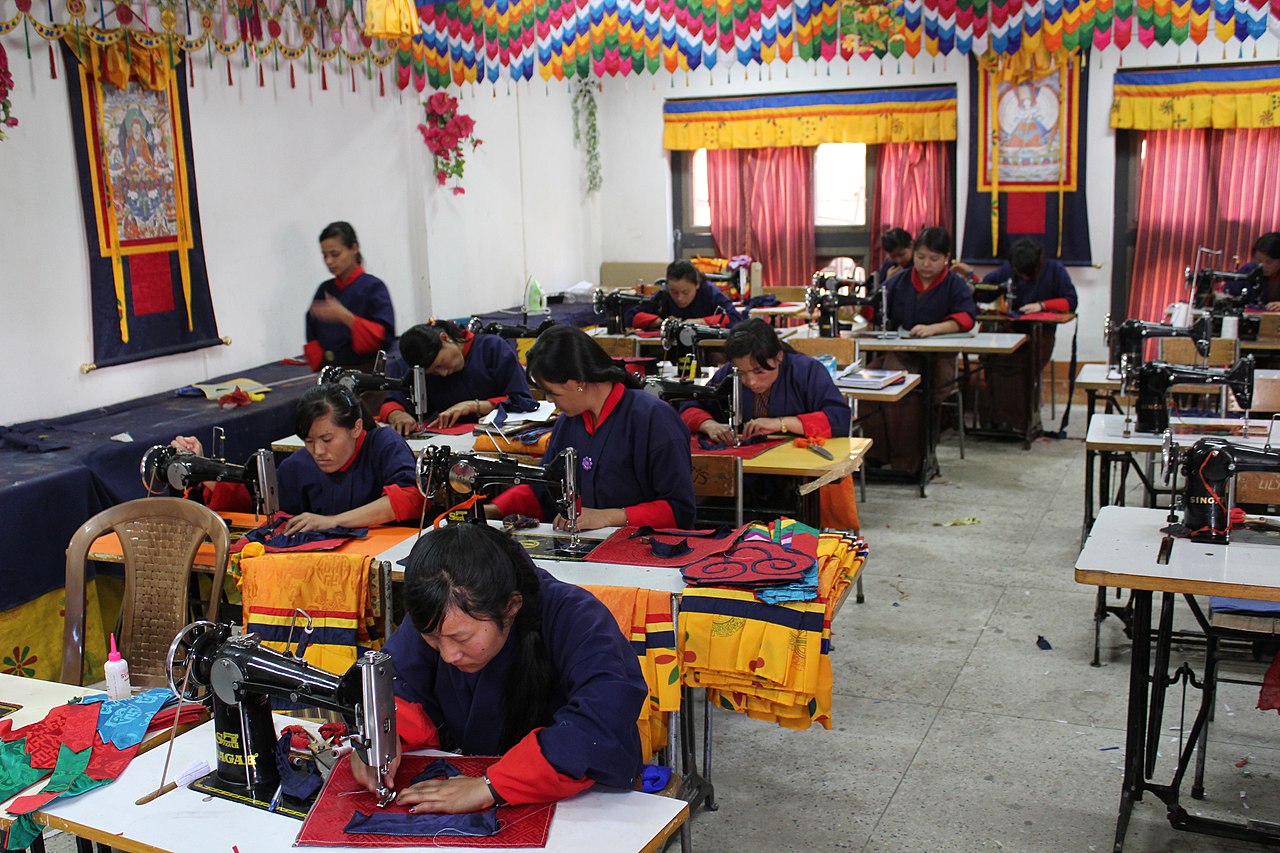
13. Tshemzo — Embroidery and Applique
Needlework encompassing embroidery, applique, and tailoring. This art produces the elaborate thangka banners used in festivals, monks' robes, ceremonial costumes, boots, and decorative textile hangings. The creation of large applique thongdrel for festivals is among the most demanding applications of this craft.
Classification and Philosophical Basis
The thirteen arts can be broadly grouped into several categories. The "fine arts" — painting, sculpture, and carving — are considered the highest disciplines because of their direct connection to religious imagery and Buddhist doctrine. The "constructive arts" — masonry, carpentry, and blacksmithing — provide the physical infrastructure of civilisation. The "textile arts" — weaving, embroidery, and tailoring — clothe the body and adorn sacred spaces. The remaining crafts serve both practical and ritual functions.
Underlying the Zorig Chusum system is the Buddhist concept that skilled craftsmanship is a form of spiritual practice. The Dzongkha term zorig combines zo ("to make" or "to create") with rig ("science" or "knowledge"), indicating that these are not merely manual skills but systematic bodies of knowledge with theoretical as well as practical dimensions. Mastery of a craft is understood as a form of discipline and mindfulness that contributes to the practitioner's spiritual development.
Preservation and Modern Challenges
The Bhutanese government has long recognised the Zorig Chusum as essential to national identity and has taken active measures to preserve the traditional arts. The establishment of the National Institute of Zorig Chusum in 1971 institutionalised the transmission of these skills. Building codes requiring traditional architectural elements sustain demand for practitioners of several crafts. The annual Royal Highland Festival and various tshechu celebrations provide platforms for displaying traditional artistry.
Nevertheless, the traditional arts face challenges from modernisation, the availability of mass-produced alternatives, changing career aspirations among young Bhutanese, and the loss of some raw materials due to environmental change. The government and cultural organisations continue to develop strategies for ensuring that the Zorig Chusum remains a living tradition rather than a museum piece, balancing preservation with the reality of a society in rapid transition.
References
Related articles
Know something about this topic? Edit this article or . Anonymous contributions welcome — no account required.