Phallus Paintings of Bhutan
From BhutanWiki, the people's encyclopedia of Bhutan · culture · Verified
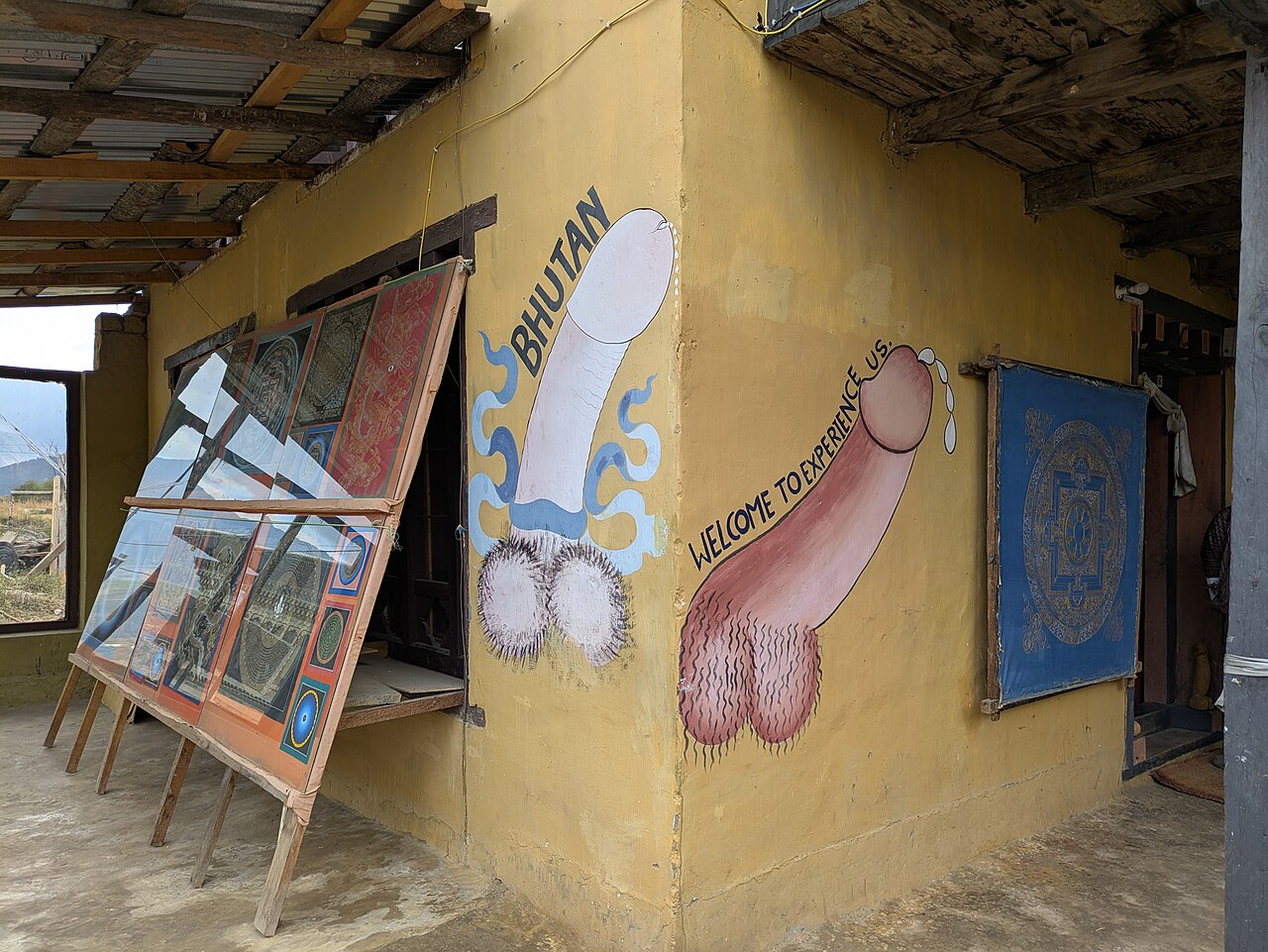

Phallus paintings are among the most immediately recognisable and frequently remarked-upon features of the Bhutanese cultural landscape. Brightly coloured depictions of erect phalluses — often adorned with ribbons, ejaculating flames, or accompanied by eyes and other symbolic elements — are painted on the exterior walls of houses, shops, and other buildings throughout Bhutan, particularly in central and western regions. To visitors from other cultures, these images can appear startling or incongruous on the walls of a deeply Buddhist society. Within Bhutan, however, they are understood as protective symbols rooted in religious tradition and folk belief, primarily associated with the fifteenth-century saint Drukpa Kunley.
The paintings are not considered vulgar or sexually explicit by Bhutanese cultural standards. Rather, they belong to a tradition of using shock, humour, and the subversion of conventional propriety as tools for spiritual teaching — a tradition embodied above all by Drukpa Kunley, whose unorthodox methods and outrageous behaviour are celebrated throughout the country as expressions of enlightened wisdom unconstrained by social convention.
Drukpa Kunley: The Divine Madman
The phallus painting tradition is inseparable from the figure of Drukpa Kunley (1455-1529), a Tibetan Buddhist master of the Drukpa Kagyu lineage who spent much of his life wandering through Bhutan. Known as the "Divine Madman" (Drukpa Kunley or 'Brug pa Kun legs), he rejected monastic formality, institutional religion, and social propriety in favour of a radically unconventional approach to spiritual teaching. His methods included heavy drinking, sexual encounters with women of all social classes, crude humour, and deliberate provocation of religious authorities — all understood within the tradition of "crazy wisdom" (smyon pa) as skilful means for cutting through ego, hypocrisy, and attachment.
Drukpa Kunley is credited with subduing demons and malevolent spirits throughout Bhutan using his "Flaming Thunderbolt of Wisdom" — a euphemism for his phallus, which he employed as a spiritual weapon against evil. In Bhutanese folk belief, the phallus thus became associated with the protective power of this saint, and its depiction on buildings serves as an apotropaic device — a ward against evil spirits, the evil eye, and harmful gossip.
The Chimi Lhakhang temple in the Punakha Valley, founded by Drukpa Kunley, is the primary pilgrimage site associated with the saint. Couples seeking children visit the temple to receive a blessing involving a wooden phallus relic, and the surrounding village of Sopsokha features particularly prominent phallus paintings on nearly every building.
Symbolism and Belief
The phallus paintings serve multiple symbolic functions in Bhutanese culture. Their primary purpose is protective: Bhutanese householders believe that the images ward off evil spirits (dre) that might otherwise cause illness, misfortune, or discord within the household. The paintings are also understood to counter the harmful effects of envy and malicious gossip — the "evil eye" that might be directed at a prosperous or happy family.
Fertility symbolism is a secondary but significant dimension. The phallus represents generative power and vitality, and homes displaying the paintings may be expressing a wish for children, healthy livestock, and abundant harvests. The association with Chimi Lhakhang reinforces this fertility dimension, as the temple is one of Bhutan's most popular destinations for couples hoping to conceive.
The paintings also carry a philosophical message consistent with Vajrayana Buddhist thought. By displaying what other cultures might consider obscene imagery in a public and sacred context, the tradition challenges conventional distinctions between pure and impure, sacred and profane. This reflects the tantric Buddhist understanding that enlightenment is found not by rejecting the material world but by transforming one's relationship to it.
Visual Characteristics
Bhutanese phallus paintings vary considerably in style, size, and elaboration. Some are simple outline drawings; others are large, detailed, and vividly coloured compositions. Common elements include:
- Ribbons and scarves: The phallus is frequently depicted wrapped in or adorned with coloured ribbons or ceremonial scarves (khatak), signifying its sacred rather than merely anatomical nature.
- Flames: Fire or flame motifs emanating from the tip represent the "Flaming Thunderbolt" of Drukpa Kunley and symbolise the power to burn away negativity and evil.
- Eyes: Some paintings include an eye at the tip, representing vigilance against evil forces.
- Ejaculating motifs: Streams of semen or milk may be depicted, symbolising fertility and abundance.
- Dragons and other creatures: Occasionally, the phallus is combined with dragon imagery or depicted being carried by birds, adding layers of symbolic meaning.
The paintings are typically executed directly on whitewashed exterior walls using house paint, and they are refreshed periodically as weathering fades the colours. They are most commonly found flanking the main entrance of a house or on prominent wall surfaces visible from the road.
Geographic Distribution
While phallus paintings are found throughout Bhutan, they are most prevalent in the western and central districts, particularly in the Punakha, Wangdue Phodrang, and Thimphu valleys — areas most closely associated with Drukpa Kunley's activities. In eastern Bhutan, where different local traditions and religious lineages predominate, the paintings are less common. Urban areas, especially in Thimphu, have seen some decline in the practice as modernisation and international sensibilities exert influence, though the paintings remain widespread in rural communities.
Tourism and Contemporary Attitudes
The phallus paintings have become one of the most photographed and discussed aspects of Bhutanese culture among international visitors. Tour operators routinely include visits to Chimi Lhakhang and Sopsokha village, where the concentration of paintings is highest. Souvenir shops across the country sell carved wooden phalluses, painted phallus key chains, and other related items.
This tourist interest has created a somewhat paradoxical situation: the paintings have become a major cultural attraction and source of income, even as some educated urban Bhutanese express ambivalence about the international attention focused on what they consider a minor folk tradition. Government cultural authorities have generally supported the preservation of the practice as an authentic element of Bhutanese heritage, recognising its roots in the country's unique approach to Buddhist culture.
Within Bhutanese society, attitudes toward the paintings range from unselfconscious acceptance in rural communities, where they are simply part of the domestic landscape, to more reflective engagement among urban and educated populations. The tradition remains robust, however, and new houses in many parts of the country continue to be decorated with phallus paintings as a matter of course.
See also
- Lhazo — Painting
- Bhutanese Painting Classification System
- Architectural Painting in Bhutan
- Thangka Painting
References
- "Drukpa Kunley." Wikipedia.
- "Chimi Lhakhang." Wikipedia.
- Dowman, Keith. The Divine Madman: The Sublime Life and Songs of Drukpa Kunley. Dawn Horse Press, 1980.
Related articles
Know something about this topic? Edit this article or . Anonymous contributions welcome — no account required.