Atsara (Sacred Clowns of Bhutanese Festivals)
From BhutanWiki, the people's encyclopedia of Bhutan · culture · Verified
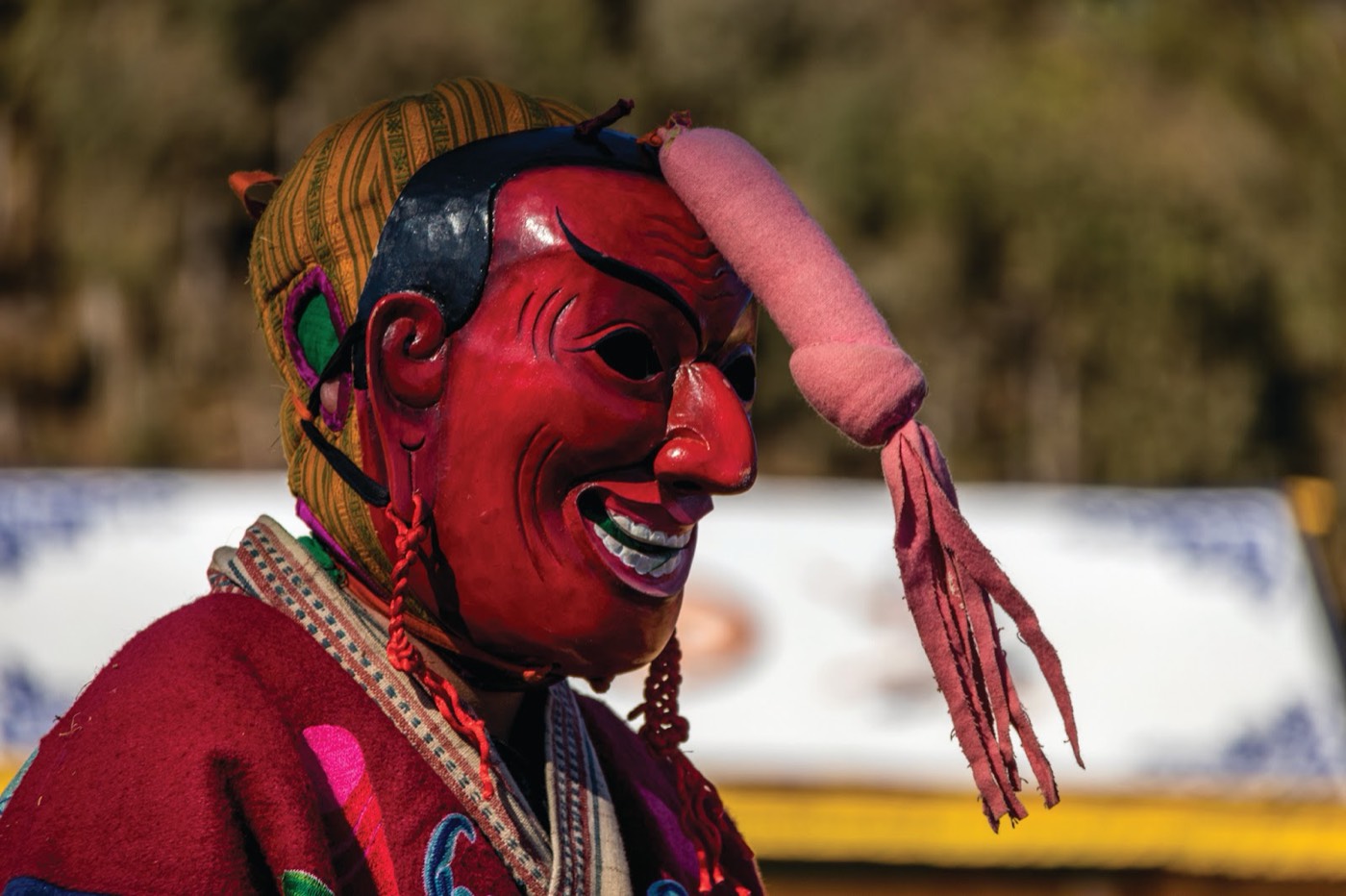
Atsaras (Dzongkha: ཨ་ཙ་ར) are the sacred clowns of Bhutanese religious festivals, unmistakable figures who weave through the crowds and interrupt the solemn proceedings of tshechu celebrations with bawdy humour, slapstick comedy, and ribald antics. Wearing distinctive red masks with bulbous noses and wide grins, dressed in ragged or comically oversized clothing, and frequently wielding wooden phalluses, the atsaras occupy a unique position in the ritual ecology of Bhutanese cham dance festivals — they are simultaneously entertainers, ritual functionaries, social critics, and dispensers of blessings.[1]
The word "atsara" is believed to derive from the Sanskrit "acharya" (teacher or master), a linguistic origin that hints at the deeper significance beneath the clownish exterior. In the Bhutanese religious context, the atsara is not merely a comedian but a figure who embodies the tantric Buddhist principle that wisdom can be found in unexpected forms and that the boundary between the sacred and the profane is ultimately illusory. Their apparently disrespectful behaviour toward the solemn cham dances paradoxically reinforces the spiritual teachings those dances convey.[2]
Role in Tshechu Festivals
Atsaras are a ubiquitous presence at tshechu festivals throughout Bhutan, from the grand celebrations at Thimphu, Paro, and Punakha dzongs to the smaller community tshechus held in remote villages.[8] They appear between and during cham dances, filling the gaps in the sacred programme with their comic routines. Their activities include mimicking the serious dancers, chasing audience members (particularly women and children), engaging in mock fights with each other, pretending to sell goods or dispense medical treatment, and performing exaggerated parodies of everyday life. Atsaras are typically drawn from among lay monks or spiritually trained men chosen for their wit and command of ritual, and their patter is largely unscripted, built on improvisation in the moment.[2]
The atsaras serve several practical functions within the festival structure. They maintain audience engagement during long intervals between dances, when the crowd might otherwise become restless. They control crowd movement and create space for the dancers. They collect offerings from spectators and distribute blessings, often by touching people with their wooden phalluses — a gesture that is considered auspicious rather than offensive in Bhutanese culture. And they provide a human, accessible counterpoint to the otherworldly solemnity of the masked dances, ensuring that the tshechu remains an inclusive community event rather than an exclusively monastic ritual.[3]
Phallus Symbolism
One of the most distinctive and, for foreign visitors, surprising aspects of the atsara tradition is the prominent display of wooden phalluses (phallic symbols). Atsaras commonly carry carved and painted wooden phalluses, sometimes of exaggerated proportions, which they brandish, wave at the audience, and use to "bless" spectators by touching them on the head or shoulders. This phallus symbolism is deeply embedded in Bhutanese culture and is related to the broader Bhutanese tradition of phallic imagery that is visible throughout the country in the form of painted phalluses on house walls, wooden phalluses hung from eaves, and phallus-shaped objects sold in markets.
The origins of Bhutanese phallic symbolism are attributed to the fifteenth-century Buddhist master Drukpa Kunley, known as the "Divine Madman" (Drukpa Kunley), who used outrageous and sexually provocative behaviour as a method of teaching and spiritual liberation. Drukpa Kunley's hagiography describes him using his phallus as a weapon against demons and as a means of bestowing blessings and enlightenment. The atsaras' phallic displays are understood in this context as a continuation of Drukpa Kunley's "crazy wisdom" tradition, in which conventional propriety is deliberately transgressed to shatter the rigid conceptual frameworks that obstruct spiritual realisation.[4]
In practical folk belief, the phallus is also considered a powerful symbol of fertility and a ward against evil spirits. Being touched by an atsara's phallus is widely believed to bestow blessings of fertility, prosperity, and protection from malevolent forces. The symbol thus operates on multiple levels simultaneously: as a tantric teaching device, as a folk protective charm, and as a source of communal laughter that binds the festival audience together in shared amusement.
Social Commentary
Beneath the slapstick, atsaras function as vehicles for social commentary and satire. Their routines frequently mock recognisable social types — the pompous official, the dishonest merchant, the lazy monk, the vain beauty — and address topical issues in the community. Because the atsara operates within a ritually sanctioned space of inversion and transgression, he can say and do things that would be unacceptable in ordinary social interaction, functioning as a kind of licensed critic who holds up a mirror to the community's follies and failings.
This satirical function connects the atsara tradition to the broader anthropological category of the ritual clown or sacred fool, found in cultures worldwide — from the heyoka of the Lakota Sioux to the vidushaka of Sanskrit drama and the court jesters of medieval Europe. In each tradition, the clown occupies a liminal space between the sacred and the profane, using humour and transgression to reveal truths that cannot be spoken directly. The atsara's position at the intersection of monastic ritual and lay festivity makes him uniquely qualified for this mediating role in Bhutanese society.[5]
Costumes and Masks
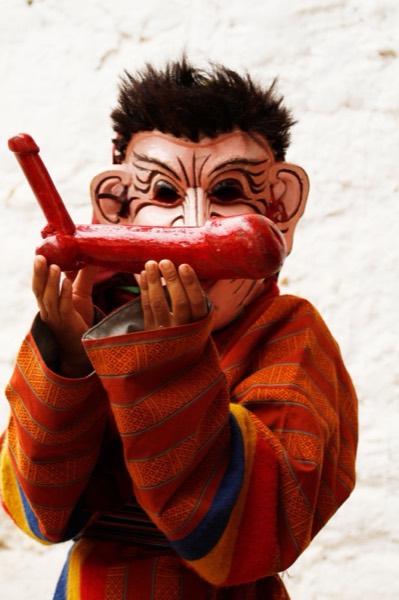
The atsara costume is deliberately ragged and chaotic in contrast to the elaborate, precisely codified costumes of the cham dancers. The red mask, typically made of carved wood or moulded papier-mâché, features an exaggerated bulbous nose, wide grinning mouth, and sometimes wrinkles or other comic distortions. The mask is often the most humanlike face visible at the tshechu, contrasting with the wrathful deities, serene Buddhas, and animal figures of the cham masks. In Vajrayana interpretation the red of the mask is said to evoke the flames of wisdom that burn away ignorance, aligning the atsara with the wrathful deities who deploy fierce or startling means toward compassionate ends.[1]
Atsaras typically wear mismatched or patched clothing, sometimes incorporating garments borrowed or stolen from audience members during the performance. They may carry an assortment of props in addition to the wooden phallus: bags for collecting offerings, mock weapons, items of food (which they pretend to hoard or eat greedily), and various improvised objects that serve their comic routines. The deliberately shabby appearance reinforces the atsara's role as an outsider figure who does not belong to the ordered hierarchy of the religious establishment but who is nevertheless essential to the festival's functioning.
Spiritual Dimensions
While the atsara is primarily experienced as a comedian, the tradition carries genuine spiritual weight. The atsara's apparent irreverence toward the sacred dances enacts the tantric Buddhist principle of non-duality: the understanding that enlightenment transcends the conventional distinction between sacred and profane, serious and humorous, high and low. By laughing at the most solemn aspects of the festival, the atsara paradoxically affirms their sacredness — only something genuinely powerful can withstand being laughed at.
The atsara also embodies the Buddhist teaching on the dangers of spiritual pride. His mockery of the ceremonious dancers serves as a reminder that attachment to one's own spiritual attainment or religious status is itself an obstacle to liberation. In this way, the clown performs an essential function within the ritual structure: he ensures that the sacred does not become self-important, that the religious establishment remains grounded, and that the community approaches the dharma with humility and good humour as well as devotion.[6]
Blessing and Fertility
Many Bhutanese, particularly women hoping to conceive, actively seek blessings from the atsaras during tshechu festivals. Being touched by an atsara's phallus or receiving a mock blessing from an atsara is widely believed to promote fertility and ensure the birth of healthy children. Atsaras sometimes single out newly married women in the crowd for special attention, pursuing them with comic exaggeration while the audience laughs and cheers. This fertility dimension connects the atsara tradition to pre-Buddhist folk practices that were absorbed into the Buddhist festival framework.
Contemporary Relevance
The atsara tradition continues to thrive in contemporary Bhutan, adapting its content to address modern themes while maintaining its traditional form. Contemporary atsara routines may include parodies of tourists (a rich source of comedy at the more visited festivals), satire of government policies, commentary on the impact of mobile phones and social media on traditional life, and jokes about current events. This adaptability is one of the tradition's great strengths, ensuring that the atsara remains a relevant and vital presence in Bhutanese cultural life rather than a fossilised relic of the past.[7]
Atsara on film
See also
References
- "Atsara: The Sacred Clown of Bhutanese Tshechu." Tshechu.com (Druk Asia).
- "Atsara: The Sacred Clown of Bhutanese Tshechu" — etymology, selection and training. Tshechu.com.
- "Bhutan's astounding festivals." Department of Tourism, Royal Government of Bhutan (bhutan.travel).
- "Drukpa Kunley." Wikipedia.
- Centre for Bhutan and GNH Studies.
- "Atsara: The Sacred Clown of Bhutanese Tshechu" — non-duality and crazy wisdom. Tshechu.com.
- "Bhutan's astounding festivals." Department of Tourism, Royal Government of Bhutan (bhutan.travel).
- "Tshechu." Wikipedia.
Related articles
Know something about this topic? Edit this article or . Anonymous contributions welcome — no account required.