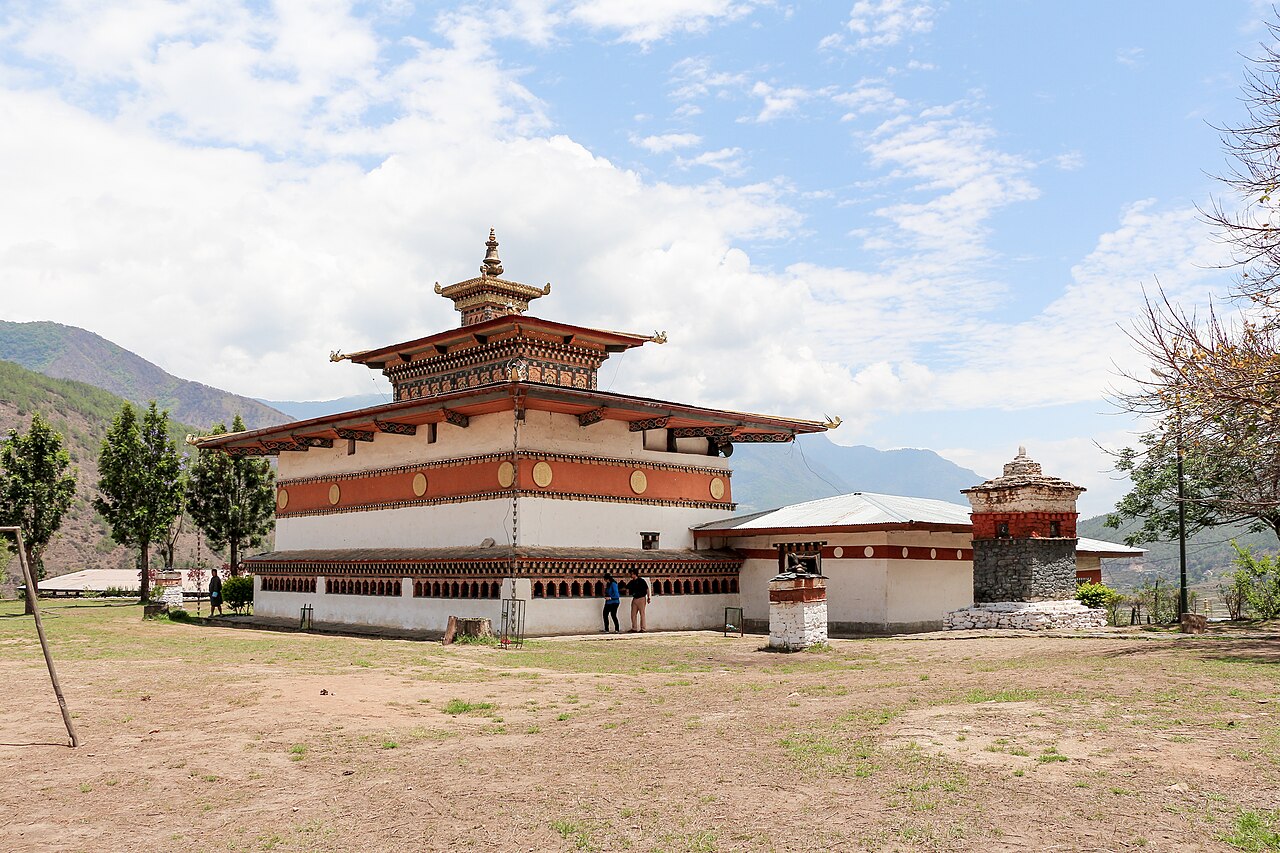

Chimi Lhakhang (Dzongkha: ཆི་མེད་ལྷ་ཁང་), commonly referred to as the "Temple of Fertility" or the "Temple of the Divine Madman," is a small Buddhist temple perched on a round hillock in the Punakha-Wangdue valley of western Bhutan. Located in the village of Sopsokha, approximately six kilometres from Punakha Dzong, the temple was built in 1499 by the 14th Drukpa hierarch Ngawang Choegyel on the spot where the celebrated wandering saint Drukpa Kunley (1455-1529) is said to have subdued a demoness with his "magic thunderbolt of wisdom."[1]
Drukpa Kunley, known in Bhutan as the "Divine Madman" (Drukpa Kunley), was one of the most unconventional figures in the history of Tibetan Buddhism. A wandering yogi of the Drukpa Kagyu lineage, he employed outrageous behaviour — heavy drinking, explicit sexual conduct, and scatological humour — as deliberate methods of spiritual teaching, challenging religious hypocrisy and social convention. His legacy pervades Bhutanese folk culture, and Chimi Lhakhang stands as the primary monument to his memory and teachings.[2]
Today, Chimi Lhakhang is best known as a pilgrimage site for couples seeking blessings for fertility and the birth of children. Visitors — both Bhutanese and foreign — travel to the temple to receive a ritual blessing from the resident monk, who taps supplicants on the head with a wooden phallus and a bow and arrow said to have belonged to Drukpa Kunley. The temple and surrounding village are also notable for the prominent display of phallus paintings on house walls, a tradition linked to Drukpa Kunley's teachings and believed to ward off evil spirits.[3]
History
The founding of Chimi Lhakhang is inseparable from the legends of Drukpa Kunley, who arrived in Bhutan from Tibet in the late fifteenth century. Born in 1455 into a noble family related to the founders of the Ralung Monastery in Tibet, Kunley received a thorough monastic education before rejecting conventional monasticism in favour of itinerant wandering and deliberate antinomian behaviour. He is credited with converting numerous Bhutanese to Buddhism through unconventional means, often employing sexual metaphor and ribald humour to convey profound spiritual teachings.[4]
According to Bhutanese tradition, Drukpa Kunley subdued a powerful demoness of Dochu La pass who had been terrorising the local population. He chased the demoness across the valley and pinned her beneath the hillock where Chimi Lhakhang now stands. The temple was subsequently constructed by Ngawang Choegyel in 1499 to mark and sanctify the site. The name "Chimi" is derived from Kunley's own name — a contraction of "Chimey" (meaning "no dog"), reportedly a reference to an episode in which he rid the area of threatening wild dogs.[5]
Over the centuries, the temple has been maintained by the local monastic community and has undergone periodic repairs and restoration. Its association with fertility blessings appears to have grown over time, likely amplified by the broader cultural reverence for Drukpa Kunley and the phallus symbolism he introduced into Bhutanese religious art and architecture.[6]
Architecture
Chimi Lhakhang is a modest structure by the standards of Bhutanese religious architecture. The temple is a small, whitewashed building with a golden roof finial, set within a walled compound atop the hillock. The approach from the road requires a walk of approximately twenty minutes through rice paddies and across a small stream, lending the visit a quality of rural pilgrimage.[7]
The interior of the temple is intimate, with a central altar housing an image of Drukpa Kunley and various sacred relics. The wooden phallus used in the blessing ceremony is displayed prominently, alongside a bow and arrow. Thangka paintings and butter lamps adorn the walls and altar. The compound also contains a small chorten (stupa) and prayer wheels that visitors circumambulate in the traditional clockwise direction.[8]
Religious Significance
Chimi Lhakhang occupies a unique position in Bhutanese religious culture. While Buddhism in Bhutan is generally associated with monastic discipline and scholarly tradition, Drukpa Kunley's legacy represents a countercurrent — the "crazy wisdom" (yeshe chölwa) tradition of enlightened masters who use unconventional and sometimes shocking methods to liberate beings from attachment and delusion. Kunley's approach drew on the Indian mahasiddha tradition and the Tibetan practice of "divine madness" as a path to realisation.[9]
The fertility blessing tradition at Chimi Lhakhang reflects a synthesis of Buddhist practice with pre-Buddhist beliefs in the protective and generative power of the phallus. Phallus imagery in Bhutan is not considered obscene but is understood as an apotropaic symbol — a guardian against malevolent spirits and a representation of the creative energy tamed and directed by enlightened awareness. This tradition is unique to Bhutan among Buddhist nations and is directly attributed to Drukpa Kunley's influence.[10]
Couples who have received blessings at Chimi Lhakhang and subsequently conceived children frequently return to the temple to offer thanks and to name their newborn. The temple's reputation has made it one of the most visited religious sites in Bhutan, drawing pilgrims from across the country and tourists from around the world.[11]
Festivals
Chimi Lhakhang does not host a major tshechu of its own on the scale of those held at the large dzongs. However, local religious observances and smaller ceremonies take place throughout the year, particularly on auspicious days of the Bhutanese calendar. The surrounding Punakha Valley hosts the annual Punakha Tshechu and the Punakha Drubchen, major festivals held at nearby Punakha Dzong, which draw large crowds and often coincide with increased visitation to Chimi Lhakhang.[12]
Visiting
Chimi Lhakhang is located approximately 76 kilometres from Thimphu, accessible via the Dochu La pass (3,100 metres). From the roadside parking area near Sopsokha village, visitors walk through terraced rice fields for about twenty minutes to reach the temple hillock. The approach offers views of the Punakha Valley and the surrounding mountains. The temple is open to visitors daily, and the resident monk performs fertility blessings for those who request them. Visitors are expected to dress modestly and remove shoes before entering the temple interior. The village of Sopsokha below the temple features houses decorated with the distinctive phallus paintings associated with Drukpa Kunley's tradition.[13]
References
- "Chimi Lhakhang." Wikipedia.
- "Drukpa Kunley." Wikipedia.
- "Chimi Lhakhang." Wikipedia.
- "Drukpa Kunley." Wikipedia.
- "Chimi Lhakhang." Wikipedia.
- "Chimi Lhakhang." Lonely Planet.
- "Chimi Lhakhang." Wikipedia.
- "Chimi Lhakhang." Wikipedia.
- "Drukpa Kunley." Wikipedia.
- "Chimi Lhakhang." Wikipedia.
- "Chimi Lhakhang." Lonely Planet.
- "Punakha Tshechu." Wikipedia.
- "Chimi Lhakhang." Wikipedia.
Related articles
Know something about this topic? Edit this article or . Anonymous contributions welcome — no account required.